

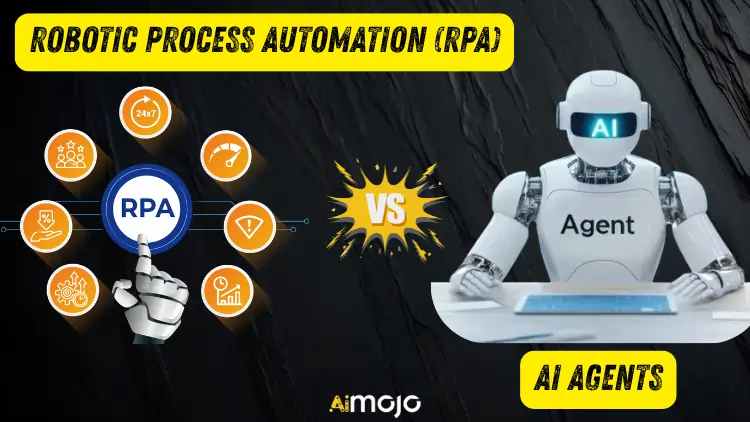
If you’ve been anywhere near the business automation conversation this year, you’ve probably heard both terms thrown around like they mean the same thing. They don’t. And picking the wrong one? That’s a six-figure mistake waiting to happen.
RPA vs AI agents — one follows a script like a well-trained intern who never thinks for itself. The other actually reasons, adapts, and figures things out across multiple systems without someone holding its hand.
Here’s the kicker: 60% of robotic process automation projects underperform, and 79% of companies are already running AI agents in live operations. So the shift isn’t coming — it’s already here. But that doesn’t mean RPA is useless. It means you need to know exactly where each one fits before you commit your budget.
What RPA Actually Does (And What It Can’t)
The “Robot” That Isn’t Really a Robot
Let’s kill the confusion early. Robotic process automation is not artificial intelligence. It’s rule-based automation — a bot that clicks buttons, copies data between fields, and fills out forms exactly the way you recorded it. Platforms like UiPath, Automation Anywhere, and Blue Prism built billion-dollar businesses on this model. And for dead-simple, repetitive tasks inside stable systems, it absolutely works.

Where RPA Still Crushes It
Got a desktop app that hasn’t changed its interface since 2021? A payroll transfer between two legacy platforms that runs identically every cycle? An attended automation scenario where a human triggers a simple bot mid-task? That’s RPA’s home turf. Structured data, predictable screens, zero surprises — rule-based bots handle this faster and cheaper than a human ever could.

Where RPA Falls Apart — Fast
Now the part nobody puts in the brochure. The moment a portal updates its layout, your bot breaks. An MFA prompt pops up mid-run? The bot stalls and the entire queue backs up. Exception handling is practically nonexistent — every edge case gets dumped on a human to figure out.

And maintenance costs? They snowball. You need dedicated script engineers patching broken workflows, teams building shadow spreadsheets around bot failures, and constant firefighting when things go sideways. RPA scalability issues are real, and bot failure rates climb fast the moment you push beyond basic, single-app tasks.
AI Agents, Explained Like You’re Talking to a Human
Not a Chatbot. Not an RPA Bot. Something Different.
AI agents sit in a completely separate category. They use large language models, contextual reasoning, and memory to complete multi-step tasks across systems — without needing someone to hard-code every action. You give an agent a goal, and it works out the path itself. This is agentic process automation: goal-driven, adaptive, and capable of operating across disconnected applications.
What Makes AI Agents Scary Good at Complex Work
Three things set them apart from anything rule-based:
This is cognitive automation that actually earns the label. Natural language processing, AI-driven decision-making, and multi-system orchestration — all working together without brittle scripts underneath.

Real-World Proof: What AI Agents Are Actually Doing Right Now
This isn’t theory. In healthcare, agents run 3,000+ daily claim status checks across dozens of payer portals without API access. In finance, intelligent document processing agents extract data from invoices that look completely different every time. In customer service, they’re handling ticket triage, sentiment analysis, and response drafting — simultaneously, at scale.
40% of enterprise applications are expected to include AI agents by the end of 2026, up from under 5% in 2025. That’s not a slow shift. That’s a tidal wave.
RPA vs AI Agents: The Full Side-by-Side Breakdown
| Parameter | RPA | AI Agents |
|---|---|---|
| Core Logic | Scripted macros | Goal-based reasoning |
| Setup Time | Days for simple scripts | Under 7 days for live workflows |
| UI Change Handling | Breaks frequently | Adapts autonomously |
| MFA / CAPTCHA | Stalls or fails | Handles natively |
| Exception Handling | Routes everything to humans | Resolves or escalates with context |
| Unstructured Data | Cannot process | Core strength |
| Cross-App Workflows | Limited | Multi-system by design |
| Ongoing Maintenance | High and constant | Low — retrains centrally |
| Communication | Requires add-ons | Slack, Teams, email, phone built-in |
| Best Fit | Single-app, stable tasks | Portal-heavy, dynamic processes |
The “Brittle vs. Brainy” Test
Here’s a gut-check you can apply to any workflow in 30 seconds: “If the screen changes tomorrow, does my automation survive?”
If the answer is no — you’re running brittle automation. If yes — you’ve got something brainy behind the scenes. That single question tells you more about your automation maturity than any vendor pitch deck ever will.
RPA Costs vs AI Agent ROI (With Real Numbers)
RPA’s Dirty Secret — Hidden Costs Nobody Tells You About
Licensing sits around $5,000–$20,000 per bot per year depending on the platform and tier. Sounds manageable. But stack on script maintenance engineers, downtime costs during bot failures, retraining after every UI update, and the duct-tape integrations your team builds to catch what bots miss — and total cost of ownership inflates 2–3x beyond the sticker price.

AI Agent ROI — What Businesses Are Actually Reporting
The numbers tell a different story on the agent side. Organizations report average ROI of 171% on agentic AI deployments, with some U.S. enterprises hitting 192%. Companies are scaling to thousands of daily task completions without adding headcount, and 66% of organizations using AI agents report measurable productivity gains.

Free ROI Gut-Check: 5 Questions to Ask Before You Spend a Dollar
- How many hours per week does your team spend fixing broken automations?
- How many separate portals or apps does this workflow touch?
- Does the process require any judgment calls mid-stream?
- How often does the target system’s UI change?
- What’s the real cost of a single delayed or missed transaction?
If three or more answers make you wince — RPA alone won’t get you there.
Stop Guessing — Here’s Exactly When to Use RPA, AI Agents, or Both

Pick RPA If…
Your workflow lives inside one stable application, handles only structured data, involves zero mid-process decisions, has no MFA or CAPTCHA gates, and the interface hasn’t changed in years.
Pick AI Agents If…
You’re dealing with multiple portals, frequent UI shifts, security prompts blocking bots, decisions needed mid-workflow, or end-to-end process automation across disconnected systems. Autonomous AI workflows pay for themselves here.
Pick Both (Hybrid Automation) If…
Most real-world operations land in this camp. Use API integrations where they exist. RPA for stable micro-tasks. AI agents for the messy, portal-heavy, exception-filled last mile. This hybrid automation strategy is exactly what Gartner and Deloitte are pushing for enterprise operations — and it works.
The 60-Second Decision Flowchart
Start → Does the workflow span multiple apps? → Yes → AI Agents | No → Does the UI change quarterly? → Yes → AI Agents | No → Are there exceptions or judgment calls? → Yes → AI Agents | No → Is MFA involved? → Yes → AI Agents | No → RPA works fine.
Best RPA Tools and AI Agent Platforms in 2026 (Quick Rundown)
Top RPA Platforms Still Holding Their Ground
UiPath leads on orchestration and community size. Automation Anywhere dominates cloud-native scalability. Blue Prism holds strong in regulated industries. Microsoft Power Automate wins on price and native Microsoft ecosystem integration.
AI Agent Platforms That Are Actually Shipping Results
Ventus runs browser-native agents for portal-heavy operations. Kognitos focuses on natural language-driven automation. Automation Anywhere’s Agentic Process Automation and UiPath Autopilot are bolting agent capabilities onto existing RPA stacks. SuperAGI serves developer-first teams building custom workflows. Each serves a different enterprise niche.

Why Most “AI Agent” Products Are Just RPA in a Trench Coat
Here’s the uncomfortable truth — half the platforms marketing “AI agents” are running the same scripted bots underneath with a chatbot slapped on top. How to spot fakes: ask if the agent handles tasks it’s never seen before. Ask if it reasons across steps or just replays them. Ask what happens when a form field moves. Real intelligent automation has memory, multi-tool orchestration, and genuine adaptability. Everything else is a rebrand.
From “Interested” to “Live in 7 Days” — Your Automation Playbook
Step 1 — Identify Your Highest-Friction Workflow. Claims processing, invoicing, eligibility checks, scheduling — pick the process that eats the most human hours weekly.
Step 2 — Write a One-Page SOP With Guardrails. Inputs, success criteria, exception thresholds, escalation channels. One page. That’s it.
Step 3 — Run a Pilot (Not a 6-Month “Strategy Phase”). One to two weeks. Daily metrics. Slack or Teams feedback loop. Iterate and fix in real-time.
Step 4 — Scale by Cloning, Not Rebuilding. Replicate working agents across similar workflows and extend to unattended hours for compounding throughput gains.
❌ 4 Mistakes That Kill Automation Projects Before They Start
Vague success criteria where nobody agrees on what “done” means. Only recording happy-path scenarios while ignoring the exceptions that make up 80% of actual work. No escalation plan for when the agent hits a wall. Ignoring change management — your team needs to know the digital workforce exists and how to work alongside it.
Is RPA Dead? What This Means for Your Career and Your Budget
RPA Isn’t Dead — But It’s Getting a Demotion
RPA survives as one component inside a larger intelligent automation stack. It’s getting absorbed, not killed. But its role is shrinking from “the strategy” to “a utility tool” — and the budget allocations are following.
AI Agent Skills Are the New Resume Gold
RPA developer roles still exist but growth is flat. Meanwhile, AI agent builder, automation architect, and agentic AI specialist roles are where the hiring demand and salary jumps are concentrated right now.
Budget Shifts CIOs Are Making Right Now
88% of executives plan to increase AI budgets specifically because of agentic AI initiatives. Enterprise dollars are migrating from pure RPA licensing toward hyperautomation platforms and AI agent deployments. If your 2026 budget is still 100% traditional bots, the competitive gap is widening fast.
RPA vs AI Agents — Your Burning Questions, Answered
What is the main difference between RPA and AI agents?
RPA replays pre-recorded scripts on stable screens. AI agents reason through goals, adapt to changes, and handle complex decisions across multiple systems without rigid programming.
Can AI agents fully replace RPA bots?
Not entirely. RPA still fits simple, single-app, zero-exception tasks. But for anything multi-system, dynamic, or exception-heavy — agents outperform by a wide margin.
How much does RPA implementation cost vs AI agents?
RPA licensing runs $5K–$20K/bot/year, but hidden maintenance inflates costs 2–3x. AI agents cost more upfront but deliver 171% average ROI with lower ongoing upkeep.
What are the best AI agent platforms for enterprise in 2026?
Automation Anywhere APA, UiPath Autopilot, Ventus, Kognitos, and SuperAGI lead across different use cases and industries.
Is robotic process automation still worth learning?
Yes, but pair it with AI agent skills. RPA-only expertise is becoming commoditized fast.
Can RPA and AI agents work together?
Absolutely. A hybrid automation strategy uses RPA for execution-layer tasks and agents for reasoning-heavy workflows.
How long does it take to deploy an AI agent?
Focused pilots go live in under seven days for a single high-value workflow.
What industries benefit most from AI agents over RPA?
Healthcare, finance, insurance, retail, and any industry drowning in portal-based workflows with frequent exceptions.
So, Here’s the Bottom Line.
RPA clicks buttons. AI agents think about which buttons to click — and what to do when the button disappears.
The real mistake in 2026 isn’t choosing the wrong tool. It’s choosing neither and staying manual while 79% of your competitors already have agents running live.
Use the decision framework above. Run a focused pilot this quarter. And stop treating business process automation as next year’s problem — because your competition already made it this year’s priority.
AiMojo Recommends:


 BONUS: Get our $200 “AI Mastery Toolkit” FREE when you sign up!