

Argilla Key Insights
What is Argilla?

Argilla is a free, open source data annotation and human feedback platform built for AI engineers and domain experts who need to create high quality datasets. Originally developed as a standalone tool, Argilla is now part of the Hugging Face ecosystem. It supports a wide range of AI tasks including text classification, named entity recognition, LLM fine-tuning through supervised learning, and RLHF preference data collection.
The platform uses a Python SDK and a browser based UI that lets teams label, rate, rank, and review data records with filters, AI assisted suggestions, and similarity search. Argilla is entirely self-hosted with no mandatory subscription, making it ideal for teams that need full data ownership and control. It runs on Hugging Face Spaces or Docker containers and supports programmatic dataset management for continuous model improvement workflows.
Argilla simplifies collecting human preference data for reinforcement learning from human feedback. Annotators can rank and rate multiple model responses to a single prompt, generating the comparison datasets needed for reward model training. This makes it one of the most accessible open source tools for aligning large language models with human values.
The platform supports rating, ranking, text, single-label, multi-label, and span question types. Teams can mix and match these templates to build custom annotation workflows that fit virtually any use case. This flexibility means a single dataset can capture multiple forms of feedback at once, saving annotator time and improving data richness.
Datasets can be imported directly from and exported to the Hugging Face Hub through the UI or Python SDK. This tight integration makes it effortless to version control annotation projects, share datasets with the community, or pull in popular open source datasets for quick experimentation. One click deployment on Hugging Face Spaces gets a full Argilla instance running in under five minutes.
The Argilla SDK gives engineers full control over dataset creation, record management, user administration, and data export. Everything that can be done in the UI can also be scripted in Python, enabling automated pipelines that connect annotation workflows to model training loops. The SDK supports Python 3.9 through 3.13 and Pydantic v2.
Argilla lets teams attach model predictions as suggestions to records, so annotators can accept, modify, or reject them rather than labelling from scratch. Combined with semantic search and metadata filters, this dramatically reduces annotation time. Annotators focus their effort on the records that matter most instead of working through data blindly.
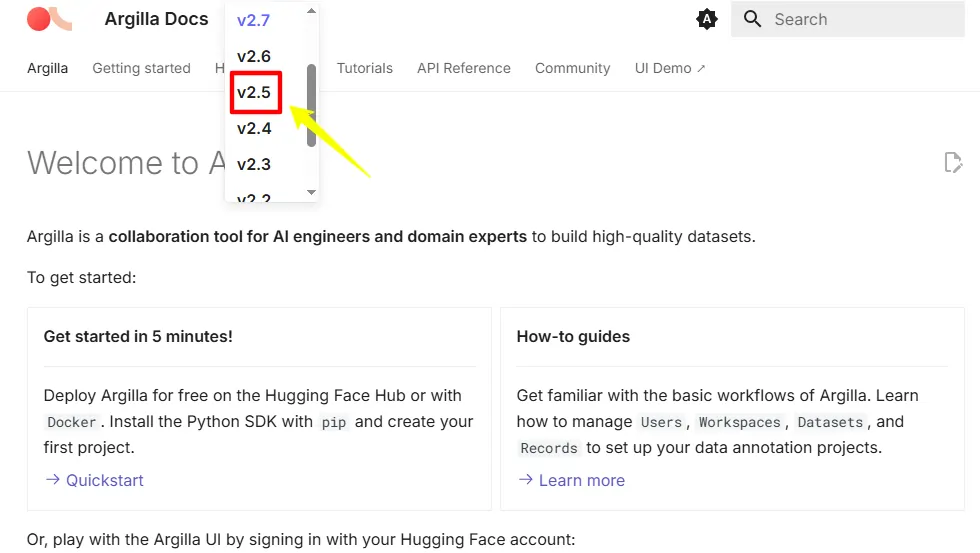
Version 2.5 introduced webhook support, allowing external systems to react to events inside Argilla in real time. When a record is completed or a dataset changes, Argilla can trigger downstream processes such as retraining jobs or quality checks. This turns Argilla into a live component of a production MLOps pipeline rather than a standalone annotation tool.
Argilla Pricing Plans
| Plan Name | Cost | Key Limits and Features |
|---|---|---|
| Open Source (Self-hosted) | $0 | Unlimited users, unlimited datasets, full feature access, deploy on Docker or local server |
| Hugging Face Spaces Persistent | From $5/month | Persistent storage, upgraded hardware, suitable for small teams |
| Hugging Face Spaces Enterprise | Custom | Dedicated hardware, organisation SSO, private networking |
Deploying Argilla on Your Own Infrastructure
For teams with strict data governance requirements, Argilla can be deployed entirely on private infrastructure using Docker. This gives full control over storage backends (PostgreSQL plus Elasticsearch or OpenSearch), user authentication, and network access. The server supports environment variable configuration for OAuth2 providers, SSL, and base URL routing.
Helm charts are available for Kubernetes deployments, making it straightforward to scale annotation capacity alongside existing ML infrastructure. Because the platform is MIT licensed, there are no usage fees, seat limits, or feature gates on self-hosted instances.
Pros and Cons
- Completely free and open source.
- Native Hugging Face Hub integration.
- Purpose built for RLHF workflows.
- Flexible question and field templates.
- Full Python SDK for automation.
- Unlimited users and datasets.
- No managed cloud hosting option.
- Original core team has moved on.
- No native audio/video annotation.
- Setup requires technical knowledge
Argilla and the Hugging Face Ecosystem
Argilla joined Hugging Face in 2024, cementing its role as the go-to annotation layer within the largest open source AI community. This acquisition means tighter integration with Hugging Face Datasets, Transformers, and the Hub. Users can push annotated datasets directly to the Hub for version control and community sharing.
The Distilabel library from the same team complements Argilla by generating synthetic data that annotators then curate. Together, these tools create a feedback loop where synthetic generation and human validation run side by side, accelerating dataset creation for LLM projects without sacrificing quality.
Best Argilla Alternatives
| Data Annotation & Human Feedback Platform | Open Source & Self-hosted | LLM/RLHF Focus |
|---|---|---|
| Label Studio | ✅ Open source, also has Enterprise tier | Limited, primarily general annotation |
| Prodigy | ❌ Commercial licence only | Moderate, strong for active learning NLP |
| Labelbox | ❌ SaaS only with paid plans | Moderate, broader computer vision focus |