The AI numbers have stopped being “wow” moments and started being business decisions. Every marketer, founder, HR manager, and developer right now is trying to figure out one thing: what does the data actually say?
Not the vague predictions. Not the recycled think-piece opinions. The real numbers — by industry, by use case, by function.
This is that article. 150+ AI statistics , organized so you can stop guessing and start citing.
Global AI Market Size & Growth AI Statistics
Global AI Market Size & Growth AI Statistics
The money flowing into AI is staggering — and it's not slowing down.
The global AI market was valued at $196.6 billion in 2023 and is on track to hit $1.8 trillion by 2030. AI is expected to contribute $15.7 trillion to the global economy by 2030 — more than the current output of China and India combined. The generative AI market alone was worth $44.89 billion in 2023, projected to surge to $667.96 billion by 2030. Global AI investment crossed $91.9 billion in 2022, a record at the time. North America holds the largest AI market share at 36.8% of global revenue. Asia-Pacific is the fastest-growing AI region, with a projected CAGR of 39.4% through 2030. The AI hardware market — chips, GPUs, and processors — is expected to reach $89.8 billion by 2027. Funding for AI startups hit $45.8 billion in Q1–Q3 of 2023 alone. The machine learning market is projected to reach $209.91 billion by 2029. Generative AI Usage Statistics
Generative AI didn't just grow — it went from boardroom buzzword to everyday tool in under 24 months.
Key metrics at a glance
Metric Stat ChatGPT monthly active users (2024) 180 million+ Time to reach 100M users 2 months (fastest app ever) GenAI adoption among business leaders 65% actively deploying Productivity gain for workers using GenAI Up to 40% faster task completion Organizations using GenAI in marketing 58% Enterprises with a GenAI strategy in place 71% Knowledge workers using GenAI tools weekly 46%
More stats:
ChatGPT crossed 1 million users in just 5 days of its launch. Over 100 million people use generative AI tools weekly as of 2025. A leading conversational AI model surpassed 500 million users within its first year. 67% of senior IT leaders say generative AI is a top investment priority. Companies using generative AI report an average 3.7x return on investment within 14 months. The number of generative AI models available publicly grew from under 50 in 2020 to over 15,000 in 2024. 📊 AI Adoption Statistics Worldwide 📊
Global AI Adoption Stastics
You're not early to AI anymore — but you're not too late either.
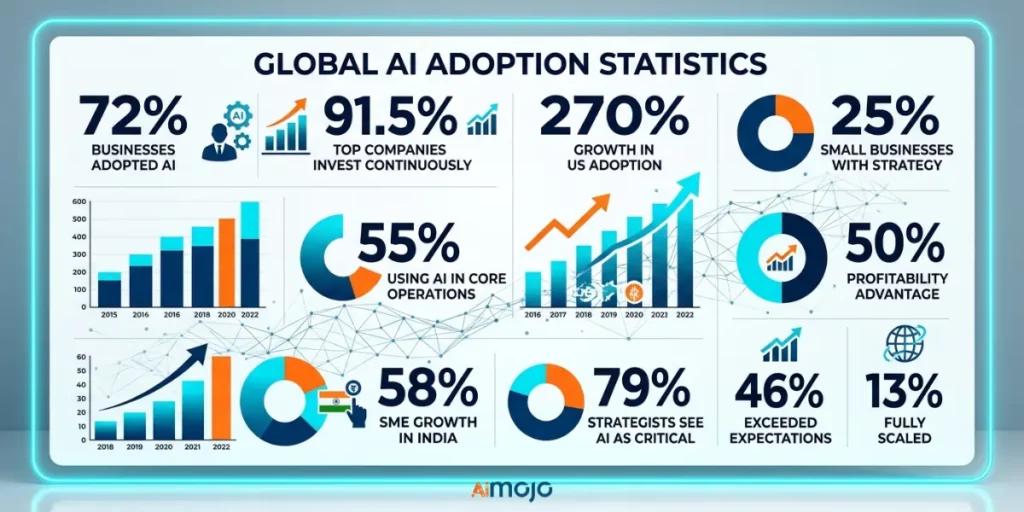
72% of businesses have adopted AI in at least one business function. 91.5% of top global businesses invest in AI on a continuous basis. AI adoption among U.S. businesses grew 270% in four years. Only 1 in 4 small businesses had an AI strategy in place as of 2024 — a huge gap. 55% of organizations report using AI for at least one core operation as of 2023. Companies that fully adopt AI outperform competitors by 50% in profitability metrics. 63% of organizations say AI directly drives additional revenue. SME AI adoption in India grew 58% year over year between 2022 and 2024. 79% of corporate strategists believe AI will be critical to their business within 2 years. 46% of companies report that AI adoption has exceeded initial expectations. Only 13% of businesses say they're “fully scaled” on AI — meaning most are still in early stages.
AI in Business & Enterprise Statistics
The C-suite has made up its mind. Here's the data.
65% of executives say AI will have a greater business impact than the internet itself. 84% of C-level leaders believe AI is essential to achieving growth objectives. Enterprises using AI for decision-making report 25% faster time-to-market for products. 43% of businesses say AI reduced operational costs by at least 20%. AI-driven companies are 2.5x more likely to rank in the top quartile of financial performance. 60% of finance leaders are already using AI for forecasting and risk analysis. Supply chain AI adoption grew from 12% to 44% between 2019 and 2024. AI in enterprise software is a $47.1 billion market as of 2024. 74% of enterprises plan to expand their AI budgets in 2026. AI-powered ERP systems reduce manual data entry by up to 80%. Companies using AI in procurement reduce costs by an average of 15%.
AI in Marketing Statistics 2026
AI in Marketing Statistics
These stats are for every marketer who still thinks AI is “just for developers.”
61.4% of marketers use AI tools in some capacity. AI-generated email subject lines have 5–10% higher open rates than manually written ones. 35% of content marketers use AI to draft or assist in writing blog content. Marketing teams using AI report 40% reduction in content production time. 80% of marketing leaders believe AI will completely change how marketing functions in 3 years. AI-powered ad targeting improves click-through rates by up to 30%. Personalized AI-driven campaigns see 20% more revenue than non-personalized ones. 52% of marketers say AI has improved the quality of leads they generate. 47% of digital advertisers currently use AI-driven bidding strategies. Chatbots handle 85% of customer interactions without human escalation in marketing funnels. 77% of consumers have interacted with an AI chatbot in the past year. AI in Healthcare Statistics
AI isn't replacing doctors. It's giving them superpowers they didn't have before.
AI diagnostic tools have shown 94.5% accuracy in detecting certain cancers — exceeding some radiologists. AI reduces drug discovery timelines by up to 70%. 90% of hospitals in the U.S. have deployed AI in at least one clinical area. AI-powered predictive analytics reduces hospital readmissions by 20–30%. Over 500 AI/ML-enabled medical devices have regulatory approval as of 2024. AI-assisted surgery systems are used in over 1.1 million procedures annually worldwide. 60% of healthcare providers say AI reduces administrative burden significantly. AI in radiology alone is expected to save $10 billion annually for U.S. hospitals. Mental health AI apps saw 200% growth in downloads between 2021 and 2024. AI in Finance Statistics
AI in Finance Statistics
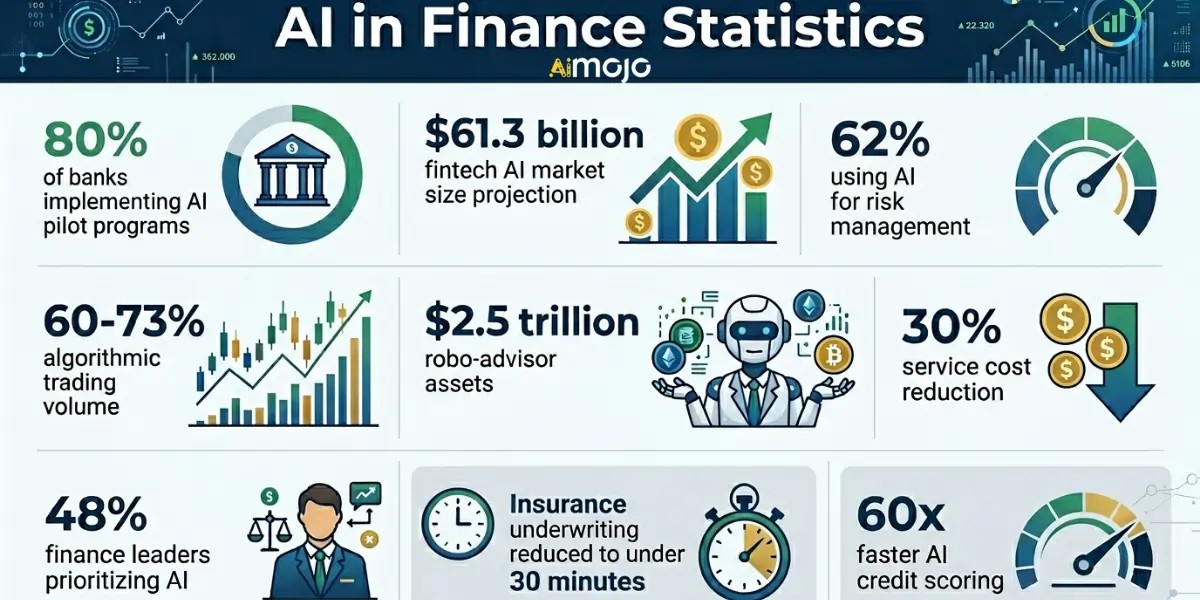
80% of banks are aware of the benefits of AI and have implemented at least pilot programs. AI in fintech is projected to reach a market size of $61.3 billion by 2031. AI fraud detection systems prevent an estimated $10 billion+ in financial fraud annually. Algorithmic, AI-driven trading accounts for 60–73% of all U.S. equity trading volume. AI-powered robo-advisors manage over $2.5 trillion in assets globally. Banks using AI in customer service report 30% reduction in service costs. 48% of finance leaders say AI is the technology most likely to impact their function over the next 3 years. AI in insurance underwriting reduces decision time from weeks to under 30 minutes. AI credit scoring models process applications 60x faster than traditional methods. 🛒 AI in E-commerce Statistics 🛒
The numbers behind why your favorite online store feels like it reads your mind.
Quick e-commerce AI snapshot
Metric Data Revenue impact of AI recommendations (large e‑retailer) ~35% of total revenue Shoppers who prefer personalized AI experiences 80% Cart abandonment reduction via AI Up to 18% AI-driven chatbot ROI for e-commerce brands $8 for every $1 spent E-commerce companies using AI for inventory 45% Conversion lift from AI-personalized pages +26%
More stats:
The AI in retail market is expected to reach $45.74 billion by 2032. AI visual search adoption in retail grew 60% between 2022 and 2024. 72% of shoppers say they only engage with personalized marketing messages. AI-driven dynamic pricing increases revenue for retail brands by up to 10%. AI in Education Statistics
The global AI in education market is expected to hit $47.7 billion by 2030. Students using AI tutors score 1.5 grade levels higher in comprehension tests on average. The AI tutoring market alone is projected to reach $3.97 billion by 2026. 60% of educators say AI tools save them at least 5 hours per week on administrative tasks.
60/100
AI personalized learning platforms improve student test scores by an average of 62%.
62/100
30% of universities worldwide now offer AI-related degree programs.
30/100
Adaptive AI learning systems increase course completion rates by 26%.
26/100
85% of edtech investors say AI is the top investment area in education for 2025–2026.
85/100
AI grading tools can assess student work with 94% accuracy compared to human graders.
94/100
56% of K–12 teachers report using AI tools in the classroom as of 2024.
56/100
🔐 AI in Cybersecurity Statistics 🔐
AI in Cybersecurity Statistics
Hackers are using AI. The only way to fight it is with more AI.
AI detects cyberthreats 60x faster than traditional rule-based security systems. 69% of enterprise security professionals say AI is necessary to respond to cyberattacks. AI-powered security tools can reduce false positive alerts by up to 60%. Cybercrime costs the global economy $8 trillion annually — AI interception tools block a portion of that damage. 74% of data breaches involve a human element; AI behavioral analysis is now used to flag anomalies. Companies using AI-based security tools see 2.2x faster breach containment times. Phishing attacks generated by AI grew 135% in 2023 alone. 55% of security leaders say AI is the single biggest security threat they face from external actors. AI-based identity verification reduces account takeovers by 90% in fintech apps. AI Jobs & Workforce Statistics
AI Jobs & Workforce Statistics
Some jobs are shrinking. New ones are exploding. Here's the real picture.
AI is expected to displace 85 million jobs but create 97 million new roles by 2025. AI-related job postings grew 450% over five years. The average AI engineer salary in the U.S. is $136,620 per year. 40% of the global workforce (1.4 billion people) will need to upskill due to AI integration. AI prompt engineering roles saw 2,000% growth in job listings between 2022 and 2024. 77% of workers say they want help adapting to AI in the workplace. Demand for AI/ML specialists will grow 40% by 2027. 41% of HR professionals already use AI for resume screening and candidate shortlisting. 70% of employees report that AI tools make their day-to-day work more productive. AI Productivity & ROI Statistics
AI Productivity & ROI Statistics
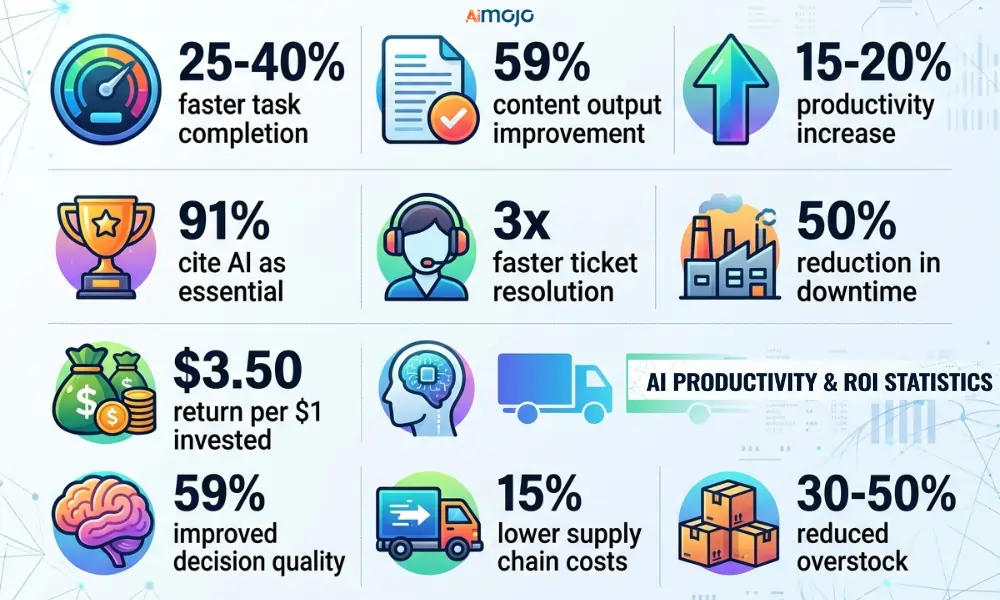
Workers who use AI assistants complete tasks 25–40% faster than those who don't. Businesses deploying AI across operations report an average 15–20% increase in overall productivity. 91% of top-performing businesses cite AI as essential to maintaining competitive advantage. Customer support teams using AI resolve tickets 3x faster. AI in manufacturing reduces unplanned downtime by up to 50%. Companies that invested $1 in AI returned an average of $3.50 within 12 months. 59% of decision-makers say AI has directly improved the quality of business decisions. AI-enabled supply chains show 15% lower supply chain costs vs. non-AI counterparts. Retail businesses using AI forecasting reduce overstock inventory by 30–50%. AI Tools & ChatGPT Usage Statistics
ChatGPT surpassed 1 billion cumulative conversations in its first 60 days. One leading AI provider’s revenue crossed $2 billion ARR by end of 2023, hitting $3.4 billion in 2024. 57% of ChatGPT users use it for work-related tasks, not just personal queries. A major AI API is used by over 2 million developers globally. A popular image model has generated over 1 billion images since its launch. AI image generation tools are used by 23% of creative professionals regularly. A widely used AI writing assistant is used by 30 million people daily. An AI-powered workspace tool crossed 4 million users within 3 months of launch. GitHub Copilot increased developer coding speed by 55% in blind tests. 65% of software developers now use AI-assisted coding tools regularly. One leading AI content platform generated over $75 million ARR within 18 months of launch. 48% of customer service teams have replaced at least one manual process with an AI tool. AI features inside a popular CRM platform are used by 89% of its enterprise clients. A major creative suite’s AI image tool generated over 3 billion images in its first year. The AI app market crossed $5 billion in consumer spending in 2024 across app stores. A design platform’s AI features are actively used by over 40 million users monthly.
AI in Customer Experience Statistics
Your customers already expect AI-level speed and personalization. The stats prove it.
63% of customers expect companies to know their unique needs and expectations.
63/100
AI-powered chatbots reduce average customer service response time by 80%.
80/100
72% of shoppers will only interact with personalized messaging from brands.
72/100
44% of consumers say they prefer chatbots for simple customer service interactions.
44/100
AI sentiment analysis tools are used by 39% of enterprise customer service teams.
39/100
Brands using AI personalization see 40% more revenue per customer vs. non-personalized brands.
40/100
80% of CEOs believe AI will change how they interact with customers over the next 3 years.
80/100
AI-assisted customer service resolves issues 4x faster than traditional methods. Businesses using AI in customer experience see a 10–15% increase in satisfaction scores. AI-driven loyalty programs increase customer retention by 5–10%. AI in Small Business Statistics
AI in Small Business Statistics
Small businesses are not waiting around — and the numbers prove it.
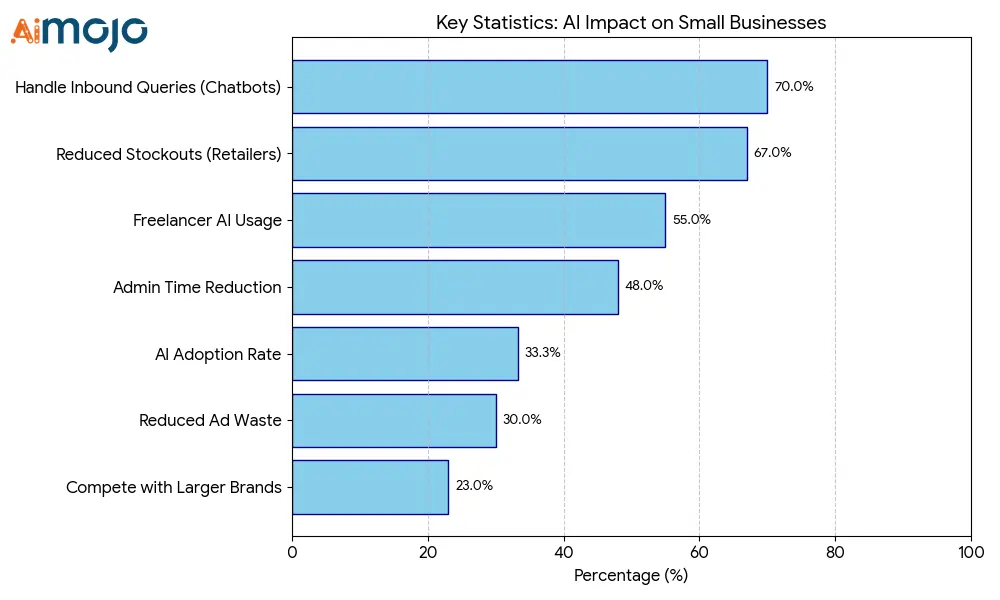
1 in 3 small businesses in the U.S. now uses AI tools for at least one function. Small businesses using AI see average revenue growth of 12–15% compared to non-AI peers. 48% of small business owners say AI reduces time spent on administrative tasks. AI bookkeeping tools save SMEs an average of 5 hours per week. 67% of small retailers using AI-driven inventory management report fewer stockouts. AI marketing tools cut ad spend waste by 30% for small businesses. 23% of small businesses say AI has allowed them to compete directly with larger brands. Chatbot tools for small businesses cost as little as $30/month — yet handle 70%+ of inbound queries. 55% of freelancers use AI tools to increase their output and take on more clients. Small business AI adoption grew 58% year over year between 2023 and 2025. AI Ethics, Regulation & Consumer Trust Statistics
79% of consumers say they are concerned about how companies use their AI-generated data.
79/100
Only 30% of AI projects are fully compliant with data privacy regulations at launch.
30/100
64% of executives say they struggle to explain AI decision-making to stakeholders.
64/100
52% of people globally say they trust AI decisions less when they involve personal data.
52/100
85% of AI researchers say ethical guidelines should be legally enforceable, not voluntary.
85/100
Companies that publish AI ethics policies see 23% higher consumer trust scores.
23/100
43% of customers say they would stop using a brand if they knew it used AI irresponsibly.
43/100
A major AI law in the EU now covers over 450 million citizens. Reported AI bias incidents grew 700% between 2018 and 2023. Governments worldwide spent $1.7 billion on AI regulation initiatives in 2023 alone. 🚀 Bonus: Fast AI Stats Worth Bookmarking
There are now over 70,000 AI startups globally. AI-generated code accounts for roughly 30% of all new code commits on GitHub as of 2024. The number of AI patents filed grew 340% between 2016 and 2023. 77% of devices people use daily feature some form of AI. AI translation tools handle over 100 billion words per day globally. The energy consumption of training a single large AI model equals the lifetime emissions of 5 cars. 48% of CEOs say AI is the technology they're most worried about not adopting fast enough. AI-generated music crossed 10 million tracks across streaming platforms as of 2024. The average enterprise now uses 5.4 different AI tools across departments — up from 1.9 in 2021. 📌 Quick Reference: AI Statistics by Industry
Industry Key 2026 Stat Healthcare AI in healthcare market hits $187B by 2030 Finance AI manages $2.5T in robo-advisor assets E-commerce ~35% of revenue at a major retailer from recommendations Marketing 61.4% of marketers use AI tools Education 60% of educators save 5+ hours per week Cybersecurity Detects threats 60x faster Manufacturing 50% less unplanned downtime HR/Recruiting 75% faster time-to-hire with AI Customer Service 80% faster response times Small Business 12–15% average revenue growth with AI
The data is clear: AI isn't a future topic anymore. It's an operational fact for businesses across every industry. If you're building a strategy, pitching investors, writing content, or just trying to figure out where things are headed — these numbers are your starting point.
Bookmark this page. It’ll matter more six months from now than it does today.









 BONUS: Get our $200 “AI Mastery Toolkit” FREE when you sign up!