

The Open-Source AI Market Leaders Just Flipped the Script — And Nobody Saw This Coming
One stat changed everything.
Chinese open-source AI models jumped from 1.2% of global usage in late 2024 to nearly 30% by end of 2025. That’s not a slow crawl — that’s a full power shift.
And here’s what most people get wrong about the open-source AI market leaders right now: the top names aren’t who you think. Not Meta. Not Mistral. Not Google.
This piece breaks down which models actually rank highest, who’s bluffing, where the licensing traps hide, and what to pick for your stack — all current as of March 2026.
What “Open Source” Even Means in AI Right Now
Most people throw around “open source” like it’s one thing. It’s not. Three categories get mashed together constantly — and confusing them can cost real money or land you in a licensing dispute.
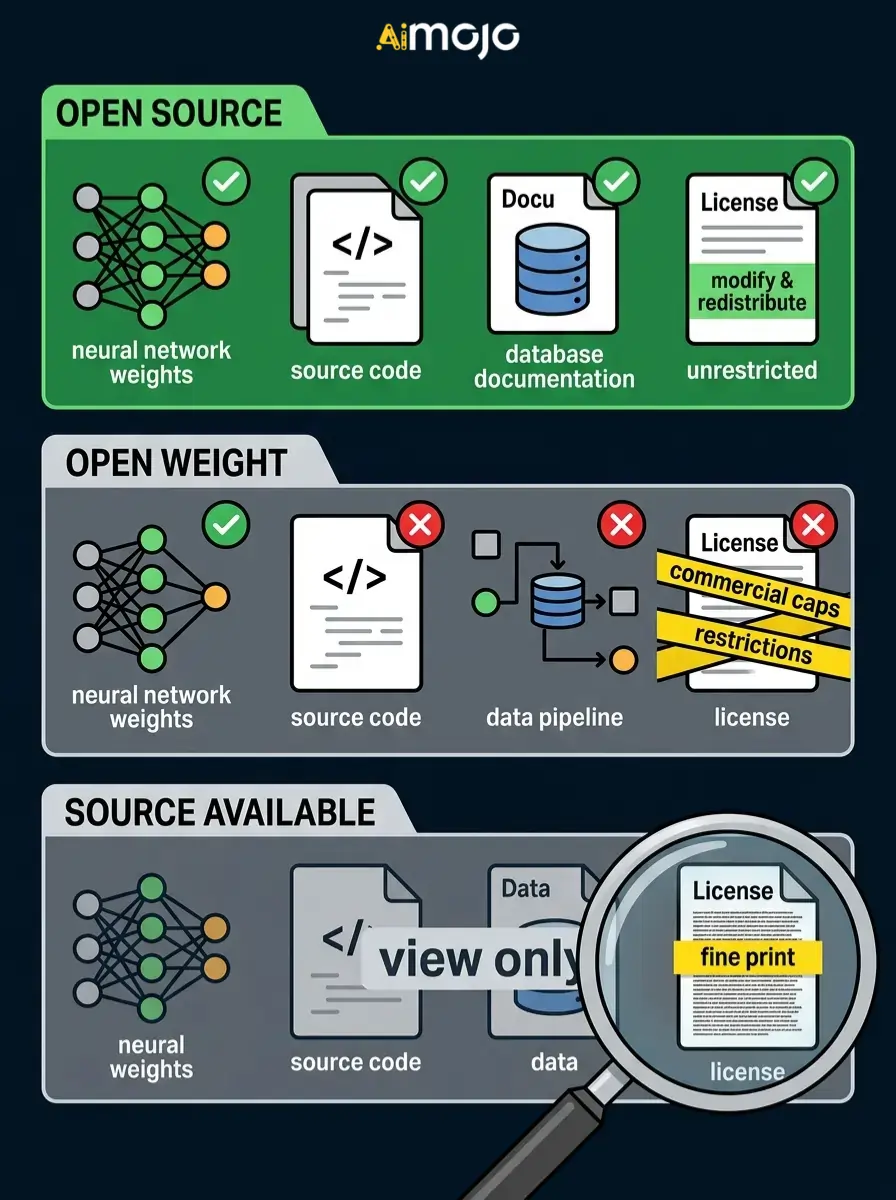
Now here’s where it gets ugly. Meta ships Llama under a Community License with commercial thresholds. Alibaba’s Qwen has its own license. DeepSeek went full MIT — genuinely permissive, no strings. Mistral ships several models under Apache 2.0, the closest thing to “do whatever you want” in this space.
The OSI has been trying to nail down a formal definition for open-source AI. The industry still can’t agree. Always read the license before building on top of any model.
Quick License Reference:
| Model Family | License Type |
|---|---|
| Llama 4 (Meta) | Llama Community License |
| Qwen 3.5 (Alibaba) | Qwen License |
| DeepSeek V3.2 | MIT |
| Mistral 3 | Apache 2.0 |
| Gemma 3 (Google) | Apache 2.0 |
| GLM-5 (Zhipu AI) | Zhipu License |
The 2026 Open-Source AI Leaderboard
Let’s kill the guessing. Here’s where things stand based on benchmark performance and independent evaluations.
S-Tier: The Models Sitting at the Top Right Now

🏆 GLM-5 (744B) — Zhipu AI: Currently #1 on reasoning benchmarks. A Chinese lab most Western developers haven’t even heard of. That blind spot is expensive.
🏆 Kimi K2.5 (1T MoE) — Moonshot AI: Trillion-parameter mixture-of-experts architecture. Multiple evaluations and Reddit’s r/LocalLLaMA tag it as the strongest non-proprietary model available today.
🏆 DeepSeek V3.2 (685B) — DeepSeek: The sequel to the model that rattled Wall Street in January 2025. Still top-three globally — especially dominant in coding and multilingual tasks.
A-Tier: Extremely Strong, Widely Deployed
MiniMax M2.5 delivers consistent top-4 performance across evals. GLM-4.7 (355B) is Zhipu’s more practical, easier-to-deploy sibling. And Qwen 3.5 from Alibaba quietly matches GPT-5.4 and Claude 4.6 Opus on several benchmarks — Alibaba doesn’t get the headlines, but the download numbers tell a different story.

B-Tier: Solid Picks for Specific Jobs
Meta Llama 4 (Scout & Maverick) is still the most recognized name in open AI — but benchmark position tells a more complicated story after the rough April 2025 launch. Mistral Large 2 and Mistral 3 are Europe’s strongest entries — Apache-licensed, sovereignty-friendly. Google Gemma 3 27B punches hard for its size and is a fine-tuning favorite. Microsoft Phi-4 is the pick for tight GPU budgets and edge deployment.

Full Comparison Table:
| Model | Org | Params | License | Context Window | Best For |
|---|---|---|---|---|---|
| GLM-5 | Zhipu AI | 744B | Zhipu License | 200K | Reasoning |
| Kimi K2.5 | Moonshot | 1T (MoE) | Kimi License | 200K+ | General + Reasoning |
| DeepSeek V3.2 | DeepSeek | 685B | MIT | 130K | Coding + Multilingual |
| Qwen 3.5 | Alibaba | Varies | Qwen License | 128K+ | All-rounder |
| MiniMax M2.5 | MiniMax | — | MiniMax License | 128K+ | Balanced Performance |
| GLM-4.7 | Zhipu AI | 355B | Zhipu License | 200K | Practical Deployment |
| Llama 4 Scout | Meta | Large MoE | Llama License | 10M+ | Long Context |
| Mistral 3 | Mistral AI | — | Apache 2.0 | 128K | EU Enterprise |
| Gemma 3 | 27B | Apache 2.0 | 128K | Fine-tuning + Edge | |
| Phi-4 | Microsoft | Small | MIT | 16K | On-device + Edge |
China Is Winning the Open-Source AI Race
This isn’t opinion. The data is public and consistent.
Four Chinese labs — Alibaba (Qwen), DeepSeek, Moonshot (Kimi), Zhipu (GLM) — are shipping a new top-performing model roughly every 4 to 6 weeks. After DeepSeek’s January 2025 shock, the flood of low-cost, high-performance Chinese models hasn’t stopped. Meta’s fumbled Llama 4 launch opened the door — and Chinese models took developer mindshare with them.

US startups are now quietly fine-tuning Chinese open-weight models for production. That political tension? Nobody in Silicon Valley wants to discuss it on the record.
What the Western Players Are Actually Doing
Small Language Models Are the Sleeper Story of 2026
Forget the trillion-parameter headlines for a second.
For real production workloads with budgets and latency limits, models under 30B parameters are where the serious momentum lives.
Top open-source SLMs right now: Gemma 3 27B, Llama 3.1 8B, Mistral 7B, SmolLM3, and Phi-4. These run on laptops, phones, and edge hardware — no cloud, no API costs, full data privacy.

The hybrid inference pattern is becoming standard: pair a small local model for fast, cheap tasks with a large cloud model for the hard stuff. RAG pipelines slot right in. And the cost math is brutal — inference per million tokens on a 7B model vs. a 700B model isn’t a small gap. It’s orders of magnitude. For high-volume workloads, that difference decides profitability.
Open-Source vs. Closed-Source in 2026
✅ Where open models match or beat closed: coding (SWE-Bench), multilingual tasks, domain-specific work after fine-tuning
❌ Where proprietary still holds the edge: the absolute frontier of complex reasoning — Claude Opus 4.6, GPT-5.4, Gemini 3.1 Pro
But the real differentiator in 2026 isn’t raw capability anymore. It’s deployment trade-offs — data privacy, vendor lock-in avoidance, latency control, total cost of ownership. Enterprises now run open models for internal workloads and reserve proprietary API calls only for high-stakes, external-facing tasks.
How Companies Are Actually Using Open-Source AI (Not Just Benchmarking It)
Agentic AI: Autonomous workflows chaining multiple model calls — open models give teams the control that proprietary APIs with rate limits and opaque behavior can’t match
The Licensing & Safety Mess Nobody Wants to Talk About

The Licensing Problem
The 2026 OSSRA report should alarm every engineering lead: open-source vulnerabilities doubled to 581 per codebase. 87% of audited codebases carry risk. AI-generated code can reproduce licensed material verbatim, creating IP exposure most teams aren’t even thinking about. Permissive licensing keeps trending upward, but AI-specific restrictions are creating a gray zone no existing framework handles cleanly.
The Safety Problem
The International AI Safety Report 2026 put it plainly: open-weight model safeguards “can be more easily removed.” Thousands of servers run open LLMs with zero platform-level guardrails.
The counterargument is valid — transparency allows more red-teaming, more community oversight, and more safety research than black-box APIs. But autonomous AI agents operating on unrestricted open models is the exact scenario regulators fear most.
What’s Next for Open-Source AI
So… Which Open-Source AI Model Should You Actually Pick?
Stop chasing hype. Match the model to the job:
| Your Situation | Best Pick |
|---|---|
| Strongest possible open model (with GPU budget) | Kimi K2.5 or GLM-5 |
| Enterprise + EU regulatory pressure | Mistral 3 (Apache 2.0) |
| Agentic workflows or dev tools | DeepSeek V3.2 or Qwen 3.5 |
| Consumer hardware / edge devices | Gemma 3 27B, Phi-4, or Mistral 7B |
| Fine-tuning for a specific vertical | Llama 4 Scout or Gemma 3 (largest community + tooling) |
Here’s what no leaderboard will ever tell you — test on YOUR data, YOUR prompts, YOUR latency requirements. The benchmark is a starting point. Your production environment is the only finish line.
Frequently Asked Questions
What is the best open-source AI model in 2026?
GLM-5 by Zhipu AI leads reasoning benchmarks, while Kimi K2.5 by Moonshot AI ranks as the strongest overall non-proprietary model. The right pick depends on your use case and hardware.
Is open-source AI as good as ChatGPT or Claude?
On coding, multilingual, and fine-tuned domain tasks — yes, often equal or better. Claude Opus 4.6 and GPT-5.4 still edge ahead on the hardest reasoning problems, but the gap is shrinking fast.
Which country produces the most open-source AI models?
China now drives roughly 30% of global open-source AI usage. Labs like Alibaba, DeepSeek, Moonshot, and Zhipu are shipping new top-tier models every few weeks.
Can I use open-source AI for commercial purposes?
Depends on the license. DeepSeek (MIT) and Mistral (Apache 2.0) allow broad commercial use. Meta’s Llama and Alibaba’s Qwen carry restrictions. Always check before you build.
What is the difference between open-source and open-weight AI?
Open-source gives you everything — weights, training code, data docs, permissive license. Open-weight gives you the model weights only, often with usage restrictions baked into the license.
How do I run an open-source LLM on my own computer?
Use tools like Ollama, llama.cpp, or vLLM. Models in the 7B–27B range run on consumer GPUs. Quantized formats like GGUF cut memory needs further. Aim for 8–16GB VRAM minimum.
Are open-source AI models safe to use in production?
Safeguards on open-weight models can be stripped more easily than proprietary ones. But transparency also means better community red-teaming. For production — always add your own safety layers on top.
AiMojo Recommends:


 BONUS: Get our $200 “AI Mastery Toolkit” FREE when you sign up!