
Millions of AI job postings. Thousands of rejected applicants. Same roles sitting empty for months. Something is seriously broken here.
Companies are pouring billions into AI adoption like their survival depends on it—because it genuinely does. But the workforce? Most professionals are still figuring out basic ChatGPT prompts and slapping “AI enthusiast” on their LinkedIn bio.
The AI skills gap isn’t some distant warning from a McKinsey report. It’s a right-now, every-industry, growing-by-the-quarter crisis that’s costing companies revenue and costing workers their careers.
How Bad Is the AI Skills Gap Right Now?
AI-related job postings surged over 300% in three years. Qualified applicants filling those roles? That number barely moved. The artificial intelligence jobs market is starving for talent while the talent pool splashes around in the shallow end. And no—this isn’t just a Big Tech problem anymore.
| 🏥 Healthcare | Needs AI literacy for diagnostics and patient data |
| 🏦 Banking | Needs machine learning skills for fraud detection |
| 🛒 Retail | Needs generative AI skills for supply chains |
| 🏭 Manufacturing | Needs computer vision for quality control |
| ⚖️ Legal | Needs NLP for contract analysis and research |
Workplace AI adoption has outpaced workforce readiness in virtually every sector. The biggest AI adoption challenges aren’t about the technology—it’s the people who can’t keep up. The data science skills gap keeps feeding this larger fire, and nobody’s holding the hose.
What Employers Actually Screen For
The hard requirements are loud and clear: Python, SQL, cloud platforms, machine learning frameworks, prompt engineering skills, natural language processing experience, data-driven decision making, and hands-on generative AI model building.
Not using ChatGPT—building with it. AI certifications carry weight too, but employers can smell a weekend certificate from across the room.
Here’s what trips up 90% of candidates though:
The skills that never appear in the job description but absolutely decide the interview: AI soft skills. Critical thinking about model outputs.

Cross-functional communication. Responsible AI awareness—bias detection, fairness auditing. And AI project management. Most applicants don’t even know these are being evaluated.
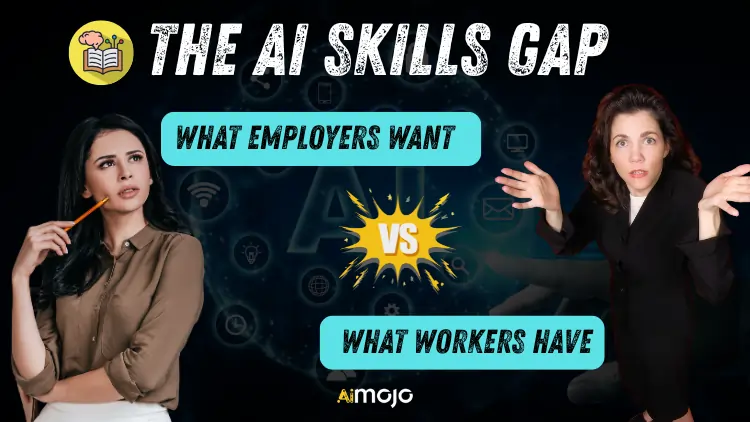
The Wish List vs. Reality? Many companies post delusional AI job requirements—five years of experience in two-year-old tools, PhDs for mid-level salaries. Their corporate AI strategy says one thing. HR screens for something else. Leadership wants AI for business. Middle management can’t define what that means. The employer side of this equation is way messier than anyone admits.
Where Workers Actually Stand
The Self-Assessment Trap is real. Surveys say workers feel “AI ready.” Competency tests say otherwise. A few hours with ChatGPT workplace skills doesn’t make anyone AI-literate. Using AI tools for professionals and understanding the mechanics underneath are two completely different universes.

Traditional education isn’t saving anyone either. University curricula barely touch deep learning or applied generative AI. The gap between academic AI education programs and real-world employer AI expectations grows wider every semester. A CS degree alone? Not enough anymore.
But the real crisis is hiding in plain sight:
Mid-career workers. Ages 35-55. Most affected by automation job displacement. Least targeted by AI training programs. Not fresh graduates who can pivot easily. Professionals with mortgages, families, and 20 years of expertise in fields being restructured underneath them—right now. Mid-career AI reskilling is the single most neglected segment of workforce development, and it’s creating a ticking time bomb.
Skills That Actually Get You Hired
Not all AI skills carry equal weight.

Why Reskilling Programs Keep Failing
Most corporate reskilling is a checkbox exercise. Generic AI bootcamps have terrible completion rates and worse placement numbers. Workers need messy, real-world projects—not polished slide decks about AI workforce development that nobody remembers a week later.
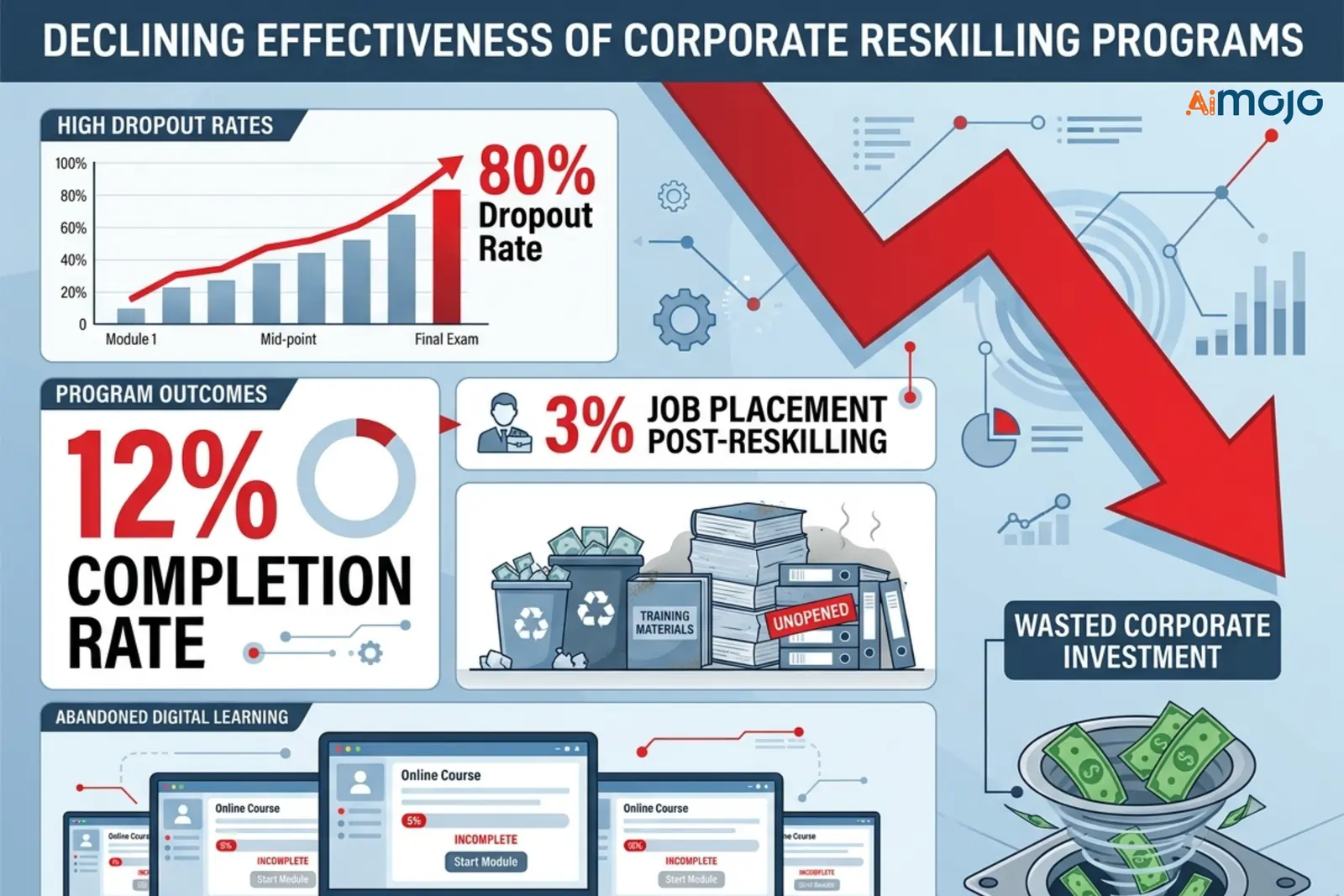
What top companies do differently: The organizations actually closing their tech talent gap build internal AI talent pipelines through micro-credentialing, project-based learning, and mentorship. No lecture halls. No webinars everyone mutes. Real work, real problems, real results—higher retention, faster deployment, stronger teams.
For self-directed learners, three things matter more than anything:
Employers Are Part of the Problem Too
Let’s say it plainly. When companies demand 10 tools, 5 years of experience, and a PhD for mid-level pay—strong candidates self-select out. The artificial intelligence jobs market is gatekeeping itself into a shortage. That’s not a talent problem. That’s a job description problem.
The math is damning:
Workforce automation gets funded generously. Workforce preparation gets scraps. If your corporate AI strategy doesn’t include humans, it’s not a strategy—it’s a shopping list.
Hiring potential over perfection is the shift smart companies are making. They’re betting someone with strong fundamentals and hunger gets trained faster than a “perfect” candidate gets found. And they’re winning. Future-proof career building has to be a shared responsibility—dumping it entirely on employees while the C-suite complains about talent shortages is a blame game, not a workforce strategy.
What Happens If Nobody Acts?
Economically? Every unfilled AI role = stalled project = lost revenue. AI and employment trends are clear: companies that can’t staff AI initiatives fall behind permanently. Countries investing in AI education programs pull ahead. Everyone else publishes reports about maybe doing something eventually.

The human cost is what every report skips. AI career transition anxiety is real and measurable. Automation job displacement isn’t just hitting factory floors—it’s gutting white-collar roles across accounting, legal research, content production, and customer service. Financial instability. Identity crisis. The psychological weight of watching your skill set become irrelevant overnight doesn’t show up in quarterly earnings.
But it’s widespread. And it’s accelerating.
The 90-Day Action Plan
| Timeline | Action |
|---|---|
| Weeks 1–2 | Take a free AI competency test. Honest assessment, zero ego. |
| Weeks 3–4 | Identify target AI career paths. Pick ONE focus area only. |
| Weeks 5–8 | Start upskilling for AI via project-based courses. Build something real. |
| Weeks 9–12 | Update portfolio, fix resume, start applying. No quitting your day job. |
Audit your real AI competency framework—not the aspirational one. Build internal AI training programs around actual project work. Rewrite job descriptions to attract future-proof career seekers instead of unicorns that don’t exist.
AI education programs need industry co-design, not academic theory alone. Fund mid-career AI reskilling at scale—the single most underserved segment. National AI readiness benchmarks need teeth and accountability, not dusty PDFs on government websites.
Top Questions On The AI Skills Gap—Answered
What exactly is the AI skills gap?
It’s the mismatch between the AI skills employers need and what the current workforce actually has. This gap spans every industry, not just tech.
Which AI skills are most in-demand right now?
Python, machine learning frameworks, prompt engineering, cloud platforms, generative AI model experience, and data pipeline management top the list. Responsible AI skills and AI project management are close behind.
Can I close my AI skills gap without going back to college?
Yes. Targeted AI bootcamps, online AI certifications, and project-based learning often carry more weight with recruiters than another degree. Build real projects, not just certificates.
Why do employers struggle to fill AI roles?
Unrealistic AI job requirements, disconnected hiring processes, and almost zero investment in AI workforce development. Companies fund the tools but starve the people budget.
Are mid-career professionals at risk?
They’re the most at-risk and the least supported. Workers aged 35-55 face the highest automation job displacement exposure but get the least attention from AI training programs.
How long does it take to become job-ready in AI?
With focused effort, most professionals can build foundational AI competency within 90 days—without quitting their current job.
The Gap Won’t Close Itself
Employer AI expectations sit sky-high. Worker readiness sits rock-bottom. Finger-pointing between both sides helps absolutely nobody.
The AI skills gap is fixable—but only when companies invest in people with the same urgency they pour into tools, and workers get brutally honest about where they actually stand. Waiting for the other side to move first? That’s exactly how we got here.
Share this with someone still pretending AI won’t touch their career.
AiMojo Recommends:


 BONUS: Get our $200 “AI Mastery Toolkit” FREE when you sign up!