

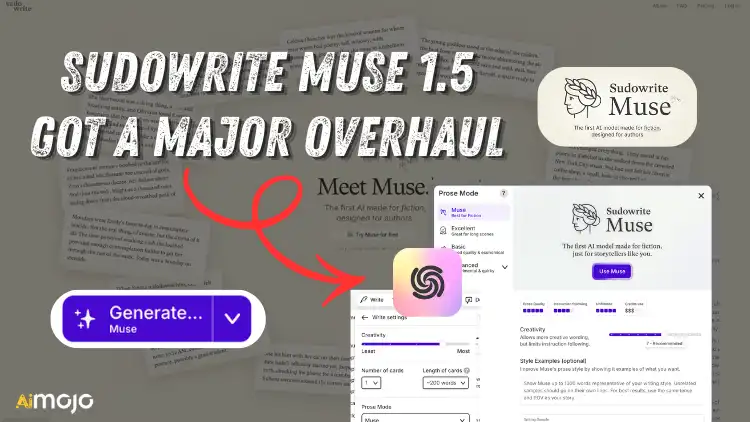
💡 TL;DR — The Muse 1.5 Situation in 30 Seconds
If you write fiction and you've been hearing the Muse 1.5 buzz, here's the deal — Sudowrite quietly replaced its original Muse model with a sharper, longer-running version in 2026. Scenes stretch further, prose feels denser, and voice stays locked across full manuscripts. Same price, same credit cost, better output. That's the story.
📊 Muse 1.5 at a Glance — Straight Facts, No Fluff
| Question | Straight Answer |
|---|---|
| What is it? | Sudowrite Muse 1.5 — fiction-native AI model |
| When did it drop? | June 2025, became 2026 default |
| Biggest upgrade? | 40% longer scenes, sharper prose, locked voice consistency |
| Price change? | None — same credit cost as Sudowrite Muse 1.0 |
| Who is it for? | Novelists, short-story writers, long-form fiction authors |
| Who should skip it? | Bloggers, marketers, non-fiction writers |
| Best alternative inside Sudowrite? | Claude Sonnet 4.6 (edits), GPT-5.4 (long context) |
| Starting price? | ~$10/month |
| Free trial? | Yes |
| Our exclusive deal? | 200,000 bonus credits on signup via our link |
| Worth it in 2026? | Yes, for fiction writers — it's the category leader |
🔬 How We Tested This — Our Methodology
This breakdown isn't recycled press-release talk. Here's exactly how we put together this review so you know what's behind every claim on this page.
1. Hands-on testing across real manuscripts
Our team ran Muse 1.5 across multiple full-length drafts — short stories, novella chapters, and sections of a 70,000+ word manuscript — to see how the model actually holds up past the first 2,000 words. No demo prompts. Real fiction, start to finish.
2. Head-to-head model comparisons
We tested Sudowrite Muse 1.5 side-by-side with Claude Sonnet 4.6, GPT-5.4, and Gemini 3.1 Pro using identical scene prompts, identical Story Bibles, and identical Style Examples. Same input, four outputs, direct comparison.
3. What 70,000 words of testing actually revealed
Three things kept showing up across our long-form runs:
4. Community-sourced feedback
We cross-checked our findings against active Sudowrite user communities, author Discords, and public feedback from working novelists who draft inside the platform daily. One recurring note we kept seeing: “It's the first AI model where I don't feel like I'm editing against the tool.”
5. No paid placement, no sponsored angle
Sudowrite didn't pay for this review. We use affiliate links because we genuinely use the tool ourselves — but every observation here came from actual testing, not a briefing document.
6. Update cadence
We revisit this article every time Sudowrite pushes a meaningful model or feature update. Current as of 2026, covering the February 2026 third-party model rollout and the Visualize tool refresh.
Wait — What Even Is Sudowrite Muse?
Before jumping further into the 2026 changes, a quick refresher for anyone new here.
Muse is Sudowrite's in-house AI model, built from scratch for one job: writing fiction. Not blog posts. Not emails. Not product descriptions. Fiction.

Here's what makes it different from the usual suspects:
If Claude is the polite intern and GPT is the eager generalist, Muse is the writer who has actually finished a novel.
From Muse 1.0 to Muse 1.5 — The Key Upgrade You Should Know About
Quick timeline so the context lands:
| When | What Happened |
|---|---|
| March 2025 | Muse 1.0 launches, first fiction-native AI model |
| June 2025 | Muse 1.5 drops, becomes new default |
| 2026 | Muse 1.5 is the standard model across all Sudowrite tools |
| 2026 | Muse 1.0 moved to “Retired Models” inside Advanced Settings |
What Sudowrite Muse 1.0 was missing
It was good. Not great. Scenes sometimes ran short. Dialogue occasionally drifted into stage-play territory. Sensory detail was solid but inconsistent across longer outputs. Authors loved it for pure prose, but complained about having to regenerate for length.
What Sudowrite Muse 1.5 actually fixed
No rebrand, no paywall on the upgrade, no hype cycle. It just quietly replaced the old model.
New Models Inside Sudowrite in 2026
February 2026 brought a big update to the Prose Mode selector. Sudowrite added three heavy-hitters alongside Muse. Here's the honest breakdown:
| Model | Best For | Where It Falls Short vs Muse |
|---|---|---|
| Sudowrite Muse 1.5 | Literary fiction, sensory prose, character-driven scenes | Shorter context window than GPT-5.4 |
| Claude Sonnet 4.6 | Precise instruction-following, structural edits | Less literary feel, more “clean” than emotional |
| GPT-5.4 | Long manuscripts, factual accuracy, 1M token context | Prose reads generic, needs heavy rewriting |
| Gemini 3.1 Pro | Structured storytelling, plot scaffolding | Still catching up on fiction nuance |
The honest verdict
More models = more choice. That's genuinely good for authors. But for actual scene writing — the moment your character walks into a room, the moment dialogue lands, the moment a reader needs to feel something — Muse 1.5 still wins.
GPT-5.4's 1M token context is a serious play for epic fantasy and series writers juggling years of worldbuilding. Claude 4.6 is the precision tool for editing passes. Muse is the one you actually draft in.
The Visualize Tool Also Got an Upgrade — Here's What's New
Sudowrite Muse wasn't the only thing that got attention in 2026. The Visualize tool — Sudowrite's built-in image generator — also got a meaningful refresh.
What's new:
How to Get the Most Out of Muse 1.5 Right Now
If you already have Sudowrite open, here's the quick playbook.
Where to find it
Muse 1.5 is in the model switcher inside Write and Draft tools. One click. It's the default, so you probably don't need to change anything.
Creativity slider — what it actually means
The slider runs 1 to 11 (yes, really). Here's how to use it:
Style Examples — the underrated feature
Paste 3–5 paragraphs of your own writing into Style Examples. Muse locks onto your voice. This is the fastest way to make AI output sound like you and not a generic author.
One power-user workflow
Draft in Muse 1.5. Switch to Claude Sonnet 4.6 for structural edits and continuity fixes. Use GPT-5.4 only if you're working across a manuscript longer than 200K words and need the extra context window.
Credit management tip
Muse 1.5's longer scenes mean you burn through credits faster per generation, but slower overall (fewer regenerations needed). Net result: most authors report using fewer credits per chapter than they did on Muse 1.0.

Is Sudowrite Muse 1.5 Worth It for You in 2026?
Short answer — depends on what you write.
For everyone else — which is most fiction writers — Muse 1.5 is the strongest fiction-specific AI model available inside any writing tool in 2026. Not by marketing. By output.
Ready to Test Muse 1.5 Yourself?
Sudowrite's free trial lets you run Sudowrite Muse 1.5 on real scenes before committing. If you like it, use our exclusive link to lock in 200,000 bonus credits on your first subscription — enough to take a full novel from blank page to finished first draft.
The fiction-writing toolkit looks completely different in 2026 than it did two years ago. Muse 1.5 is a big reason why.
AiMojo Recommends:


 BONUS: Get our $200 “AI Mastery Toolkit” FREE when you sign up!