


Quick Answer: Prompt engineering as a standalone job title is shrinking in 2026 — but the skill itself is now one of the highest-leverage abilities in the job market. The smart play: combine prompt engineering with a domain (marketing, SEO, healthcare, finance, dev) and you're looking at a high-paying, future-proof career. As a pure title? Risky. As a hybrid skill? Worth every hour.
Is Prompt Engineering Still a Good Career in 2026?

Two years ago, prompt engineering was the internet's favorite “no-degree, $300K salary” fantasy. LinkedIn was flooded with self-proclaimed prompt engineers. Twitter promised it was the career of the decade.
Then 2025 happened. Models got smarter. Companies stopped paying premiums for someone whose only job was typing clever prompts. Headlines flipped from “Prompt engineering is the future” to “Prompt engineering is dead.”
Both takes are wrong.
The reality in 2026 is more interesting — and a lot more profitable for people who actually understand what's happening.
Who This Guide Is For
If you want hype, this isn't the guide. If you want a clear-eyed answer on the numbers, demand, and risks, keep reading.
What a Prompt Engineer Actually Does (in 2026)
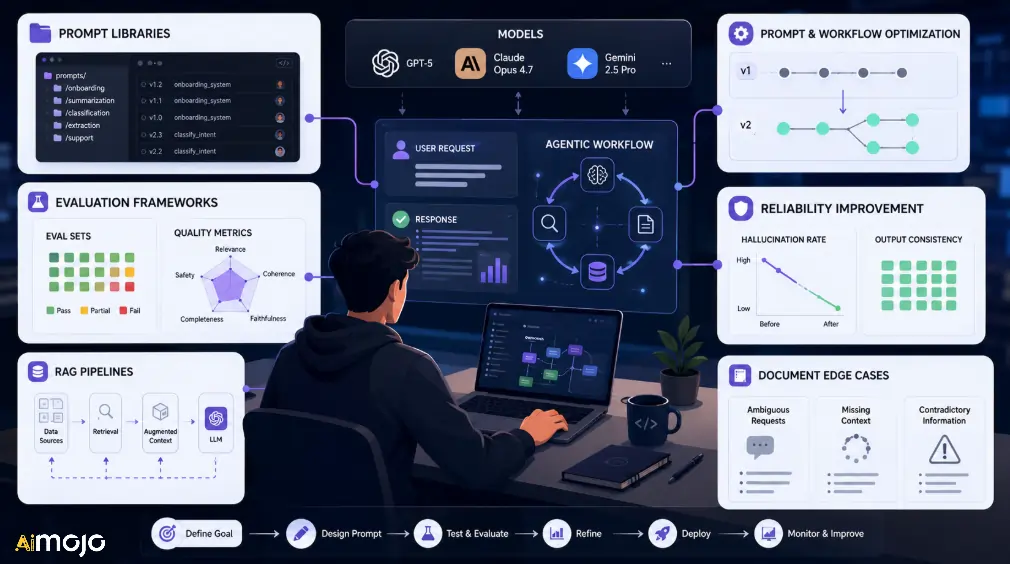
A prompt engineer designs, tests, and refines instructions given to large language models (LLMs) like GPT-5, Claude Opus 4.7, and Gemini 2.5 Pro to produce reliable, high-quality outputs at scale.
That's the textbook line. The real day-to-day looks like this:
Notice what's not on that list: just “writing creative ChatGPT prompts.” That stopped being a job in mid-2024.
Prompt Engineer Salary Breakdown (2026 Numbers)
Salaries vary wildly depending on title, region, and how the role is structured. Here's what the current data shows:
| Level | Job Title Variants | Salary Range (US) | Salary Range (India) |
|---|---|---|---|
| Entry-level | Junior Prompt Engineer, AI Content Specialist | $55K – $90K | ₹6L – ₹12L |
| Mid-level | Prompt Engineer, AI Workflow Specialist | $90K – $160K | ₹15L – ₹30L |
| Senior | Senior Prompt Engineer, AI Solutions Lead | $160K – $250K | ₹30L – ₹55L |
| Specialized | Applied AI Engineer, LLM Engineer | $200K – $400K+ | ₹45L – ₹90L+ |
| Freelance | Independent prompt consultant | $75 – $300/hour | ₹3K – ₹15K/hour |
The headline-grabbing $335K Anthropic role from 2023 still exists — but it's now called “Applied AI Engineer,” not “Prompt Engineer.” The pay is real. The title shifted.
The Demand Reality: Where the Jobs Actually Are
LinkedIn currently lists thousands of “prompt engineer” roles, but here's the catch: most are hybrid roles in disguise. Search filters reveal the pattern:
Translation: companies don't want prompt monkeys. They want domain experts who also know how to direct AI systems. That's where the money is moving.
The Big Question: Is Prompt Engineering Getting Automated?
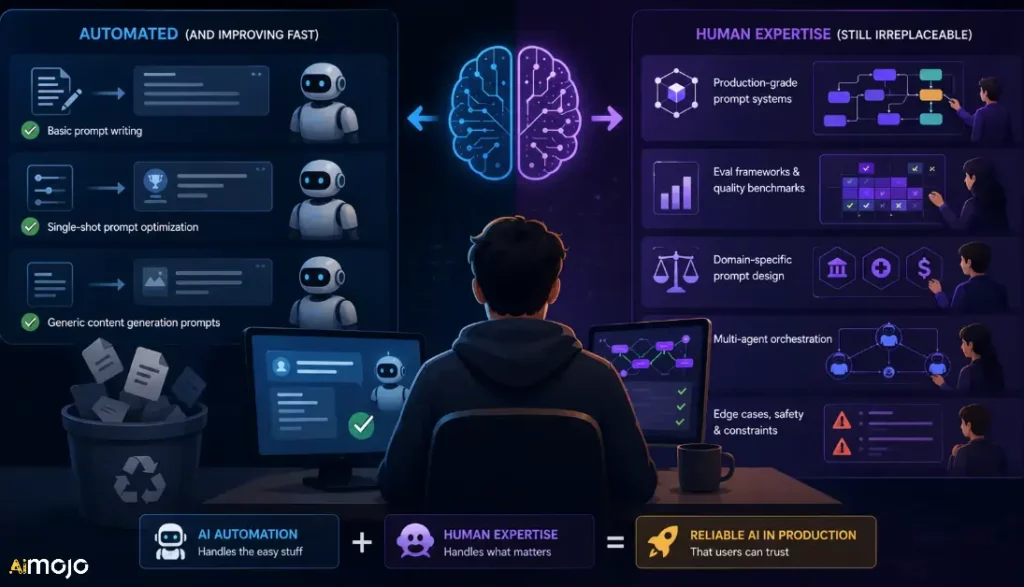
Yes and no. Here's the honest split:
What's getting automated:
What's not — and won't be — automated soon:
If your version of prompt engineering is “write clever ChatGPT prompts,” the job is gone. If your version is “design AI workflows that don't break in production,” you're in the safest part of the AI job market.
Pros and Cons of Prompting as a Career in 2026
Prompt Engineer vs AI Engineer vs ML Engineer: Which Pays More?
This is the question that actually matters for career planning.
| Role | Avg US Salary (2026) | Skill Floor | Future Outlook |
|---|---|---|---|
| Prompt Engineer | $110K | Low–Medium | Declining as a standalone title |
| AI Engineer / Applied AI | $185K | Medium–High | Strong growth |
| ML Engineer | $215K | High | Stable, strong |
| AI Product Manager | $170K | Medium | Fast growth |
| Hybrid (Domain + AI) | $130K–$220K | Medium | Strongest growth |
The takeaway: pure prompt engineering pays the least and has the weakest growth trajectory. The hybrid path consistently outperforms.
Skills Hiring Managers Actually Look For
Forget the YouTube checklists. Here's what hiring managers are actively filtering for in 2026:
- Practical experience with at least two LLMs (GPT-5, Claude, Gemini, or Llama)
- Familiarity with prompt evaluation frameworks (DeepEval, Promptfoo, LangSmith)
- Basic Python or JavaScript — enough to ship a working AI feature
- RAG and vector database basics (Pinecone, Weaviate, Chroma)
- Understanding of agentic AI and tool use
- A real portfolio: GitHub repos, case studies, or shipped projects
- Domain expertise in at least one vertical
- Soft skill: ability to translate ambiguous business problems into AI workflows
The pure “I write good prompts” pitch doesn't make it past the first screen anymore.
6-Month Roadmap to Land Your First Role
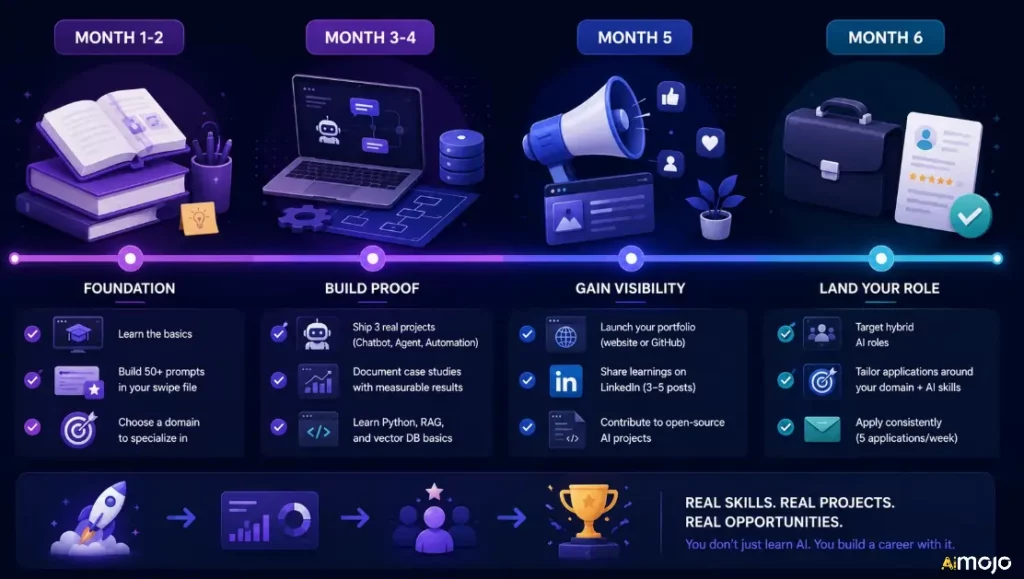
Month 1–2: Foundation
Month 3–4: Build Proof
Month 5: Visibility
Month 6: Apply Smart
People who follow this exact path are the ones landing $90K–$140K hybrid roles within 6–9 months.
Should You Bet Your Career on This?
Here's the framework I'd use if I were starting over today:
Don't pick this career because of TikTok hype. Pick it because the underlying skill compounds with everything else you already know.
Frequently Asked Questions
Is prompt engineering still in demand in 2026?
The skill is in higher demand than ever, but the job title is fading. Most companies now hire hybrid roles like Applied AI Engineer or domain-specific AI specialist instead of pure prompt engineers.
Do I need a degree to become a prompt engineer?
No. A degree helps for technical-heavy roles, but most companies care more about a working portfolio, real shipped projects, and proof of outcomes than formal credentials.
How much do prompt engineers make in 2026?
Mid-level prompt engineers in the US average $90K–$160K. Hybrid AI roles range from $130K–$220K. Senior Applied AI Engineers can clear $250K+ at top companies.
Is prompt engineering being replaced by AI itself?
Basic prompt writing is being automated by auto-prompt tools and smarter models. Production-level prompt design, evaluation frameworks, and AI workflow architecture are not — and that's where the career value sits.
What's the difference between a prompt engineer and an AI engineer?
A prompt engineer focuses on instructing LLMs to produce reliable outputs. An AI engineer builds the broader systems — APIs, RAG pipelines, agents, infrastructure — that those prompts run inside. AI engineers earn significantly more on average.
Can I freelance as a prompt engineer?
Yes — and it's one of the strongest freelance plays in 2026. Independent consultants charge $75–$300 per hour or $3K–$15K per project for AI workflow builds, prompt audits, and automation systems.
Is it too late to start a prompt engineering career?
No. The hybrid path (domain + AI) is still wide open and growing fast. The pure prompt engineer track is saturated, but the broader AI skill market is in early innings.
The Verdict
Prompt engineering as a job title is on its way out. Prompt engineering as a skill is one of the highest-paying, most transferable abilities in the 2026 job market — but only when paired with real domain expertise or technical depth.
The people who win this decade aren't the ones chasing “prompt engineer” titles. They're the marketers, developers, designers, and analysts who quietly added AI fluency to their existing skill stack and now run circles around their non-AI peers. That's the play.
Pursue the skill. Skip the title chase. Build the hybrid.
AiMojo Recommends:


 BONUS: Get our $200 “AI Mastery Toolkit” FREE when you sign up!


![Top 10 Best AI Boyfriend Apps In 2026 [Android & IOS Users]](https://aimojo.io/wp-content/uploads/2023/11/Top-AI-Boyfriend-Apps-100x100.webp)