

Most people using AI for content marketing are doing it completely backwards. They open a chatbot, type “write me a blog post,” and wonder why the output reads like every other article already sitting on page three of Google. The problem isn't the AI — it's the process surrounding it.
This guide breaks down the exact step-by-step workflow to build an AI-powered content strategy that drives organic traffic, converts readers, and doesn't scream “robot wrote this.” Running an affiliate site, scaling a SaaS blog, or managing a content team at volume — this is the playbook you actually need.
What AI Can (and Cannot) Do in a Content Marketing Setup
AI writing tools are genuinely useful — but not for everything. Here's the honest breakdown before you automate yourself into mediocrity.
| Where AI Saves Real Hours | Where Human Input Still Decides Results |
|---|---|
| Drafting long-form content at speed | Setting the original angle and hook |
| Keyword clustering and topic research | Adding real experience and first-hand perspective (critical for E-E-A-T) |
| Content repurposing across multiple platforms | Making editorial calls on quality and brand voice |
| Generating bulk meta titles and SEO descriptions |
The 80/20 split works like this: AI handles 80% of the production load, you control the 20% that actually makes content rank and convert. Flip that ratio and you get content that neither Google nor readers trust.
Step 1 — Set Up Your AI Content Strategy Before You Touch Any Tool

Skipping this step is exactly why most AI content workflows collapse within two months.
Before opening any AI writing assistant, lock down your content goals. Driving organic traffic, generating affiliate conversions, and building topical authority each require a completely different content approach. Trying to do all three with the same content type is how you end up doing none of them well.
Map your content funnel clearly — TOFU topics build awareness, MOFU content handles comparison and consideration, BOFU content closes the sale. AI-assisted SEO content works best when each piece is built with one specific funnel stage in mind.
The last — and most overlooked — setup step is building a brand voice document. Feed your AI tools your tone preferences, vocabulary style, and audience persona before generating a single word. Without this context, every output will be generic by default.
Step 2 — Use AI to Find Content Topics With Real Buyer Intent
Manually combing keyword tools for hours is now an outdated approach. AI-powered keyword research cuts that process down and surfaces opportunities human analysis misses.

Use AI to:
Pair AI keyword research tools with a real-time SEO scoring platform for maximum output. The goal isn't just finding keywords — it's finding topics where buyer intent is obvious and competition is actually beatable.
Step 3 — Build a Content Brief That Controls AI Output
Here's what nobody in content marketing automation says loudly enough: your brief determines content quality, not the AI model.
A strong AI content brief includes:
Build separate brief templates for reviews, comparisons, listicles, and how-to guides. Each format serves a different intent, so the brief structure needs to match. You can also use a recursive trick — prompt AI to generate its own brief based on your keyword, then edit it before writing starts. It speeds up the briefing process without sacrificing structure.
Step 4 — Write Content With AI That Doesn't Sound Like Everyone Else's
Generic outputs come from generic prompts. That's the whole equation.

Context-injection is the fix. Give the AI your audience persona, the specific pain point you're targeting, and the exact tone you want before asking it to write anything. This single habit separates average AI drafts from ones that actually engage readers.
For affiliate product reviews, add real specs, honest pricing comparisons, and first-person verdict framing. AI handles structure and flow well — you handle the trust signals that make readers click your links.
Non-negotiable rule: Never publish an AI first draft. A first draft gets you roughly 60% of the way there. Editing — for voice, accuracy, and originality — gets you to publishable quality.
Step 5 — Optimize for SEO While Writing, Not After
SEO optimization built into the writing process outperforms a post-publishing cleanup every time.
Key actions to run during drafting:
Content that ranks is built for search intent first and keyword targets second. Real-time SEO scoring tools keep you on track without making the content read like a keyword list.
Step 6 — Repurpose One Article Into 10 Pieces of Content Using AI
One well-researched blog post can fuel an entire month of content across platforms. Here's the repurposing stack:
| Source Content | Repurposed Output |
|---|---|
| Blog post | Email newsletter |
| Blog post | Twitter/X thread |
| Blog post | LinkedIn carousel |
| Blog post | YouTube script |
| YouTube script | TikTok/Reel captions |
The rule is reframing, not copy-pasting. Use AI repurposing prompts that adapt tone and format for each channel. A blog post talks like an expert — a Twitter thread talks like a friend sharing a hot take. The underlying information is the same; the delivery is completely different.
Step 7 — Automate Content Publishing and Distribution Without Losing Your Voice
AI-assisted scheduling tools let you push repurposed content across TikTok, Instagram, and LinkedIn without manually posting each piece. The catch — automation without brand guidelines turns your content feed into noise fast.
Set up these three things before automating anything:
- A platform-specific tone ruleset for each channel
- An email automation sequence in Beehiiv with AI-drafted copy that matches your newsletter voice
- A weekly batch scheduling workflow instead of daily posting
The Beehiiv and AI combination is especially strong for newsletter marketers running affiliate content. You can draft, personalize, and schedule complete sequences in a single session without the content feeling mass-produced.
Step 8 — Measure Results and Let AI Tell You What to Fix
Publishing is step one. The actual content marketing strategy kicks in after you start reading the data.
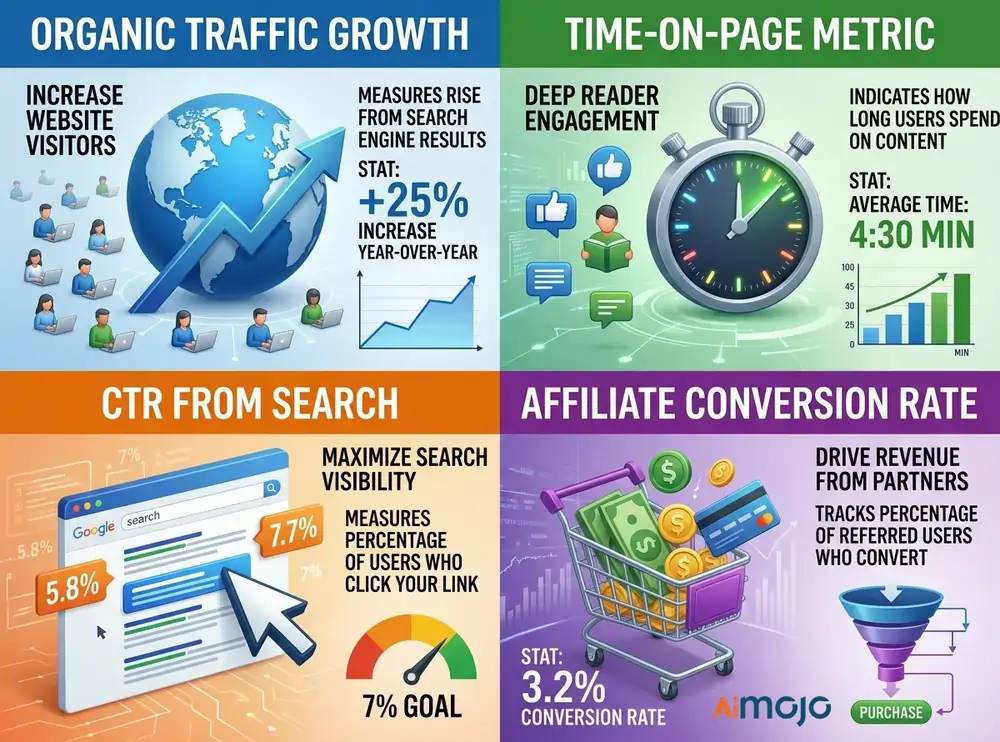
Track these metrics across all AI-generated content:
Use AI to analyze performance patterns and flag underperforming posts for content refreshes. Articles sitting on page two of Google are the best starting point — a targeted update often pushes them into top-five positions faster than writing new content from scratch. Run A/B tests on headlines and CTAs using AI-generated variants and track which combinations move numbers.
The Best AI Tools for Content Marketing Right Now (By Use Case)
Mistakes That Quietly Destroy Your AI Content Marketing Results
- Publishing AI drafts without editing — Google's E-E-A-T guidelines reward first-hand experience and original perspective. Raw AI output has neither.
- Ignoring search intent — Writing for the AI tool instead of the actual reader tanks rankings before the page even indexes properly.
- Over-automating without a quality checkpoint — Automation scales output, but it also scales mistakes if there's no human review layer in the workflow.
- Using the same prompts as everyone else — Generic prompts produce generic content. Treat prompt development as a core content skill, not an afterthought.
FAQ — How to Use AI for Content Marketing
Is AI-generated content safe for SEO in 2026?
Yes — as long as it's edited for accuracy, originality, and clear E-E-A-T signals. Google ranks content quality, not content origin.
Which AI tool is best for content marketing beginners?
ChatGPT paired with Surfer SEO is the most accessible starting combo for anyone new to AI-assisted SEO writing.
How much of my content workflow can AI realistically handle?
Roughly 60–75% of production tasks — research, drafting, repurposing, and scheduling. Strategy, editing, and brand voice are still human decisions.
Does AI work for affiliate content and product reviews?
Absolutely. AI handles structure and feature comparisons well. Add your personal verdict, real pricing data, and honest pros/cons for content that actually converts.
How do I stop AI content from sounding robotic?
Context-rich prompts, editing for natural sentence variation, and injecting first-person framing at key points. The more specific your input, the more human the output feels.
AiMojo Recommends:


 BONUS: Get our $200 “AI Mastery Toolkit” FREE when you sign up!