


Pick the wrong product and a store can stall before the first sale. That single call burns your cash, your hours, and a fair chunk of your patience.
So here's the short answer. The best AI agents for ecommerce product research in 2026 pull live demand signals, spot trending products across marketplaces, vet suppliers, crunch the margin maths, then hand you a finished brief you can act on the same afternoon. No forty open tabs. No gut-feel guessing.
At AIMojo, poking at new AI tools is basically the day job. Over recent months our team fed the same real briefs into dozens of agents. Each one had to surface a product idea, size the demand, size up rivals, and shortlist suppliers. Then we scored whatever came back.
Five earned a spot. A couple lean hard into sourcing. A couple are pure research machines. One lets you build the agent yourself. Below, we break down what each brings to ecommerce product research, where it earns its keep, and where it wobbles. Let's get stuck in.
How Product Research Quietly Became An AI Job

Not long ago, finding a product meant weeks of grind. You'd scroll supplier listings, message factories, chase minimum order quantities, then stitch it all into a messy spreadsheet.
Now the work looks different. Agentic AI shifted the game from “answer my question” to “go do the task.” You hand over a goal, and an autonomous AI agent plans the steps, browses the live web, extracts data, and returns a deliverable.
The money behind this is loud. AI in ecommerce sat at roughly $7.68 billion in 2025 and is tipped to hit $37.69 billion by 2032, growing about 25.5% a year. The wider AI agent market topped $7.9 billion in 2025 alone.
Translation for sellers: market research automation that once cost thousands and took weeks now runs in minutes. That speed changes how fast you can test ideas and kill bad ones. 🚀
What A Product-Research Agent Actually Digs Up
Before the picks, here's the useful stuff these agents fetch. Not every tool nails all of it, yet the checklist below is what separates a real research agent from a chatbot with good manners.
Get those six right and you've basically replaced a small research team. Now, onto the tools that pulled it off.
How We Tested And Scored Every Agent

We wanted results, not marketing lines. So each agent got the same job: find a candidate product in a mid-competition niche, size demand, list five rivals with prices, and shortlist three suppliers with contact details.
Then we graded on what matters day to day:
Our results were telling. A brief that eats us four hours by hand dropped to under thirty minutes with the strongest agents. Supplier shortlists that used to take a full day came back before lunch. Accuracy varied, though, and every tool needed a human sanity check on the final numbers. That's why scores below sit out of 10, and why none scored a flat perfect. Here's the snapshot. 👇
Quick Comparison: 5 AI Agents For Ecommerce Product Research
| AI Agent | Core job in product research | Where its data comes from | Output you get | Our score |
|---|---|---|---|---|
| Accio Work | Supplier-led sourcing plus product ideation | Alibaba, 1688, Taobao, AliExpress, plus Google & Amazon trends | Supplier shortlist, product plan, ready RFQs | 9.4 ⭐ |
| Sintra AI | Store-context product picking and profitability | Your store data plus bestseller signals | Product ideas, profit read, optimisation actions | 8.6 ⭐ |
| Genspark | Competitor and market research into tables | Live web, rival sites, pricing, reviews | Cited Sparkpages, AI Sheets tables, charts | 8.9 ⭐ |
| Manus AI | Autonomous deep research at scale | Live web, marketplace data, connected store apps | Reports plus sortable spreadsheets and CSVs | 9.1 ⭐ |
| Zapier Agents | Custom, always-on research and monitoring | 9,000+ connected apps plus web actions | Enriched records, docs, Slack and Sheets alerts | 8.4 ⭐ |
1. Accio Work

Our score
Alibaba built Accio for one painful part of selling: turning a rough product idea into a sourced, supplier-matched plan. What started in 2024 as a search engine grew into Accio Work, a full agent platform launched in March 2026.
By that point it had crossed 10 million monthly users. That's roughly one in five Alibaba shoppers now asking AI what to sell and where to make it. For product research tied to real factories, little else comes close.
Here's what makes it land for sourcing-first sellers:
| Product-research role | Idea to sourced, supplier-matched plan |
| What it pulls | Wholesale supplier data, trend and review signals |
| Output format | Supplier shortlist, product roadmap, RFQs |
| Connects with | Alibaba, 1688, Taobao, AliExpress, DHgate |
💡 Keep in mind: the whole thing lives inside Alibaba's world, so Amazon-only or Shopify-only sellers get less from it, and its listing copy reads like a fast first draft rather than finished work.
2. Sintra AI
Our score
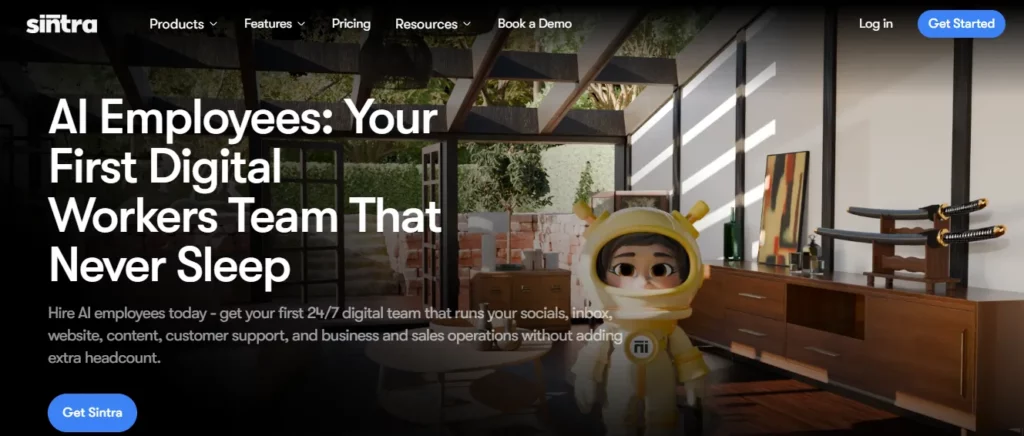
Sintra takes a different route. Instead of one big brain, you get twelve role-based AI helpers, each styled like a teammate. For product research, the one that matters is Commet, the ecommerce helper.
Commet works from your store's real context, so its picks connect to your actual products and goals, not a generic list scraped off the web. That grounding is what makes it handy for sellers who already have a shop live.
Where Commet earns points for finding winning products:
| Product-research role | Store-aware product picks and profit checks |
| What it pulls | Your catalogue, sales signals, bestseller cues |
| Output format | Product ideas, profit read, store fixes |
| Connects with | Shopify, Gmail, Notion, LinkedIn, Instagram |
💡 Keep in mind: helpers mostly work in their own lane, so Sintra suits quick, store-focused calls more than heavy web-wide crawling across a hundred rival sites.
3. Genspark

Our score
Genspark is an AI workspace with a Super Agent at the centre, orchestrating many models and 80+ tools. For product research, two features carry the load: Deep Research and AI Sheets.
Ask it to size up rivals and it acts like a junior analyst. It scans sources, then drops product specs, prices, and reviews into a live table you can sort. That output beat most tools in our tests for being ready to use straight away.
What makes it strong for competitor pricing analysis:
| Product-research role | Rival and market research into structured tables |
| What it pulls | Live web, competitor pages, prices, reviews |
| Output format | Cited Sparkpages, AI Sheets tables, charts |
| Connects with | Gmail, Google Drive, Notion, built-in browser |
💡 Keep in mind: credits drain quicker than you'd expect on big jobs, and since it's a broad workspace, always double-check the critical figures before you commit budget.
4. Manus AI

Our score
Manus takes autonomy the furthest. Hand it a goal like “research ten supplement brands, compare pricing, and build a report,” then walk away. It plans, browses, extracts, and comes back with finished work.
Under the hood it uses a sandboxed virtual machine with a real browser and file system, and it runs on Claude. So it behaves less like a chat and more like an analyst who actually clicks through pages.
Why it shines for large-scale data extraction:
| Product-research role | Autonomous deep research and bulk extraction |
| What it pulls | Live web, marketplace data, connected store apps |
| Output format | Reports, sortable spreadsheets, CSV files |
| Connects with | MCP connectors, Slack, WhatsApp, desktop app |
💡 Keep in mind: autonomy costs time, so a task can take 15+ minutes and burn credits fast. Jobs sometimes stall mid-way, and outputs still need a human eye before you rely on them.
5. Zapier Agents

Our score
The other four hand you an agent. Zapier hands you the workbench. You describe a research teammate in plain English, connect the apps, and it runs on triggers or a schedule.
That build-it-yourself angle wins when your research needs to repeat forever. Instead of a one-off scan, you get a monitor that never clocks off. For always-on ecommerce workflow automation, few things match its reach.
How sellers put it to work for research:
| Product-research role | Custom, always-on research and monitoring |
| What it pulls | Connected apps, web actions, your own data |
| Output format | Enriched records, docs, Slack and Sheets alerts |
| Connects with | 9,000+ apps, including Sheets, Slack, CRMs |
💡 Keep in mind: long agent chains still trip up now and then, and daily message limits apply. Think of it as smart connective tissue rather than a deep, solo web crawler.
Where AI Product Research Is Heading Next

The gap between research and action keeps shrinking. So it helps to see what's coming before you lock into one tool.
First, agentic commerce is moving from reading data to taking action. Agents already send RFQs and place calls, and some now nudge toward checkout with your sign-off.
Second, MCP connectors are quietly becoming the plumbing. They let an agent read clean, attributed numbers from Shopify, Meta, and Amazon, so real-time market data replaces guesswork.
Third, multi-agent teamwork is standard now. One agent hunts trends, another vets suppliers, a third builds the report, all at once.
Last, human-in-the-loop stays the safety belt. Smart sellers still approve the big calls. The agent does the legwork, you keep the judgement.
Getting Sharp Results Without Wasting Credits
These agents reward good habits. A few simple moves lifted our accuracy and cut our spend across every test.
Do that, and even the mid-scoring tools punch above their weight.
FAQ: AI Agents For Ecommerce Product Research
Which AI agent is best for finding winning products?
For sourcing-first sellers, Accio Work leads, since it ties product ideas to real suppliers. For pure web research and rival tables, Manus AI and Genspark are the strongest picks in our tests.
Can AI agents actually find verified suppliers?
Yes. Accio Work checks suppliers on production capacity and certifications, then returns a shortlist. Still, confirm each supplier yourself before sending money, because AI checks speed up vetting, they don't replace it.
Do these tools work for Shopify and Amazon sellers?
Mostly, yes. Sintra's Commet reads Shopify store data directly, while Manus AI connects to Shopify and Amazon through MCP connectors. Accio leans toward Alibaba sourcing, so pair it with a research-focused agent if you sell on Amazon.
Are AI product research agents accurate enough to trust?
They get you 80% of the way fast. Every agent we tested still slipped on at least one number, so treat outputs as a strong first draft and sanity-check the figures that drive real spending.
Is there a free way to try them?
All five offer a free tier or trial. Run one real brief through each, then judge the value by time saved rather than the headline features. 🙌
The Bottom Line
Product research used to be the slowest, most nerve-wracking part of selling online. That era is closing.
/readAfter feeding real briefs into dozens of agents, our take is simple. If sourcing and suppliers are your bottleneck, start with the sourcing-first pick. If you live in competitor data and rival pricing, lean on a research-heavy agent. And if you want a monitor that never sleeps, build your own.
Truth is, the winners aren't magic. They're fast, tireless assistants that hand you a clean brief and a shortlist so you can make the call with real numbers behind you.
Pick one, run a live product idea through it this week, and let the result decide. Your next best-seller might be one prompt away.
AiMojo Recommends:


 BONUS: Get our $200 “AI Mastery Toolkit” FREE when you sign up!