


MiniMax-M1, the latest open-source LLM from Shanghai’s MiniMaxAI, is dominating AI forums—and for good reason. Far from a routine release, this reasoning engine marries a staggering 1-million-token context window with a hybrid Mixture-of-Experts backbone and proprietary “Lightning Attention.”
Early adopters hail it as 2025’s most disruptive open-source breakthrough, promising developers, researchers, and AI tinkerers unprecedented scale without the usual hardware tax.
But can MiniMax-M1—and its companion Agent—truly deliver on the buzz? Here’s why this model may redefine LLMs, autonomous agents, and next-gen workflows.
What is MiniMax-M1? The Specs That Matter

MiniMax-M1 is an open-weight, large-scale hybrid-attention reasoning model, purpose-built for long-form reasoning, complex coding, and agentic workflows. Here’s what sets it apart:
You can grab the model weights and code on [GitHub], or try it instantly on Hugging Face and the official MiniMax chat interface.
MiniMax-M1 Key Features and Innovations
1. Lightning Attention: Speed Without Sacrificing Depth
Traditional transformers choke on long contexts due to quadratic attention costs. MiniMax-M1’s Lightning Attention slashes inference costs, making it possible to handle massive documents, codebases, or even entire book series in a single pass—without needing a supercomputer.
2. Mixture-of-Experts (MoE): Smarter, Not Just Bigger
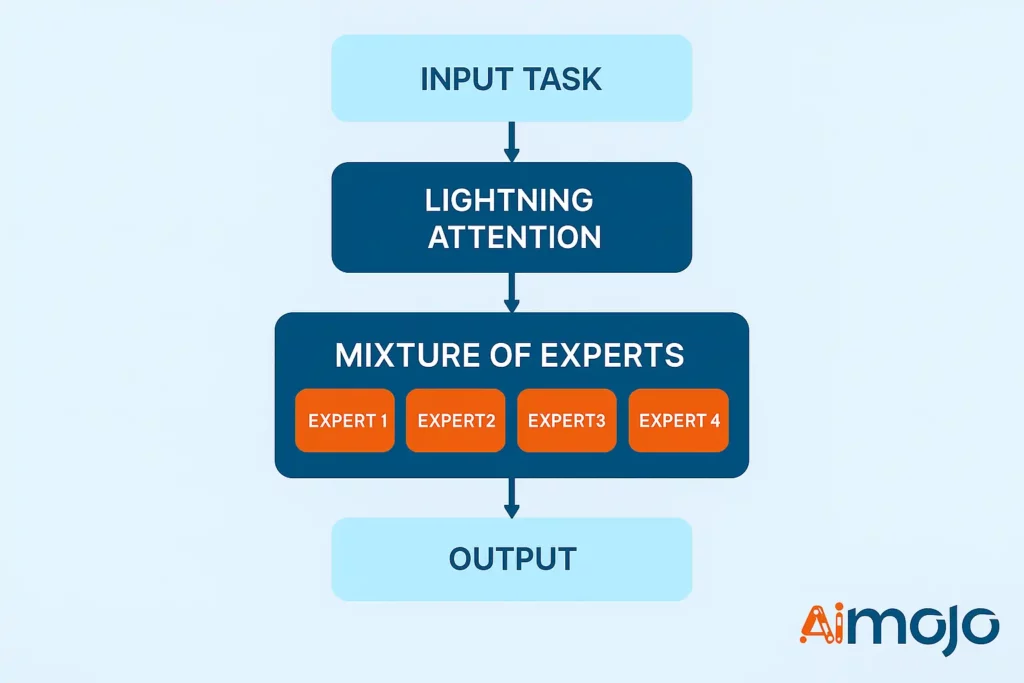
Instead of brute-forcing all 456B parameters for every token, M1 activates only the relevant “experts” for each input. This means you get the scale of a mega-model, but with the efficiency of a much smaller one—perfect for real-world workloads and cloud deployments.
3. CISPO Reinforcement Learning: Efficient, Stable Training
MiniMax’s custom RL algorithm, CISPO (Clipped Importance Sampling Policy Optimization), clips sampling weights rather than token updates. This keeps training stable even at scale, and helps the model reason through complex, multi-step problems—like maths olympiad puzzles, full-stack coding, or multi-hop question answering.
4. 1M Token Context: No More Chopped Contexts

Forget the days of splitting documents or losing track of context in long conversations. M1’s native 1M token context window is a beast—making it ideal for legal analysis, book summarisation, codebase refactoring, or any workflow where memory and continuity matter.
5. Agentic Tool Use and Multimodality
M1 isn’t just a chatbot—it’s the foundation for the MiniMax Agent, a general-purpose AI agent capable of:
MiniMax-M1 in Action: Real-World Workflows and Performance

Coding and Software Engineering
On LiveCodeBench, MiniMax-M1 clocks a solid 65%—matching or beating other open models like Qwen3-235B and DeepSeek-R1. Its FullStackBench scores (68.3%) show it’s not just about snippets, but full-stack, production-ready code. The MiniMax Agent can generate, test, and even deploy web apps and games with a single prompt.
Mathematical Reasoning
M1 is a maths whiz: 86% on AIME 2024, 96.8% on MATH-500, and strong results on multi-hop reasoning tasks. Unlike many LLMs that hallucinate or get lost in logic puzzles, M1’s hybrid attention lets it “think” through complex chains of reasoning—making it a favourite for maths researchers and educators.
Long-Context Understanding
On OpenAI-MRCR (128K tokens), M1 scores 73.4%, and it’s one of the few models that stays accurate even as context windows stretch to a million tokens. For tasks like legal document review, research synthesis, or codebase analysis, this is a big deal.
Agentic Workflows
MiniMax Agent is more than a demo—it’s a production-ready AI assistant that can:

Benchmark Showdown: How Does MiniMax-M1 Stack Up?
Here’s a quick look at MiniMax-M1’s performance on key benchmarks, compared to top open and commercial models:
| Task/Benchmark | MiniMax-M1-80K | DeepSeek-R1 | Qwen3-235B | Claude 4 Opus | OpenAI o3 | Gemini 2.5 Pro |
|---|---|---|---|---|---|---|
| AIME 2024 (Maths) | 86.0 | 79.8 | 85.7 | 76.0 | 91.6 | 92.0 |
| LiveCodeBench (Coding) | 65.0 | 55.9 | 65.9 | 56.6 | 75.8 | 77.1 |
| SWE-bench (Software) | 56.0 | 49.2 | 34.4 | 72.5 | 69.1 | 67.2 |
| OpenAI-MRCR (128K) | 73.4 | 35.8 | 27.7 | 48.9 | 56.5 | 76.8 |
| TAU-bench (Tool Use) | 62.0 | 44.0 | 34.7 | 59.6 | 52.0 | 50.0 |
💡 Note:
M1 is open-weight and free to use, while many competitors are closed or require hefty API fees.
MiniMax Agent: The Next-Gen AI Agent Built on M1

The MiniMax Agent, now in beta, is a universal AI agent designed for long-horizon, multi-step tasks. Here’s what you can expect:
And yes, you get 1,000 free credits to experiment with the Agent—no credit card required.
Unique Perks and Stats: Why MiniMax-M1 Is a Must-Try
How to Get Started with MiniMax-M1 and Agent
Final Thoughts: Is MiniMax-M1 Worth the Hype?
MiniMax-M1 isn’t just another big model—it’s a rethink of how open-source AI should work: massive context, practical efficiency, and agentic workflows ready for real-world use.
If you’re building AI apps, experimenting with agent frameworks, or just want a model that can handle your craziest prompts and longest documents, M1 is a must-try. And with the MiniMax Agent, you’re not just getting answers—you’re getting a co-pilot for your coding, research, and automation needs.
Ready to see what a truly open, efficient, and powerful LLM can do? Give MiniMax-M1 a spin—and join the next wave of AI innovation.


 BONUS: Get our $200 “AI Mastery Toolkit” FREE when you sign up!