

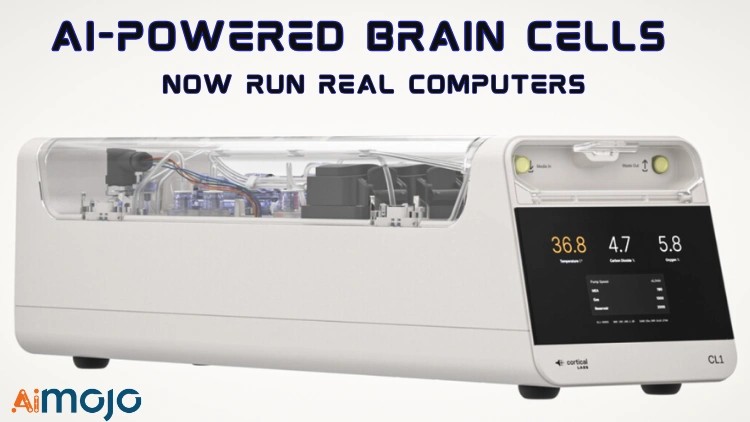
Artificial intelligence has taken a startling leap forward with the emergence of biocomputing technology that merges living human brain cells with silicon chips. This fusion represents a monumental shift in computational science, as researchers worldwide race to create biological computers that could outperform traditional silicon-based systems.
Melbourne-based startup Cortical Labs made headlines in March 2025 with the launch of CL1, the world's first commercial biological computer powered by living human neurons. The radical device introduces “Synthetic Biological Intelligence” (SBI), a new category of AI that promises to learn faster and consume significantly less energy than conventional computing systems.
Key Takeaways
The Science Behind Biological Computers

Human Brain Cells Meet Silicon Technology
The CL1 system represents a paradigm shift in computational architecture. Dr. Hon Weng Chong, Cortical Labs' founder and CEO, explains the process: “We take blood or skin and transform them into stem cells and from stem cells into brain cells or neurons that we then use for compute and intelligence”.
This biological approach capitalises on the brain's remarkable efficiency. Human brains operate on just 20 watts of power whilst outperforming supercomputers in pattern recognition and creative tasks. The neurons form billions of synapses that adapt and remember based on experience, providing the plasticity that silicon chips lack.
Organoid Intelligence Takes Centre Stage
Research into organoid intelligence has gained significant momentum in 2026. These lab-grown brain tissue structures can now:
Scientists believe organoids could eventually assist with complex decision-making and serve as bio-hybrid components in advanced AI systems.
AI Integration Across Bioinformatics Fields

1️⃣ Genomic Data Analysis Transformation
AI applications in genomics have reached unprecedented sophistication. The Evo 2 model, developed by researchers from UC Berkeley, Arc Institute, and NVIDIA, represents the largest AI model in biology to date. Trained on over 9.3 trillion nucleotides from 128,000 whole genomes, Evo 2 can:
2️⃣ Drug Discovery Acceleration
The pharmaceutical industry has embraced AI-driven biocomputing for drug development. Current AI systems can screen 2,000 molecules per second, dramatically reducing the time and cost associated with drug discovery by up to 50%. Machine learning algorithms now predict protein activity effects and disease outcomes, enabling personalised therapy development at scale.
3️⃣ Protein Structure Prediction Breakthroughs
DeepMind's AlphaFold continues to dominate protein structure prediction, achieving experimental-level accuracy in determining three-dimensional protein conformations.
This capability has accelerated the identification of new protein targets for drug development and enhanced understanding of complex biological mechanisms.
Market Dynamics and Growth Projections
The computational biology market demonstrates explosive growth potential. Current valuations show the global market over $7.18 billion in 2026, with projections reaching $21.95 billion by 2034. This represents a compound annual growth rate exceeding 12%, driven by increasing demand for:
Emerging Technologies Shaping Biocomputing

➤ Quantum Computing Integration
Quantum computers are poised to accelerate biocomputing research significantly. These systems can simulate molecular interactions at incredible speeds, predicting protein folding patterns crucial for understanding neurodegenerative diseases.
The quantum advantage becomes particularly evident in:
➤ Single-Cell Genomics Advances
Single-cell genomics technology allows researchers to study individual cells within complex tissues. This granular approach proves especially valuable for cancer research, where tumour cells exhibit diverse behaviours.
Applications include:
➤ Cloud-Based Real-Time Analysis
Cloud computing platforms enable real-time biological data analysis, supporting global research collaboration and instant clinical decision-making.
Healthcare providers can now:
Industry Applications and Use Cases
Precision Medicine Advancement
AI-powered biocomputing platforms are creating unprecedented opportunities for personalised healthcare. The AI-HOPE system, developed for clinical cancer research, demonstrates how natural language processing can convert complex medical queries into actionable analytical workflows. This technology enables:
Synthetic Biology Integration
The convergence of synthetic biology and biocomputing creates new possibilities for engineered biological systems. Current applications span:

Medical Research Acceleration
Research institutions are implementing AI-driven biocomputing to address complex medical challenges. Recent studies show significant improvements in:
Challenges and Limitations
Technical Hurdles
Despite remarkable progress, biocomputing faces several technical challenges:
Ethical and Regulatory Considerations
The integration of living biological components raises important ethical questions:
Future Outlook: Where Biocomputing Goes Next
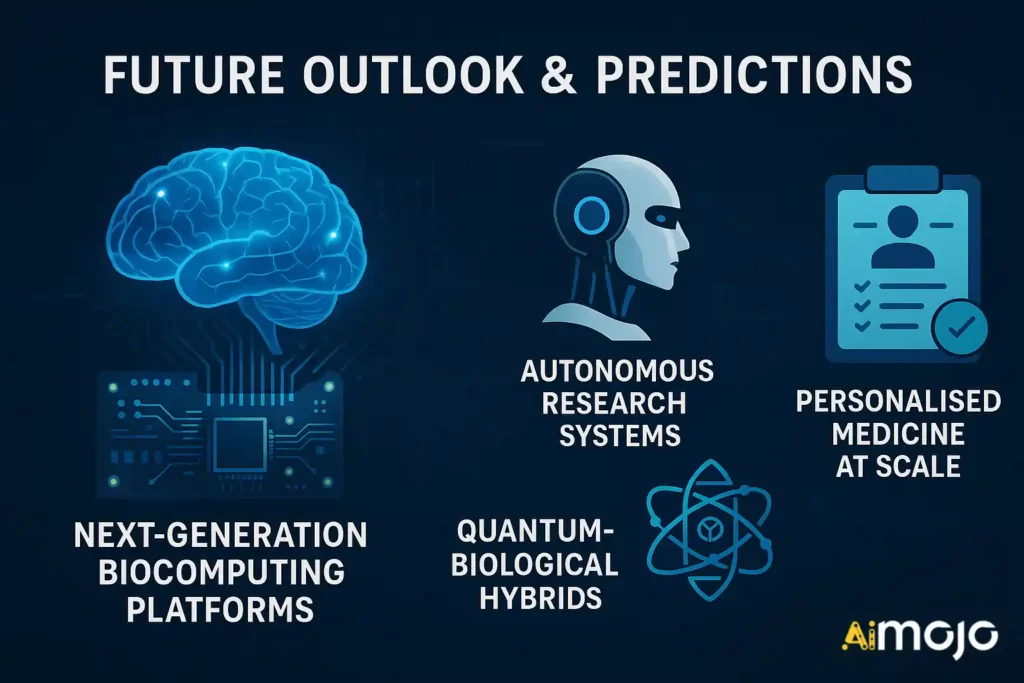
Next-Generation Biocomputing Platforms
Industry experts predict significant advancements in biocomputing technology over the next decade:
Market Evolution
The biocomputing market is expected to undergo substantial transformation:
Technological Convergence
Future biocomputing platforms will likely integrate multiple advanced technologies:


 BONUS: Get our $200 “AI Mastery Toolkit” FREE when you sign up!