

Three names own every AI Agent Platforms debate right now — AutoGen, CrewAI, and LangChain — and picking wrong can quietly burn weeks of build time. They all promise smarter multi-agent automation, but pull in three totally different directions, and most comparison posts skip the part where one of them slows you down hard.
If you're shipping autonomous agents, RAG pipelines, or LLM workflows this year, here's what each one nails, where it cracks under production load, and which fits your stack.
What AI Agent Platforms Actually Do
AI agent platforms are the orchestration layer that turns a raw language model into something that acts — calling tools, hitting APIs, querying databases, remembering context, and coordinating multiple agents toward a goal. Instead of one prompt and one reply, you get task delegation, reasoning loops, and agents that hand work off to each other.
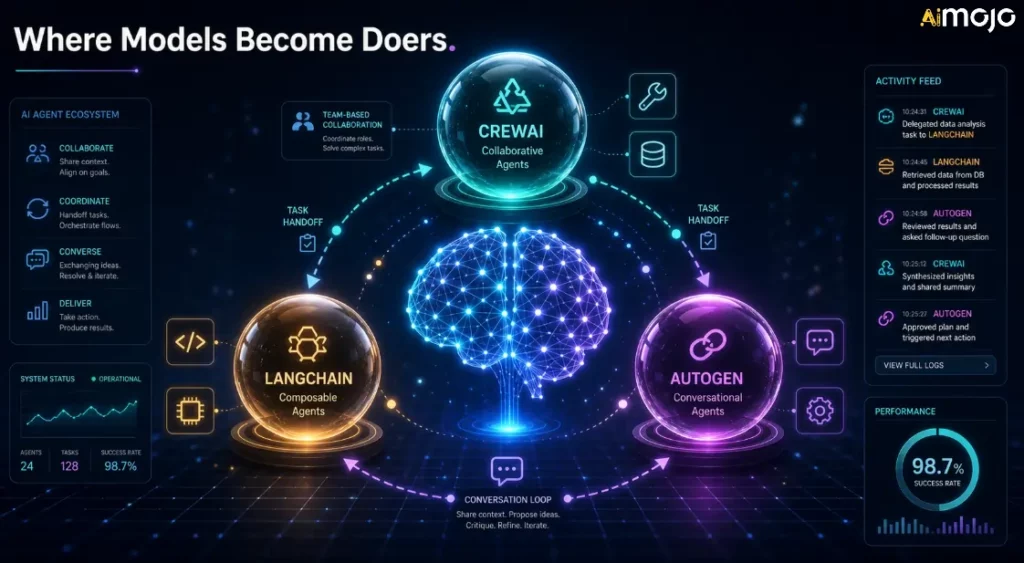
Could you build all of this from scratch with Python, async logic, and direct LLM calls? Technically yes. But the moment you need memory modules, retrieval, agent coordination, and tool integrations, frameworks start earning their keep. They hand you the prebuilt pieces so you stop reinventing the wheel.
The three names that dominate every serious conversation right now: LangChain (the toolkit), CrewAI (the crew), and Microsoft AutoGen (the conversation engine).
The 30-Second Verdict on Best AI Agent Platforms
Short on time? Here's the cheat sheet before the deep cuts:
Side-by-Side: AutoGen vs CrewAI vs LangChain
Here's the head-to-head on the criteria that actually matter when you're choosing an agent stack:
| Criterion | LangChain | CrewAI | AutoGen |
|---|---|---|---|
| Core model | Chains / graph workflows | Role-based crews | Conversational agents |
| Multi-agent support | Via LangGraph | Native, built-in | Native, conversation-based |
| Learning curve | Steep | Low | Moderate |
| Flexibility | Very high | Medium | High |
| Integrations | 600+ out of the box | Hybrid (prebuilt + custom) | Mix-and-match, younger library |
| Production maturity | High | Medium | High |
| Ecosystem size | Largest | Growing fast | Microsoft-backed |
| Pricing (paid tier) | LangSmith ~$39/mo per seat | From $99/mo (100 runs) | Free core + infra/API costs |
| Best fit | RAG, pipelines | Role delegation, automation | Code, debate, verification |
1. LangChain: The Swiss Army Knife
LangChain is the most adopted framework in the space, and it shows. Think of it as a modular SDK that links LLMs to tools, APIs, memory, retrievers, and reasoning flows — with 600+ integrations connecting to nearly every major model, vector database, and tool through a standardized interface.
The ecosystem now extends well past the core library. LangGraph lets you define agent workflows as stateful graphs, which pushes LangChain firmly into multi-agent territory with iterative refinement loops and deterministic orchestration. LangSmith handles tracing and debugging once your project outgrows the prototype stage.
The catch? It has no prescribed workflow, so you design the agent logic yourself. Developers regularly flag it for being over-engineered — verbose wrappers, excessive dependencies, and a habit of pushing simple tasks through every layer of abstraction.
👍 Best for: RAG systems, document Q&A, API-driven assistants, semantic search over knowledge bases, and flexible multi-step pipelines.
2. CrewAI: The Role-Based Team Builder
CrewAI is the lean upstart that exploded in popularity thanks to a low learning curve and solid docs. The mental model is dead simple: you assemble a “crew” of agents, give each one a role — Researcher, Writer, Reviewer, Supervisor — assign tasks, and let them collaborate.
Under the hood it runs a two-layer architecture. Crews handle dynamic, role-based agent collaboration, while Flows deliver deterministic, event-driven task orchestration. You can start with a simple agent team and layer in control logic as the project grows. It ships with role-based access control, encrypted data, and on-prem deployment by default, plus real-time agent monitoring and task limits.
Because it runs on minimal abstractions, CrewAI is fast — strong raw speed, native concurrent agents, and easy scaling from a local script to a full cluster. The downside is a slightly black-box feel and hidden abstractions that make deep customization harder once you hit production-grade complexity.
👍 Best for: structured multi-agent automation, marketing and sales workflows, tiered customer support (L1 → L2 → Supervisor), HR onboarding, and approval-heavy compliance chains.
3. Microsoft AutoGen: The Conversation Engine
AutoGen, from Microsoft Research, is conversation-centric to its core. Agents complete tasks by chatting with each other — one sends a message, another responds, and that back-and-forth drives the entire workflow. It's the natural pick for debate patterns, peer-review loops, and scenarios where agents need to verify each other's reasoning.

Architecturally, it splits into a low-level Core for event-driven messaging and a high-level AgentChat interface for building conversational agents. The mix-and-match flexibility is genuinely impressive: combine agents running different LLMs (OpenAI plus Claude), bolt on code execution, database access, and web surfing, and drop in human input wherever you need it. On safety, it confines risky code to Docker containers and lets you set custom termination conditions so no runaway agent loops creep in.
It's already proven in production — at Novo Nordisk, AutoGen powers agent orchestration in data science environments tuned for strict pharmaceutical compliance. The trade-off: it doesn't eliminate orchestration, so you manually design how agents interact, and the documentation tends to be scattered.
👍 Best for: developer assistants, automated code execution and debugging, research synthesis, scenario modeling in financial services, and anything deep in the Microsoft/Azure stack.
So Which Platform Wins Your Project?
Match the framework to your workflow DNA, not the hype:

And here's the part nobody mentions: you don't have to choose just one. In a customer service agent, LangChain can run sentiment analysis, CrewAI can manage triage and escalation, and AutoGen can handle human-in-the-loop diagnostics. Hybrid stacks are increasingly the smart play.
AI Agent Platforms Pricing Reality Check
All three ship an open-source core, but the wallet damage shows up differently:
Frequently Asked Questions
Can you combine these frameworks in one project?
Yes. Hybrid setups are common — LangChain for retrieval and analysis, CrewAI for role-based triage, AutoGen for code-backed escalation. They complement each other more than they compete.
Are AutoGen, CrewAI, and LangChain open-source?
All three are open-source, but with different levels of commercial licensing, premium features, and paid support.
Which has the strongest community?
LangChain, by a wide margin, with the most integrations and active channels. AutoGen leans on Microsoft's backing but has limited intel outside the core team. CrewAI's community is still young, so debugging sometimes means reading the source.
How often do they ship updates?
LangChain updates daily to weekly. CrewAI iterates weekly on core APIs and bug fixes. AutoGen moves slower — roughly monthly or per milestone.
Do I even need an agent framework?
Not always. For a one-off script, raw Python works. But for memory, retrieval, tool orchestration, and multi-agent coordination, a framework saves serious time.
Which is best for beginners?
CrewAI has the gentlest on-ramp thanks to its intuitive crew-agent-task model and clean docs. AutoGen's web UI also helps non-experts experiment quickly.
The Bottom Line
Stop hunting for the “best” platform — it doesn't exist. There's only the best one for your workflow, and you already have the clues you need. LangChain owns flexibility and ecosystem depth, CrewAI owns speed and clean role-based design, and AutoGen owns conversational multi-agent collaboration with tight Microsoft fit.
👉 So do this: figure out your collaboration pattern first — linear pipeline, role-based crew, or peer debate — and let that make the call for you. Nail that match early and the framework just melts into the background while your agents grind through the real work.
AiMojo Recommends:


 BONUS: Get our $200 “AI Mastery Toolkit” FREE when you sign up!