

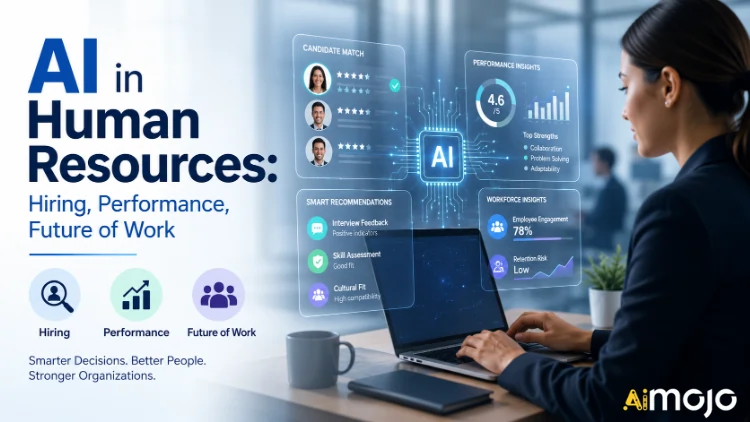
The way companies hire, manage, and retain people has changed more in the last three years than in the previous three decades. AI in Human Resources is no longer a future concept — it's already running background checks, scoring resumes, scheduling interviews, and predicting who's about to quit. If your HR team isn't using it, your competitors probably are.
This guide breaks down exactly how AI is being used across the HR lifecycle — from sourcing candidates to performance reviews — and what it means for teams, hiring managers, and workers at every level.
What's Inside: Quick Glance at AI in HR
| HR Function | AI Application | Key Benefit |
|---|---|---|
| Talent Acquisition | Resume screening, candidate matching | 60–75% faster shortlisting |
| Interview Process | AI video interviews, sentiment analysis | Reduced bias, consistent scoring |
| Onboarding | Chatbots, personalized training paths | Faster ramp-up time |
| Performance Management | Continuous feedback tools, OKR tracking | Real-time insights vs. annual reviews |
| Employee Retention | Predictive attrition models | Early warning before resignations |
| Workforce Planning | Headcount forecasting, skills gap analysis | Data-driven hiring decisions |
| HR Operations | Payroll automation, policy Q&A bots | Reduced admin overhead |
Why HR Was Overdue for an AI Upgrade
Traditional HR was — let's be honest — drowning in spreadsheets, gut-feel decisions, and reactive processes. A recruiter manually reading 300 resumes for a single role, or a manager doing a 30-minute performance review once a year and calling it “continuous feedback.” That's not a system. That's a bottleneck.

AI fixes this by processing scale that humans physically can't manage. Machine learning models trained on thousands of past hires can surface the top 10 candidates from a pool of 500 in seconds, flagged against role-specific competencies, not just keywords. That's a fundamental shift in how talent decisions get made.
AI-Powered Recruiting: Speed Meets Precision
Recruitment is where most companies first interact with AI in HR, and the results speak for themselves.
Resume Screening and Candidate Ranking
Applicant Tracking Systems (ATS) powered by AI — tools like Greenhouse, Lever, and Workday — now go beyond keyword matching. They use semantic understanding to identify qualified candidates even when they don't use the exact job title or phrasing from your posting. A “growth hacker” and a “demand generation manager” might be the same person for your role.
AI Video Interview Platforms
Tools like HireVue and Spark Hire use computer vision and natural language processing to analyze candidate responses, tone, and communication clarity. Hiring managers get a structured scorecard instead of relying on post-interview impressions that fade by Friday afternoon.
Conversational AI for Candidate Engagement
Recruiting chatbots — like Paradox's Olivia — handle screening questions, answer FAQs about roles, and schedule interviews without a human touching the process. Response rates go up. Time-to-hire comes down. Candidates actually get updates instead of ghosting.
Key LSI terms this covers: AI recruitment software, automated resume screening, AI hiring tools, intelligent candidate matching, HR automation platforms
Onboarding That Actually Sticks
Most onboarding fails because it's generic. New hires sit through the same 40-slide deck regardless of their role, experience level, or learning style.
AI-driven onboarding platforms like Leena AI or ServiceNow HR Service Delivery create personalized paths based on the employee's role, prior experience, and real-time progress. If someone breezes through compliance modules but gets stuck on internal tools training, the system adjusts — serving up additional resources automatically.
Chatbots handle the endless stream of “Where do I find the PTO policy?” questions that eat up HR reps' time. The result: faster productivity ramp-up, fewer first-week dropoffs, and HR teams freed up for strategic work.
Performance Management: Ditch the Annual Review
Annual performance reviews are one of the most hated processes in corporate life — for both managers and employees. They're delayed, subjective, and by the time they happen, half the feedback is irrelevant.

Continuous Performance Monitoring
AI tools like Betterworks, Lattice, and 15Five use machine learning to analyze ongoing work patterns — project completions, collaboration frequency, goal progress — and surface insights in real time. Managers get nudges when a team member is falling behind on OKRs. Employees get feedback loops that actually connect to their daily work.
360-Degree Feedback, Scaled
Collecting multi-source feedback used to mean endless survey emails. AI platforms now automate feedback collection, analyze sentiment across responses, and summarize themes — so managers get a clear picture without reading 200 comment fields.
Identifying High Performers Early
Rather than waiting for review season, AI models can flag high-potential employees based on contribution patterns, cross-functional collaboration, and skill development velocity. This gives HR a head start on retention and succession planning.
Predictive Analytics: Knowing Who's About to Leave Before They Do
Employee attrition is expensive. Replacing a mid-level employee costs anywhere from 50% to 200% of their annual salary when you factor in recruiting, onboarding, and lost productivity.
Predictive attrition models — built into platforms like IBM Watson Talent or Visier — analyze signals like:
When multiple signals align, the model flags the employee as flight risk — often 3–6 months before they actually submit a resignation. HR can intervene with targeted retention actions: a conversation, a role change, a compensation review.
This is arguably the highest-ROI application of AI in HR right now.
Workforce Planning and Skills Intelligence
Headcount planning used to be a mix of last year's numbers plus gut feel. AI changes this into an actual data science problem.

Skills Gap Analysis
Platforms like Eightfold AI, Gloat, and LinkedIn Talent Insights map your current workforce's skills against your strategic goals — and highlight exactly where gaps exist. Instead of hiring blindly, you know whether to hire externally, upskill internally, or bring in contractors for specific competencies.
Scenario-Based Headcount Forecasting
AI tools model multiple business scenarios (expansion, contraction, new product line) and project the hiring and training implications of each. This moves workforce planning from reactive to intentional.
Internal Talent Mobility
One underused application: AI matching internal candidates to open roles before external recruiting begins. Employees get growth opportunities. Companies reduce external hiring costs. Retention improves. Everyone wins.
Relevant LTK keywords: workforce analytics tools, AI talent management, predictive workforce planning, employee retention software, skills gap analysis AI
HR Operations: The Boring Stuff, Automated
Not every AI application is strategic. Some of the highest-value uses are the most mundane — and that's a feature, not a bug.
This isn't exciting. But it frees up HR professionals to focus on things AI genuinely can't do: building culture, mediating conflicts, coaching managers, and making judgment calls that require human context.
Real Concerns Worth Addressing
AI in HR isn't without legitimate criticism. Here's what actually matters:
Algorithmic Bias — If training data reflects historical hiring patterns that favored certain demographics, the model will replicate that bias at scale. Responsible vendors publish bias audit reports and allow explainability into model decisions.
Candidate Privacy — AI video analysis and behavioral tracking raise real questions about data consent and storage. GDPR and state-level privacy laws are increasingly applying here.
Over-Reliance on Scores — A high AI-match score shouldn't override human judgment. The best implementations use AI to inform decisions, not replace them.
Companies getting this right treat AI as a tool that surfaces options — final calls still sit with humans.
The Future of Work Is Already Being Built

The next phase of AI in HR isn't about replacing jobs — it's about changing what jobs actually involve. HR professionals who master AI tooling will handle more strategic scope. Recruiters who work with AI will fill roles faster with better quality. Managers using AI performance tools will have more meaningful, timely conversations with their teams.
The roles disappearing aren't “HR jobs” — they're the manual, repetitive tasks within HR jobs. The net effect is a function that does more with the same headcount, and people in those roles spending time on things that actually require human judgment.
Frequently Asked Questions
What is AI in human resources?
AI in human resources refers to the use of machine learning, natural language processing, and predictive analytics to automate and improve HR functions — including recruiting, onboarding, performance management, and workforce planning.
How does AI help in hiring?
AI speeds up resume screening, matches candidates to roles using semantic analysis, automates interview scheduling, and uses video analysis tools to score candidate responses consistently.
Can AI replace HR professionals?
No. AI handles repetitive, data-heavy tasks — screening, scheduling, survey analysis — but strategic HR work like culture building, conflict resolution, and leadership coaching still requires human judgment and emotional intelligence.
What are the risks of using AI in HR?
The main risks include algorithmic bias in hiring models, candidate data privacy concerns, and over-reliance on AI scores without human review. Responsible implementation includes bias audits, transparency, and keeping humans in the decision loop.
Which companies offer AI HR software?
Leading platforms include Workday, Greenhouse, HireVue, Lattice, Visier, Eightfold AI, Paradox, IBM Watson Talent, and ServiceNow HR Service Delivery.
How does AI predict employee attrition?
Predictive attrition models analyze behavioral and engagement signals — survey scores, communication patterns, promotion history — to calculate flight risk scores for individual employees, giving HR time to intervene before resignations happen.
Bottom Line
AI in HR is not optional anymore for companies that want to compete for talent. The teams using it are hiring faster, retaining longer, and making better people decisions. The teams not using it are still doing annual reviews in spreadsheets and wondering why turnover is high.
The tools exist. The data is there. The question is just whether your HR function is set up to use it.
AiMojo Recommends:


 BONUS: Get our $200 “AI Mastery Toolkit” FREE when you sign up!