

OpenCode Key Insights
What is OpenCode?
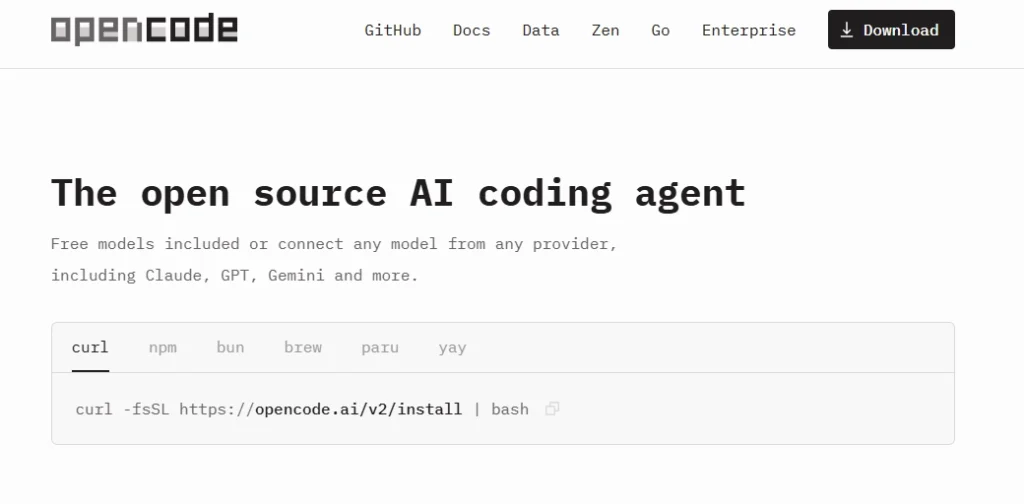
OpenCode is a fully open source AI coding agent that operates inside your terminal, desktop, or IDE. Built by the team at Anomaly (formerly behind SST), it connects to over 75 LLM providers, including Claude, GPT, Gemini, DeepSeek, and local models, giving developers total control over which AI powers their workflow. Unlike closed source alternatives, OpenCode stores none of your code or context data, making it suitable for privacy sensitive environments.
With 195,000 GitHub stars and over 16 million monthly active developers, it has rapidly become one of the most widely adopted agentic coding tools available. The agent supports parallel sessions, Language Server Protocol (LSP) awareness, plan and build modes, and a session sharing system. It is free to use with your own API keys, and optionally pairs with OpenCode Zen or OpenCode Go for curated, benchmarked model access at transparent pricing.
OpenCode automatically detects and loads the correct Language Server Protocols for the LLM you are using. This means the agent understands your project’s type definitions, imports, and symbol references without manual configuration. The result is more accurate code suggestions and fewer hallucinated imports, saving you from tedious debugging after every generation.
A single press of the Tab key switches between two distinct agents. Plan mode is read only, allowing the AI to analyse your codebase and suggest implementation strategies without touching a single file. Build mode then executes those changes with full write access. This separation mirrors how experienced engineering teams operate and prevents premature edits to production code.
OpenCode lets you spin up multiple agent sessions on the same project at the same time. You can have one session refactoring your API layer while another writes tests for your frontend components. For teams running complex monorepos, this alone can cut iteration cycles significantly.
The tool supports over 75 providers through Models.dev, including fully local models for air gapped environments. For developers who prefer a managed experience, OpenCode Zen offers pay as you go access to benchmarked models, while OpenCode Go provides a $10/month subscription with generous limits on curated open source models. You are never locked into a single provider.
Every coding session can be shared via a unique link using the /share command. Team members can review your AI conversation, understand the decisions made, and continue from where you left off. This is particularly useful for code reviews and pair programming across time zones.
The /undo command reverts all changes from the last AI action and restores your original prompt so you can refine it. The /redo command reapplies them. This gives developers a safety net that most competing agents simply do not offer, removing the fear of letting an AI modify your codebase.
OpenCode Pricing Plans
| Plan Name | Cost | Key Details |
|---|---|---|
| Free (BYOK) | $0 | Use your own API keys from any provider. No restrictions on the agent itself. |
| OpenCode Go | $10/month | Subscription access to curated open source models with generous monthly usage limits. Includes 28+ models. |
| OpenCode Zen | Pay As You Go ($20 min top up) | Access to 65+ benchmarked models including GPT, Claude, Gemini, and Grok. Billed per token at transparent rates. Auto reload at $5 balance. |
Why Open Source Matters for AI Coding Agents
OpenCode’s fully open source codebase, hosted at github.com/anomalyco/opencode, means every line of agent logic is auditable. With over 950 contributors and 13,000 commits, the project benefits from rapid community driven development that proprietary tools cannot match.
Enterprises operating under strict compliance requirements can self host OpenCode, inspect data flows, and verify that no telemetry or code leaves their infrastructure. The MIT style licence means there are no usage restrictions for commercial projects either.
OpenCode Zen vs OpenCode Go
These two paid tiers serve different developer profiles. Go is ideal for individual developers and students who want reliable access to powerful open source models at a flat $10/month. Zen targets professional teams and power users who need access to frontier proprietary models like Claude Opus or GPT 6 Astra and prefer granular pay as you go billing.
Both tiers pass provider savings directly to users with no markup beyond processing fees, and both work with third party agents too.
Pros and Cons
- Fully open source and auditable.
- Supports 75+ LLM providers.
- Privacy first with zero data storage.
- Extremely active community (195K stars).
- Terminal, desktop, and IDE support.
- Plan and Build mode separation.
- No web based visual editor.
- Desktop app still in beta.
- Initial setup requires terminal familiarity.
Best OpenCode Alternatives
| AI Coding Agent / Developer Productivity Tool | Model Flexibility | Privacy & Open Source |
|---|---|---|
| Claude Code | Single provider (Anthropic only) | Source available but not truly open source. 30 day data retention on API tier. |
| Cursor | Supports multiple models but limited to bundled providers | Closed source. Privacy mode optional. Code sent to third party servers by default. |
| GitHub Copilot CLI | GitHub ecosystem models only | Closed source. Telemetry enabled. Enterprise tier needed for zero retention. |
| Windsurf | Proprietary model routing through Cognition | Closed source. Acquired by Cognition. Data policies still maturing post rebrand. |