

AI tools save enterprise workers 40–60 min/day (Goldman Sachs, 2026), but net gains drop to 23–33% after rework and prompt overhead — and most teams never measure the difference.
That number sounds clean on a slide deck. But a 50-person team recovering 33–50 hours daily tells only half the story — nearly 40% of those hours get quietly eaten by hallucination fixes and prompt rewrites most teams never track.
These are the real AI productivity statistics for 2026 — the good, the padded, and the part nobody puts in the press release.
AI Productivity Gains at a Glance — 2026 Key Numbers
| Metric | 2026 Data Point | Source |
|---|---|---|
| Avg. hours saved per worker/week | 5–10 hrs (gross); 60% net after rework | Workday, Goldman Sachs |
| Net-effective hours saved | ~6 hrs/week after rework losses | Federal Reserve, Workday 2026 |
| Avg. ROI on scaled AI deployment | $4.60 returned per $1 spent | Accenture 2026 |
| Avg. ROI in pilot phase only | $1.20 per $1 spent | Accenture 2026 |
| AI productivity boost (augmented roles) | 37% avg. across functions | McKinsey 2026 |
| Workers losing savings to rework | ~40% of gross time savings | Workday / DD News 2026 |
| GitHub Copilot coding speed boost | 55% faster task completion | GitHub / Morgan Stanley |
| Enterprises with scaled AI deployments | 72% globally | McKinsey 2026 |
| Daily AI users vs. eligible workers | 41% active (adoption–usage gap) | Enterprise surveys 2026 |
Key Takeaways
What the Top 2026 AI Productivity Reports Actually Say

The headline numbers from 2026 major research are consistent but come with asterisks. Goldman Sachs confirmed via OpenAI enterprise account data that workers save 40–60 minutes per day, with 75% saying AI lets them complete tasks they previously could not do at all.
Federal Reserve research pegs generative AI time savings at 5.4% of total work hours weekly — roughly 2.2 hours for a standard 40-hour week — with power users reclaiming 9–20+ hours. Morgan Stanley's cross-sector survey recorded an 11.5% average net productivity increase paired with a 4% headcount reduction over 12 months.
McKinsey's Global Survey found that 88% of organizations now use AI in at least one function, and 39% track enterprise-wide EBIT impact.
The PwC AI Performance Study takes it further — linking AI adoption to a fourfold increase in productivity growth rates and a 56% wage premium in roles most exposed to AI augmentation.
How Many Hours Per Week Does AI Actually Save Workers?
Gross savings look impressive. Net savings are the real story. Workday's 2026 productivity study found workers report saving 10 hours a week — but 4 of those hours disappear into rework, output checking, and hallucination cleanup. The Federal Reserve's more conservative measure nets out to 2.2 hours for average users.
Gross weekly hours saved by role (2026 estimates):
Time-to-first-draft on long-form content is down over 60%. Email drafting, meeting summaries, and prep work together account for roughly 45–60 minutes saved per day for knowledge workers.
For large organizations, Trinity College Dublin and Microsoft Ireland data shows mid-sized companies gaining up to 1,000 hours per month, and large multinationals up to 5,000 hours monthly.
AI Return on Investment: What Companies Actually Get Back Per Dollar Spent
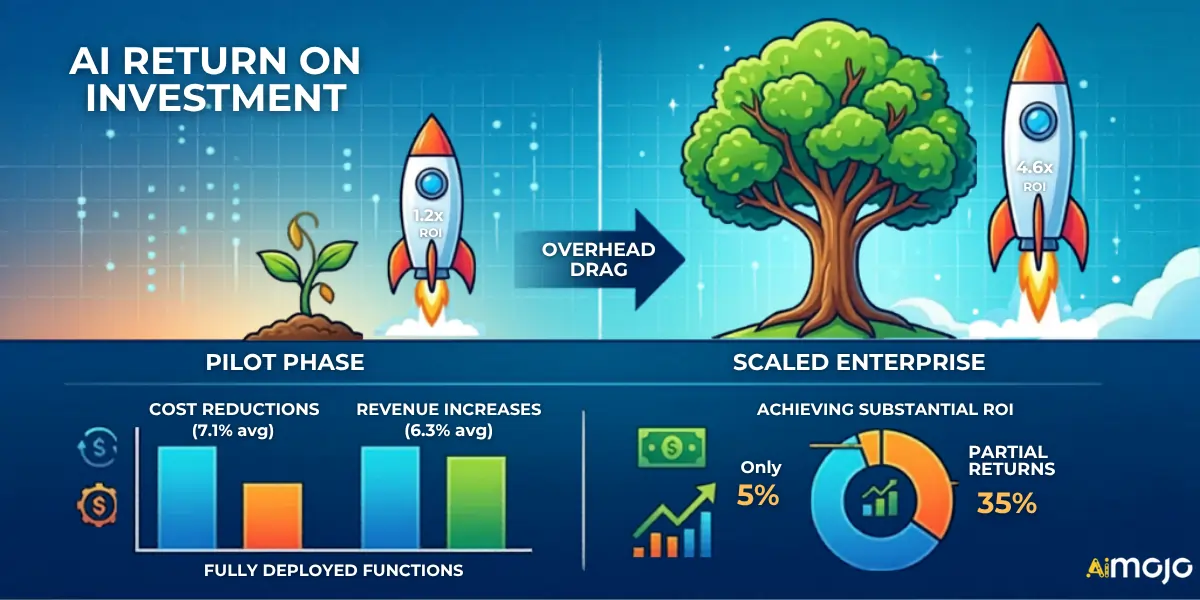
ROI is where the real split happens between AI hype and AI results. Accenture's 2026 numbers are the starkest: scaled enterprises average $4.60 back for every $1 invested. Companies still stuck in pilot phase get $1.20 — barely breaking even when overhead is factored in.
McKinsey's 2026 data shows cost reductions averaging 7.1% and revenue increases of 6.3% in functions where AI is fully deployed. Only 5% of enterprises achieve substantial AI ROI according to analysis by Master of Code, while 35% report partial returns.
SMB-level data puts annual savings at roughly $14,000–$18,000 per AI-enabled employee. Enterprise figures run $28,000–$35,000. The laggard penalty is real — firms without AI tooling are recording measurably slower revenue-per-employee growth than AI-forward competitors.
Want a tested list of tools that actually deliver these numbers for your team? Check out our breakdown of the best AI productivity tools ranked by real-world ROI.
AI Productivity Gains by Job Role: Who Benefits Most?
| Role | Speed/Output Boost | Key Stat | Top Tools Used |
|---|---|---|---|
| Software developers | +55% task speed | 40–55% more code/week | GitHub Copilot, Cursor |
| Content writers | +50–60% drafting speed | Time-to-draft cut by 61% | ChatGPT, Jasper |
| Customer support | +40–50% ticket volume | Cost per ticket down 64% | Zendesk AI, Intercom Fin |
| Sales reps | +30–40% outreach efficiency | Pipeline velocity up 28% | Gong, Clay |
| HR & recruiters | +33% screening speed | Ramp time cut from 9→5.4 months | Eightfold, Paradox |
| Finance analysts | +26–30% research speed | Error rate on data entry down 71% | Hebbia, Rogo |
| Lawyers | +30–36% document speed | Research time halved | Harvey, Spellbook |
| Designers | +35–40% output volume | Revision cycles down 44% | Adobe Firefly, Midjourney |
AI Productivity Statistics by Industry in 2026
Not every sector benefits equally. Industries with high repetitive task volumes and large knowledge-worker bases see the biggest lifts.
Which Tasks Does AI Actually Automate vs. Augment?
AI fully automates around 28% of knowledge-work tasks in 2026 — up from roughly 15% in 2023. Another 52% of tasks are augmented: humans still lead, AI assists. Summarizing documents, writing first drafts, generating boilerplate code, scheduling, and structured data entry are the top full-automation wins.
Error rates on structured data entry have dropped 71% with AI assistance. Human-rated quality scores for AI-assisted output average 4.1 out of 5 for utility — above median human performance, below expert-level.
The Junior Employee Effect: Why Newer Workers Win Biggest
The most consistent finding across research is that less-experienced workers gain the most from AI tools. Multi-institution studies confirmed junior consultants close 43% of the performance gap with senior peers once equipped with GPT-class tools.
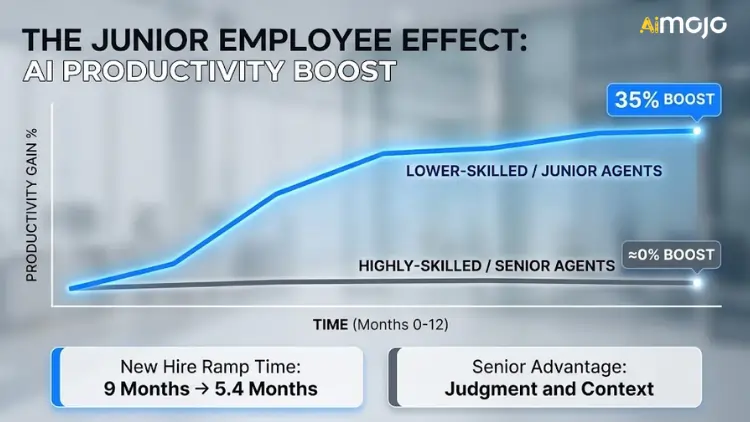
As per internal enterprise benchmarks, new hire ramp time in tech roles has dropped from 9 months to 5.4 months. Customer support agents in their first 90 days now handle case volumes comparable to 12-month veterans. Senior workers still gain — roughly 12–17% — but their advantage always came from judgment and context, not raw output speed.
A parallel study of customer service workers at a Fortune 500 company found that lower-skilled agents saw a 35% productivity boost with AI assistance, compared to nearly 0% for the most highly-skilled workers.
Tool-by-Tool AI Productivity Numbers for 2026
Where AI Costs Time Instead of Saving It: The Rework Problem
Nearly 40% of AI-generated time savings are lost to verification overhead — a finding from both Workday's 2026 study and corroborated by DD News reporting on enterprise data. The breakdown:
A February 2026 HBR study added a counterintuitive finding: AI does not shorten workdays — it densifies them. Workers produce more in the same hours, often extending scope without being asked, leading to output expansion rather than time reduction.
AI Productivity Impact on Freelancers, Remote Workers, and Solo Operators
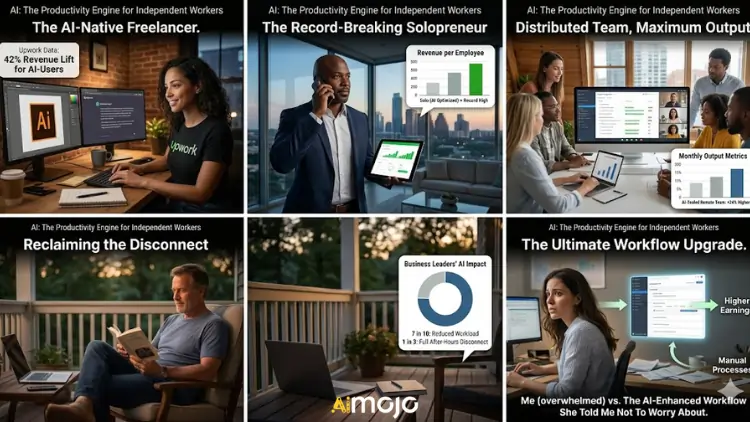
Independent workers are capturing some of the cleanest productivity-to-earnings conversions. AI-native freelancers report a 42% lift in monthly revenue and charge 28% more per hour than non-AI peers on Upwork.
Solopreneurs are posting record revenue-per-employee ratios. Remote teams with full AI tooling outperform hybrid teams without it by 24% on output metrics. 7 in 10 business leaders using AI report reduced workload, with 1 in 3 saying AI helps them fully disconnect after hours (Microsoft Ireland / Trinity College Dublin, 2026).
Does AI Productivity Translate Into Higher Wages?
Not automatically — but the premium is growing. PwC's 2026 AI Performance Study found a 56% wage premium in roles most impacted by AI augmentation. Broader job listing data shows AI-proficient workers earning 21% more on average, rising to 34% in data science and engineering roles.
Job postings requiring AI skills have surged 340% year over year. Only 29% of companies pass AI-driven savings on to employees — the rest reinvest or retain the margin.
The AI Adoption vs. Daily Usage Gap Nobody Talks About
The access-to-usage gap is the single biggest drag on enterprise AI ROI in 2026. Buying seats is not the same as building fluency.
AI Productivity by Region: Where the Gains Are Biggest
| Region | Avg. Hours Saved/Week | Notable Stat |
|---|---|---|
| United States | 6–7 hrs | Highest absolute gains globally |
| APAC (Singapore, South Korea) | 5.5–6 hrs | Fastest enterprise deployment rate |
| Ireland / UK | Up to 5,000 hrs/month (large orgs) | Trinity/Microsoft 2026 study |
| EU (Western Europe) | 4–4.5 hrs | Compliance overhead slowing gains |
| India | 4.5–5 hrs | Fastest-growing adoption market |
| Brazil / LATAM | 3.5–4 hrs | Strongest gains in marketing/content roles |
FAQ: AI Productivity Statistics Questions Answered
How many hours per week does AI actually save workers in 2026?
Gross savings average 5–10 hours per week depending on role, but net savings after rework and verification losses drop to roughly 3–6 hours. Power users with strong prompt skills and integrated workflows reclaim more — some reporting 9–20 hours weekly, per Federal Reserve and Workday data.
Does AI genuinely improve employee productivity or just shift the work?
Both. Output-per-hour rises 14–55% in augmented roles, but HBR's 2026 research confirms AI densifies workdays rather than shortening them. Workers produce more — they don't necessarily work less.
What is the average ROI of AI tools for businesses in 2026?
Scaled enterprises average $4.60 returned per $1 invested (Accenture). Companies in pilot phase average just $1.20. Marketing AI shows the fastest returns — 83% of teams report positive ROI within 12 months.
Which job role sees the biggest AI productivity boost?
Content writers and software developers lead, with 55–60% speed gains. Customer support sees the biggest cost-per-task reduction — down 64% with AI assistance.
How much money do small businesses save using AI tools?
SMBs save roughly $14,000–$18,000 per AI-enabled employee per year through task automation, faster output cycles, and reduced error rates.
Why do most companies still report no bottom-line impact from AI?
80% of enterprises see no measurable P&L impact because gains are isolated to function-level pilots. Without scaled deployment, formal training, and workflow integration, productivity gains never reach the income statement.
AI Productivity Forecast: What the Numbers Look Like Through 2030
Analysts project a compounding productivity curve through 2030. McKinsey's baseline puts AI adding 1.4–2.1 percentage points to global labor productivity annually through the decade.
Agentic AI — which hit 71% autonomous task completion in 2026 — is expected to add a 1.5–2x multiplier on top of chatbot-era gains. By 2028–2030, the average knowledge worker is projected to reclaim 9–11 hours weekly in gross terms. Goldman Sachs holds its 7% global GDP lift estimate intact, contingent on scaled adoption.
Top Sources


 BONUS: Get our $200 “AI Mastery Toolkit” FREE when you sign up!