

If we had a penny for every “AI-powered newsletter” that promised the moon but delivered bland, generic summaries, we’d have enough to buy a coffee—maybe.
Most of these so-called newsletter AI agents churn out the same old content, missing the mark on personalisation, relevance, and real engagement.
That’s why at AIMOJO, we’ve rolled up our sleeves and built, tested, and broken down the real process of building a Newsletter AI Agent that actually delivers value.
In this guide, you’ll get a hands-on, code-rich, and practical walkthrough—no fluff, just actionable steps.
Whether you’re a developer, marketer, SaaS founder, or AI enthusiast, you’ll walk away knowing exactly how to build, customise, and scale your own AI newsletter agent.
Why Newsletter AI Agents Matter in 2026

What Is a Newsletter AI Agent?
A Newsletter AI Agent is an autonomous software system that automates the end-to-end process of newsletter creation. It can:

Unlike basic automation scripts, modern AI agents use agentic workflows—meaning they can plan, decide, and act with minimal human intervention, adapting to feedback and learning over time.
How AI Newsletter Agents Work: The Workflow
Here’s a high-level view of a robust AI newsletter agent pipeline:
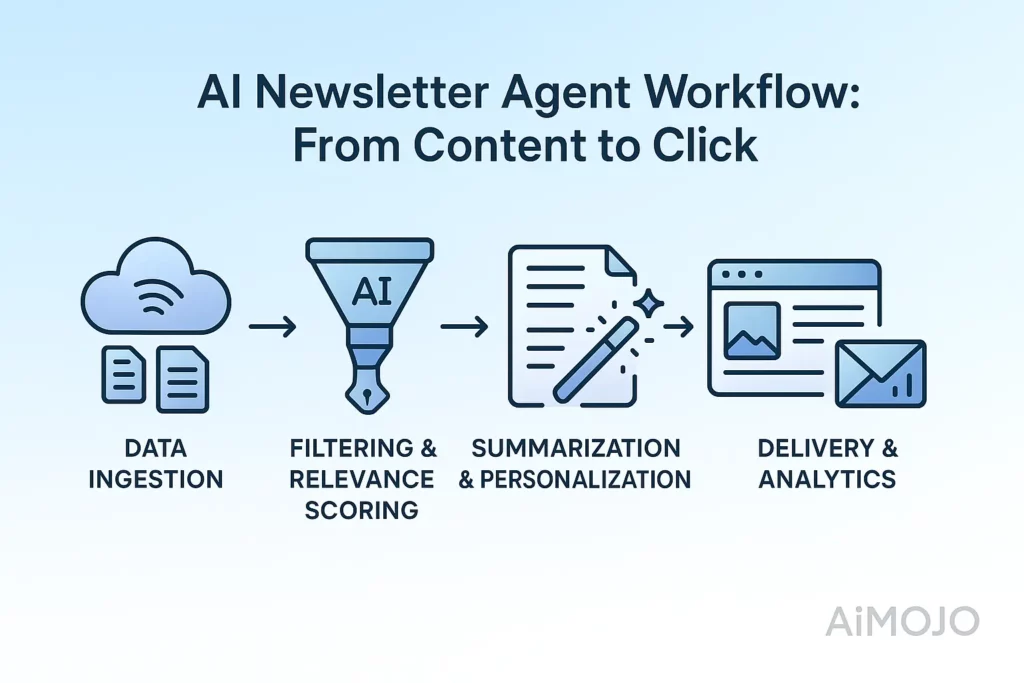
- Data Ingestion: Pull articles, blog posts, tweets, or any content from defined sources.
- Filtering & Relevance Scoring: Use AI/ML to filter for relevance (e.g., “AI news”, “machine learning”, “data science”).
- Summarisation & Personalisation: Generate concise, engaging summaries tailored to your audience segments.
- Formatting: Compile content into a visually appealing, brand-consistent newsletter.
- Delivery & Analytics: Send via email, track engagement, and refine based on feedback.
Step-by-Step Tutorial: Building Your Own Newsletter AI Agent
Let’s get hands-on. We’ll build a Python-based AI newsletter agent that reads a CSV of news articles, filters for AI topics, summarises them with an LLM, and outputs a ready-to-send newsletter.
Ingesting Data with Pandas
First, load your dataset of news articles (CSV format).
python
import pandas as pd

def load_news_csv(file_path: str):
    df = pd.read_csv(file_path)
    return df

news_data = load_news_csv("news_articles.csv")
print(news_data.head())
Pro tip: You can adapt this to pull from RSS feeds, APIs, or web scraping for real-time content.
Filtering for AI-Related Content
Let’s filter for articles relevant to AI, ML, LLMs, and related keywords.
python
class AIContentFilter:
    def __init__(self, ai_keywords=None):
        self.ai_keywords = ai_keywords or [
            'ai', 'artificial intelligence', 'machine learning', 'deep learning',
            'neural network', 'chatgpt', 'claude', 'gemini', 'openai', 'anthropic'
        ]

    def keyword_analysis(self, content: str) -> bool:
        content_lower = content.lower()
        return any(keyword in content_lower for keyword in self.ai_keywords)

    def filter_articles(self, df: pd.DataFrame) -> pd.DataFrame:
        return df[df['content'].apply(self.keyword_analysis)]

ai_filter = AIContentFilter()
filtered_articles = ai_filter.filter_articles(news_data)
print(filtered_articles.head())
Advanced: Swap keyword filtering for LLM-based topic classification for better accuracy.
Scoring and Selecting the Most Relevant Articles
Let’s apply a threshold to select the most relevant articles based on keyword density.
python
def apply_relevance_threshold(df: pd.DataFrame, ai_keywords, threshold: int = 3) -> pd.DataFrame:
    df['relevance_score'] = df['content'].apply(
        lambda x: sum(keyword in x.lower() for keyword in ai_keywords)
    )
    return df[df['relevance_score'] >= threshold]

relevant_articles = apply_relevance_threshold(filtered_articles,
ai_filter.ai_keywords, threshold=3)
print(relevant_articles.head())
Pro tip: You can use cosine similarity or embeddings for more nuanced filtering.
Summarising Articles with LLMs
Now, use an LLM (like GPT-4o, Claude, or Gemini) to generate concise summaries.
python
from langchain_openai import ChatOpenAI

def generate_summary(content: str, openai_api_key: str) -> str:
    llm = ChatOpenAI(model="gpt-4o-mini", temperature=0.1, api_key=openai_api_key)
    prompt = f"Summarise the following article:\n\n{content}"
    response = llm(prompt)
    return response['choices'][0]['text'].strip()

relevant_articles['summary'] = relevant_articles['content'].apply(
    lambda x: generate_summary(x, openai_api_key="your-openai-api-key")
)
print(relevant_articles[['title', 'summary']].head())
Tip: Batch your API calls to save on costs and speed up processing.
Formatting the Newsletter (Markdown/HTML)
Compile your content into a newsletter-friendly format.
python
def format_newsletter(articles_df: pd.DataFrame) -> str:
    newsletter_content = "# AI News Newsletter\n\n"
    for _, row in articles_df.iterrows():
        newsletter_content += f"## {row['title']}\n\n"
        newsletter_content += f"**Summary**: {row['summary']}\n\n"
        newsletter_content += "----\n"
    return newsletter_content

newsletter = format_newsletter(relevant_articles)
print(newsletter)
Advanced: Use Jinja2 for HTML templates, or integrate with email marketing APIs for direct sending.
Sending Your Newsletter
You can use Python libraries like smtplib for basic email sending, or plug into tools like Mailchimp, SendGrid, or CleverReach for advanced delivery and analytics.
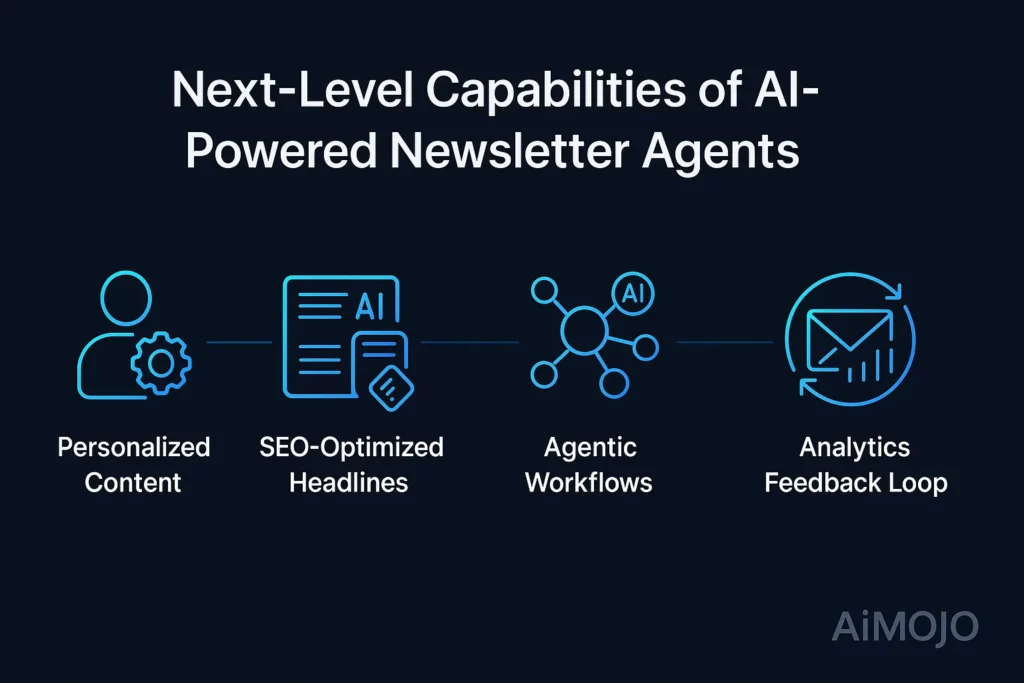
Advanced Features: Taking Your AI Newsletter Agent to the Next Level
Real-World Use Cases and Tools
| Use Case | Tool/Framework | Benefit |
|---|---|---|
| AI newsletter for SaaS | LangChain, OpenAI | Fast, relevant updates, brand consistency |
| Personalised news digests | Rasa.io, Mailmodo | Hyper-personalisation, higher open rates |
| Automated content curation | Numerous.ai, Feedly | Always up-to-date, zero manual effort |
| Multi-step research workflows | DeerFlow, LangGraph | Modular, scalable, human-in-the-loop |
| SEO-optimised newsletters | Claude, CleverReach | Higher search ranking, better engagement |
Best Practices for Newsletter AI Agents
Sample Prompts for SEO and Engagement
“Write an engaging introduction for a newsletter about AI tools that naturally incorporates the keywords ‘AI newsletter agent’, ‘automated content curation’, and ‘LLM-powered email’ within the first 100 words.”“Generate 10 newsletter subject lines for a weekly AI news digest targeting ‘machine learning’, ‘GenAI’, and ‘AI workflow’ keywords.”“Summarise this article for a technical audience, highlighting key AI advancements and practical takeaways.”Tip: Use Claude, Gemini, or GPT-4o for prompt-based content generation.
Scaling Up: Multi-Agent and Agentic AI Workflows
If you want to build a next-level solution, consider moving beyond single-agent scripts:

Troubleshooting and Common Pitfalls
Resources and Further Learning
Final Thoughts
Building a Newsletter AI Agent isn’t just about automating a boring task—it’s about creating a scalable, intelligent system that delivers real value to your audience while saving you hours every week. With the right workflow, a bit of Python, and the power of LLMs and agentic AI, you can turn your newsletter into a must-read resource that stands out from the noise.
Stay tuned to AIMOJO for more hands-on guides, tutorials, and the latest news in AI, LLMs, and agent workflows. Got questions or want to share your own newsletter agent build?
Drop a comment below or join our Discord—let’s keep pushing the boundaries of what AI can do for content creators and marketers!
Ready to build your own? Bookmark this guide and start experimenting—your next killer newsletter is just a few lines of code away!


 BONUS: Get our $200 “AI Mastery Toolkit” FREE when you sign up!