


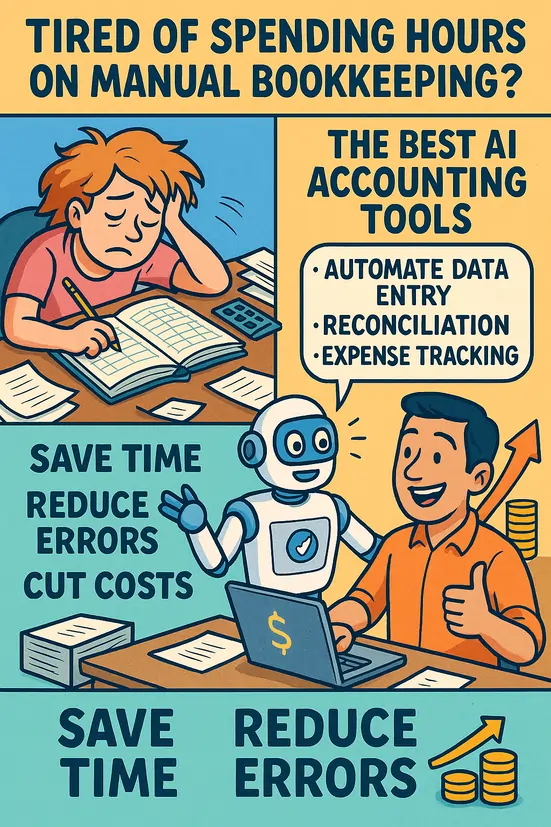
Tired of spending hours on manual bookkeeping? The Best AI Accounting Tools are changing how businesses handle their finances.
These smart solutions automate tedious tasks like data entry, reconciliation, and expense tracking, saving you valuable time and reducing errors.
AI-powered financial software doesn't just record transactions – it analyzes patterns, flags irregularities, and helps with tax preparation.
Small business owners report saving 5-10 hours weekly by switching to automated accounting systems.
Ready to streamline your financial management? Let's explore the top AI accounting solutions that can transform your financial workflow without breaking your budget.
Benefits of Using AI in Accounting Software
AI in accounting software offers numerous advantages that simplify financial management and enhance accuracy.
By automating complex processes, AI accounting solutions help businesses save time, cut costs, and maintain reliable financial records effortlessly.
Best AI Accounting Software in 2026: A Detailed Comparison
| AI Accounting Tool | Best For | Pros | Cons |
|---|---|---|---|
| Trullion | Compliance-focused firms | Real-time insights, audit efficiency, compliance with ASC 842 and IFRS 16 | Limited user feedback |
| Vic.ai | Accounts payable automation | Reduces manual errors, integrates with ERP systems, streamlines workflows | Requires setup and integration, learning curve for new users |
| Zeni | Startups and small businesses | Combines AI with expert financial guidance, intuitive dashboard | Limited integrations, higher pricing for advanced features |
| Xero | Small to medium-sized firms | Automated reconciliations, seamless reporting | Requires manual setup for some features |
| Digits | Small businesses | Real-time financial dashboards, secure encryption | Limited customization options |
| Netgain | Enterprise-level firms | Dynamic reporting, compliance automation | Focused on fixed assets only |
| Docyt | Growing businesses | High accuracy in transaction categorization, integrates with QuickBooks | May not suit non-QuickBooks users |
| Karbon | Accounting firms | Improves team collaboration and client communication | Limited to practice management features |
| Febi.ai | Freelancers and consultants | Simplifies routine tasks | Less suited for large-scale enterprises |
| ClickUp | Multi-functional needs | Highly customizable workflows | Requires manual configuration for accounting-specific tasks |
#1 Trullion

Trullion stands out in the AI accounting software market by focusing on automated compliance workflows. This powerful tool tackles the complex world of lease accounting, revenue recognition, and audit processes through its advanced GenAI capabilities.
The system excels in three critical areas:
| Capability | Function | Benefit |
|---|---|---|
| Data Extraction | Automatically pulls information from documents | Saves hours of manual input |
| Data Validation | Verifies accuracy of financial information | Reduces compliance risks |
| Data Reconciliation | Matches data across systems | Ensures financial consistency |
Trullion's AI-powered financial accuracy helps accounting teams:
By blending proprietary AI models with accounting expertise, Trullion gives finance professionals more time for strategic decision-making while ensuring flawless financial oversight in areas like lease accounting and revenue recognition.
#2 Vic.ai

Vic.ai pioneers the AI-first approach to accounts payable automation. Unlike traditional AP tools that merely digitize processes, Vic.ai completely reimagines invoice management through autonomous accounting technology.
Vic.ai's impressive metrics demonstrate its impact:
| Performance Metric | Result | Business Impact |
|---|---|---|
| Processing Speed | 5x faster | Shorter payment cycles |
| No-touch Rate | 85% by month 6 | Reduced manual intervention |
| Accuracy | 99% | Fewer errors and exceptions |
| ROI | 7-month payback | Quick financial return |
The Vic.ai APSuite™ includes specialized tools:
For finance leaders seeking to modernize AP functions, Vic.ai delivers concrete benefits: reduced processing costs, optimized cash flow, real-time financial visibility, and fraud prevention—all without adding headcount. This makes it particularly valuable for industries with complex AP needs like freight, construction, and manufacturing.
#3 Zeni

Zeni combines AI bookkeeping technology with human expertise to deliver a complete financial management solution. This hybrid approach makes it ideal for startups and growing businesses that need both automation and strategic financial guidance.
Zeni's stage-based approach provides targeted support:
| Business Stage | Financial Focus | Zeni Benefits |
|---|---|---|
| Pre-Seed & Bootstrapped | Foundation building | Financial visibility, expense management |
| Seed | Unit economics | Account management, expert tax advice |
| Series A | Growth decisions | Financial insights, budgeting recommendations |
| Series B | Operational efficiency | Streamlined processes, automation |
| Series C+ | Scaling systems | System optimization, professional insights |
Zeni's all-in-one dashboard enables users to:
What sets Zeni apart is how it grows with your business, providing increasingly sophisticated financial support as companies scale. From basic bookkeeping for early-stage startups to complex financial operations for established companies, Zeni adapts its AI-powered services to match your current business needs.
#4 Xero

Xero has integrated AI accounting capabilities throughout its cloud platform, focusing on practical applications that solve everyday accounting challenges. Their approach combines machine learning, predictive AI, and generative AI to enhance productivity without overwhelming users.
Xero's AI capabilities span multiple accounting functions:
| AI Feature | Function | User Benefit |
|---|---|---|
| Receipt & Invoice Scanning | Document data extraction | Eliminated data entry |
| Transaction Categorization | Auto-categorizing bank transactions | Faster reconciliation |
| Invoice Reconciliation | Matching deposits to outstanding invoices | Improved AR management |
| Accounts Receivable | Automated payment reminders | Better cash flow |
| Cash Flow Forecasting | Pattern-based projections | Improved financial planning |
Xero emphasizes that AI should complement rather than replace accountants:
By taking a measured approach to AI implementation, Xero ensures that its tools remain accessible to accounting professionals at all technical levels. This makes it particularly valuable for small and medium businesses that need sophisticated capabilities without complexity.
#5 Digits

Digits delivers autonomous accounting through specialized machine learning models designed specifically for financial workflows. Their unique approach focuses on eliminating tedious tasks while maintaining complete accuracy.
Digits offers clear advantages over alternatives:
| Feature | Digits | Traditional Firms | Other Platforms |
|---|---|---|---|
| ML-powered intelligence | ✓ | ✗ | Partial |
| Hallucination-free categorization | ✓ | ✓ | ✗ |
| Integrated financial operations | ✓ | ✗ | Partial |
| Explorable financial statements | ✓ | ✗ | ✗ |
| Real-time quality checks | ✓ | ✗ | Partial |
Digits' specialized capabilities include:
What makes Digits stand out is its focus on accounting-specific AI rather than general-purpose algorithms. This domain specialization ensures that the system understands financial contexts, accounting rules, and business operations in ways that generic AI cannot match. For businesses tired of patching together multiple systems, Digits offers a unified approach to financial management.
#6 Netgain
Netgain represents the next evolution in financial automation software, created by Big 4 accountants specifically for accounting professionals. This enterprise-grade solution embeds directly into existing ERP systems to enhance functionality without disrupting workflows.
Netgain's specialized solutions address specific accounting challenges:
| Product | Function | AI Capability |
|---|---|---|
| NetClose | Month-end close automation | Flux analysis explanations via ChatGPT |
| NetLease | Lease accounting compliance | AI-powered lease abstraction |
| NetAsset | Fixed asset management | AI-powered asset creation from vendor bills |
Netgain's NetSuite integration delivers significant advantages:
Unlike standalone tools, Netgain enhances your existing financial infrastructure rather than replacing it. This approach makes it particularly valuable for mid-market and enterprise organizations that have already invested in ERP systems but need enhanced automation capabilities to manage growing complexity without adding headcount.
#7 Docyt
Docyt introduces a new category of AI bookkeeping software by deploying specialized AI agents that work alongside accounting teams. The platform's standout feature is GARY, proclaimed as the “World's First AI Bookkeeper,” who prioritizes tasks and streamlines month-end closing.
Docyt delivers measurable results for accounting professionals:
| Impact Area | Improvement | Business Benefit |
|---|---|---|
| Revenue Accounting Errors | Reduced by 95% | More accurate financial reporting |
| Data Entry | Saves 40+ hours monthly | Staff time redirected to analysis |
| Multi-entity Management | Streamlined processes | $2,000+ in cost savings |
The platform's AI components include:
Docyt is particularly effective for specific business types, including accounting firms managing multiple clients, franchise brands requiring consolidated reporting, and hotels needing property-specific performance insights. The system's ability to work across multiple business entities makes it especially valuable for organizations with complex corporate structures.
#8 Karbon
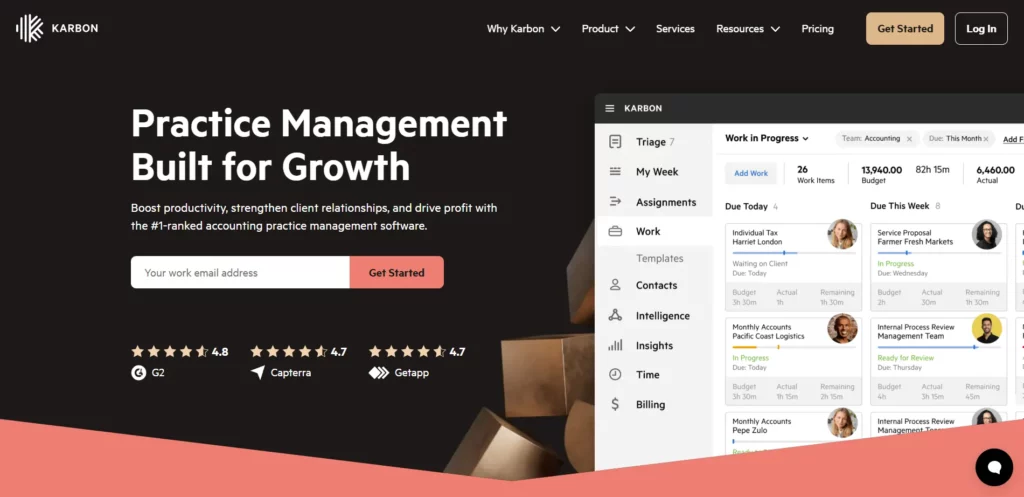
Karbon positions itself as a guide to implementing AI accounting solutions rather than just offering tools. Their approach focuses on identifying the right applications for AI within existing accounting workflows to maximize value while minimizing disruption.
Karbon identifies key areas where AI delivers maximum accounting value:
| AI Application | Task Type | Productivity Impact |
|---|---|---|
| Data Summarization | Information processing | High |
| Organization & Analysis | Pattern recognition | Medium-high |
| Expense Processing | Document extraction | High |
| Reporting & Forecasting | Data visualization | Medium |
| Fraud Detection | Anomaly identification | High |
| Workflow Automation | Process management | Medium-high |
Karbon's strategic guidance helps firms:
Unlike vendors pushing specific products, Karbon provides a vendor-neutral perspective on AI in accounting. This educational approach helps accounting professionals make informed decisions about which AI technologies will truly benefit their specific practice needs and client base.
#9 Febi.ai

Febi.ai introduces itself as “India's first AI-powered bookkeeping” solution, combining automated accounting with dedicated human support. This hybrid approach addresses the unique tax and compliance requirements of Indian businesses while providing the efficiency of AI automation.
Febi.ai's platform features solve specific pain points:
| Feature | Function | Business Benefit |
|---|---|---|
| AI Transaction Management | Automated categorization | Real-time financial accuracy |
| Automated File Management | Document organization | Reduced administrative overhead |
| Automated Tax Filings | GST and TDS preparation | Compliance without complexity |
| Smart Invoicing | Simplified invoice creation | Improved cash flow management |
| Finance Concierge | Dedicated personal accountant | Expert guidance on demand |
Febi.ai uniquely combines:
For Indian entrepreneurs looking to minimize “service dependency,” Febi.ai offers the opportunity to consolidate financial operations without hiring additional staff or juggling multiple software solutions. This integrated approach is particularly valuable for fast-growing businesses that need scalable financial infrastructure without complexity.
#10 ClickUp

ClickUp approaches accounting automation from a workflow perspective, integrating AI capabilities into project management frameworks that support financial processes. This task-oriented approach helps teams coordinate accounting activities alongside other business functions.
ClickUp enhances accounting processes through workflow optimization:
| Feature | Application to Accounting | Efficiency Gain |
|---|---|---|
| AI Task Automation | Recurring accounting processes | Reduced manual scheduling |
| Natural Language Processing | Document analysis and summarization | Faster information extraction |
| Custom Dashboards | Financial KPI tracking | Real-time performance visibility |
| Workflow Templates | Standardized accounting procedures | Consistent process execution |
ClickUp helps accounting teams:
Unlike dedicated accounting software, ClickUp provides the surrounding infrastructure that ensures financial processes integrate seamlessly with other business operations. This makes it particularly valuable for organizations where accounting teams need to collaborate closely with other departments on financial matters like budgeting, expense management, and financial planning.
AI Accounting Tools FAQ: Expert Answers to Your Questions
Can AI Accounting Software handle tax compliance for multiple regions?
Yes. Advanced systems adapt to regional tax laws, automate filings, and flag compliance risks. They update rules dynamically, making them ideal for businesses operating across states or countries.
Are AI Bookkeeping Tools secure for sensitive financial data?
Most platforms use bank-grade encryption and comply with regulations like GDPR. Features like multi-factor authentication and audit trails add layers of protection against breaches.
How much time can small businesses save with AI Accounting?
Businesses report saving 10–15 hours monthly by automating tasks like invoicing, payroll, and report generation. This allows teams to focus on strategic decisions.
What’s the cost difference between Traditional and AI-driven Accounting?
While upfront costs vary, AI tools reduce long-term expenses by minimizing errors and labor. Subscription models often start at $20/month, making them accessible to startups.
Is technical expertise required to use AI Accounting Platforms?
No. Most tools prioritize user-friendly dashboards, automated workflows, and 24/7 chatbots to guide users without accounting or tech backgrounds.
Can AI detect fraudulent transactions in real time?
Absolutely. By analyzing spending patterns and cross-referencing historical data, these tools flag suspicious activity instantly, reducing financial fraud risks.
Recommended Readings:
Why AI Accounting Tools Are a Must-Have for Businesses
Managing finances doesn’t have to be overwhelming anymore. With the Best AI Accounting Tools, businesses can simplify complex tasks like bookkeeping, tax preparation, and financial analysis.
AI-powered accounting solutions not only save time but also improve accuracy, helping you make better financial decisions. The future of accounting is automated, and now is the perfect time to embrace these innovations.
Start exploring how AI-driven accounting systems can transform your financial processes and take your business to the next level. Make smarter choices today for a more efficient tomorrow



 BONUS: Get our $200 “AI Mastery Toolkit” FREE when you sign up!