

Dify AI Key Insights
What is Dify AI?
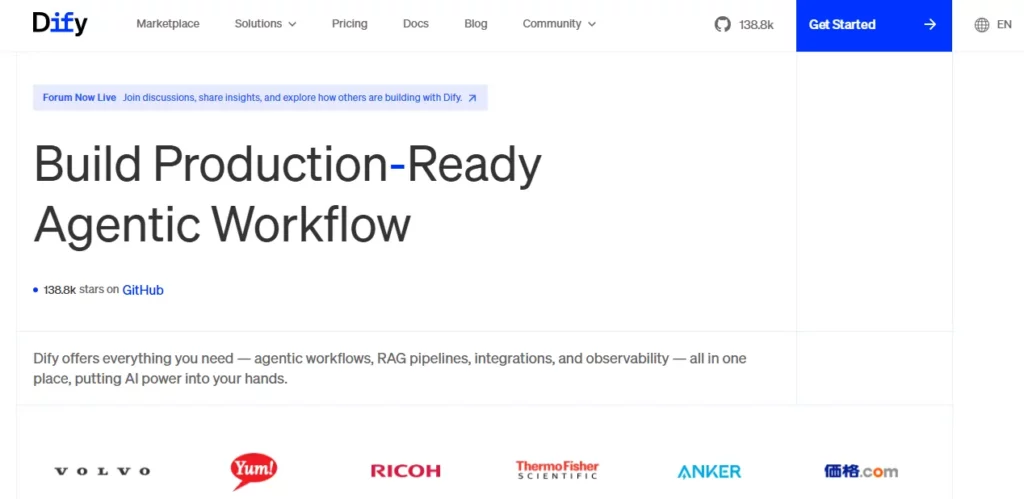
Dify AI is an open source LLMOps platform built by LangGenius that enables teams to develop, deploy, and manage production ready AI applications through a visual, low code interface. It brings together agentic workflow orchestration, retrieval augmented generation (RAG) pipelines, multi model support, and full observability into a single workspace. Businesses use Dify AI to build chatbots, AI agents, text generators, and complex multi step workflows without writing extensive backend code.
The platform supports both cloud hosted and self hosted deployment, giving organisations full control over data residency and security. With over 60,000 GitHub stars, Dify AI has become one of the most popular open source tools for business automation and AI application development, serving everyone from solo developers to Fortune 500 teams.
Dify AI lets you assemble AI applications on a canvas by dragging and connecting nodes for prompts, LLM calls, conditional logic, tools, and retrievers. This removes the need to stitch together scripts manually. Teams can prototype a working agentic workflow in minutes, test it visually, and push it to production from the same interface. The time savings during iteration are significant compared to code only approaches.
The platform ships with a full RAG pipeline that lets you upload documents, websites, and custom data chunks into a knowledge base. Dify AI handles chunking, embedding, and retrieval automatically. You can connect external vector stores like Qdrant or Weaviate for larger scale use cases. This means your AI apps can answer questions grounded in your own proprietary data rather than relying solely on general LLM training.
Dify AI connects to virtually every major LLM provider out of the box, including OpenAI, Anthropic, Azure OpenAI, Llama, Hugging Face, and Replicate. You can switch models mid workflow, compare outputs side by side, and even run load balancing across multiple API keys. This prevents vendor lock-in and lets you optimise for cost, latency, or quality on a per task basis.
Once your workflow or chatbot is ready, Dify AI lets you publish it instantly as a standalone web application or expose it through a REST API. The Backend as a Service layer handles hosting, scaling, and session management. This eliminates weeks of infrastructure work that would normally be required to move from prototype to a live product.
Every run through a Dify AI workflow is fully logged with input/output pairs, token usage, latency metrics, and cost breakdowns. The platform integrates with Langsmith and Langfuse for advanced tracing. Built in annotation tools let human reviewers flag and correct outputs, feeding improvements directly back into the system. This is essential for maintaining quality in production AI applications.
Unlike many SaaS only competitors, Dify AI offers a fully self hosted edition via Docker. Organisations with strict data governance requirements can run the entire stack on their own infrastructure. The Enterprise tier adds SSO, advanced role management, and dedicated support. A SOC Type II compliance report is available for regulated industries.
Dify AI Pricing Plans
| Plan Name | Cost | Key Limits and Features |
|---|---|---|
| Sandbox | $0 | 200 message credits, 1 member, 5 apps, 50MB knowledge storage, 30 day log history |
| Professional | $59/month | 5,000 credits/month, 3 members, 50 apps, 5GB knowledge storage, unlimited log history |
| Team | $159/month | 10,000 credits/month, 50 members, 200 apps, 20GB knowledge storage, priority execution |
| Enterprise | Custom | Custom limits, SSO, dedicated support, advanced compliance |
Dify AI and the RAG Advantage
The RAG pipeline inside Dify AI deserves special attention. Most low code AI builders treat knowledge retrieval as a secondary feature, but Dify AI places it at the centre of its architecture. You can ingest PDFs, web pages, and structured data, then define custom retrieval strategies per application.
The platform also supports agentic RAG, where the AI agent autonomously decides when and how to query the knowledge base during a multi step workflow. This pushes the tool well beyond simple Q&A bots and into genuine business process automation territory.
Pros and Cons
- Fully open source and self hostable.
- Excellent visual workflow builder.
- Strong multi LLM provider support.
- Built in RAG pipeline included.
- Active GitHub community and updates.
- No native built in vector database.
- Cloud credit limits require monitoring.
- Learning curve for complex workflows.
Best Dify AI Alternatives
| LLMOps / Agentic AI Workflow Platform | Open Source Flexibility | Workflow Complexity |
|---|---|---|
| Flowise | Open source, but limited to LangChain patterns | Basic node chains, weaker conditional logic |
| LangFlow | Open source with deep component customisation | Strong visual flows, steeper learning curve |
| n8n | Open source general automation with AI nodes | Excellent for broad automation, less AI native |
| Coze | Closed source, cloud only | Good bot builder, limited self hosting options |