


With legal professionals facing extreme burnout from heavy workloads, many are turning to AI for help. The problem is that the market is saturated with AI legal assistants that are little more than expensive search engines, often delivering inaccurate results that require more work to fix.
We've bypassed the hype and tested dozens of these legal AI tools ourselves. Our review focuses on what truly matters to lawyers and law firms: accurate legal research, fast document analysis, and genuine workflow support, showing you the assistants that actually deliver.
What Are AI Legal Assistants and How Do They Help Lawyers?
AI legal assistants are advanced software applications that use artificial intelligence, natural language processing (NLP), and machine learning to perform or augment legal tasks. These tools are designed to automate repetitive, time-intensive activities, allowing legal professionals to focus on strategic work that requires human judgment. Unlike standard software, these assistants can interpret, analyze, and generate legal content.

AI legal assistants help lawyers and law firms in several key ways:
AI Legal Assistants That Are Reshaping Law Practices
| AI Legal Assistant ⚖️ | Core Function 🔍 | User Focus 🎯 |
|---|---|---|
| AI Lawyer | Legal Research | Solo & Small Firms |
| LexisNexis | Deep Research | Large Firms |
| NexLaw | Contract Review | Contract Lawyers |
| Paxton AI | Unified Platform | Law Firms |
| Law.co | Case Analysis | Litigators |
| Lawdroid | Client Intake | Small Firms |
| Legora | Team Collaboration | Legal Teams |
1. AI Lawyer Pro
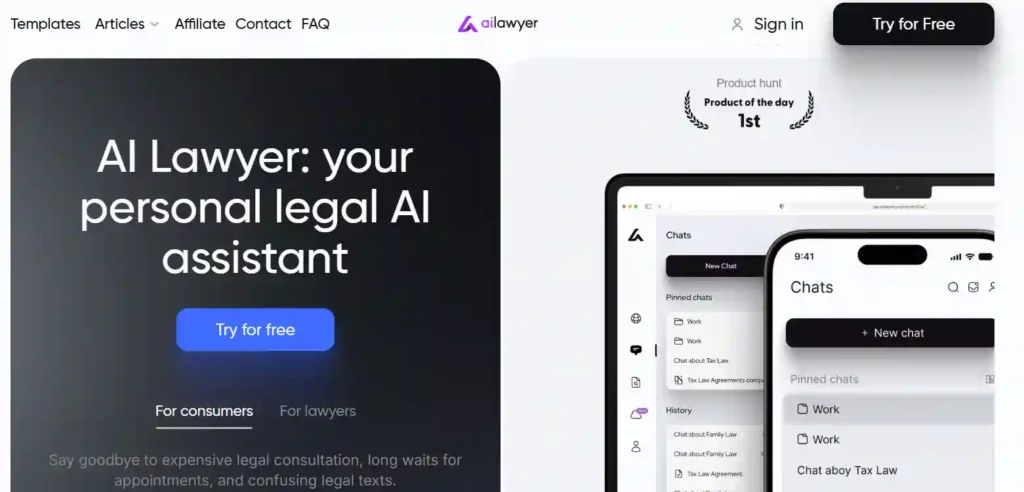
AI Lawyer Pro serves as a comprehensive AI legal assistant designed to enhance productivity for modern legal professionals. It integrates a powerful suite of tools for tasks ranging from automated document drafting and legal research to case management and client communication, aiming to centralize a law firm's core operational needs.
This platform is engineered for lawyers who need a multi-functional tool to handle diverse legal work without switching between different software. It simplifies complex processes, allowing practitioners to focus on high-value analysis and client strategy.
Pros and Cons of AI Lawyer Pro
Pricing
AI Lawyer Pro offers several plans, including a Pro plan at approximately $49 per month for individuals and a Team plan designed for collaboration.
Best for:
Solo practitioners and small law firms seeking an affordable, all-in-one legal AI tool to manage a wide variety of tasks efficiently.
2. Lexis+ AI
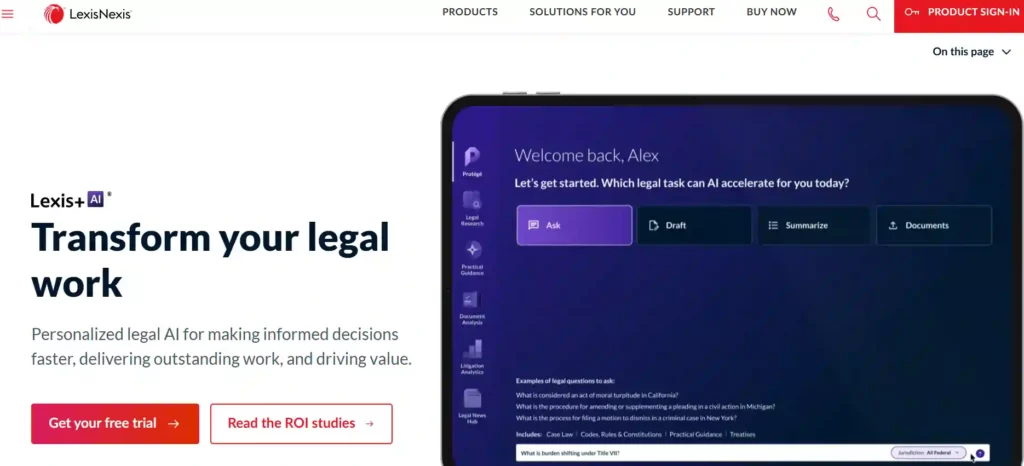
Lexis+ AI is an enterprise-grade legal research AI built upon LexisNexis's authoritative and extensive database of legal content. This assistant uses conversational search to allow lawyers to ask complex legal questions in natural language, receiving trustworthy and cited answers.
Its core strength lies in its generative AI capabilities, which are grounded exclusively in verified legal documents to prevent AI “hallucination” and ensure accuracy. This makes it an indispensable tool for in-house counsel and large law firms where precision is critical.
Pros and Cons of Lexis+ AI
Pricing
Pricing for Lexis+ AI is available upon request through a consultation or demo, as it is tailored to the needs of the firm or organization.
Best for:
Large law firms and corporate legal departments that require a highly accurate and secure AI for lawyers for complex research and drafting.
3. NexLaw
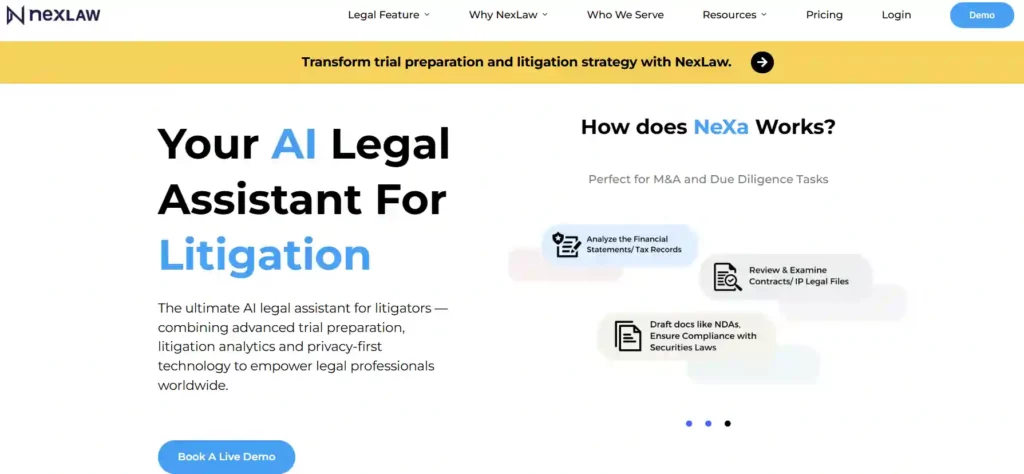
NexLaw functions as an intuitive AI-powered legal assistant, positioning itself as a “co-pilot” for legal professionals. The platform specializes in streamlining legal workflows by accelerating tasks like legal research, document summarization, and data extraction.
It is designed for lawyers who want to integrate AI seamlessly into their daily work to improve efficiency. NexLaw's focus on a clean user experience helps reduce the learning curve, making advanced legal AI software more accessible for mid-size firms.
Pros and Cons of NexLaw
Pricing
NexLaw's pricing is offered in tiers, typically starting with a basic plan and scaling to custom enterprise solutions, with costs available after a demo.
Best for:
Tech-savvy lawyers and mid-size firms looking for an efficient AI legal assistant to enhance their daily research and drafting workflows.
4. Paxton AI

Paxton AI distinguishes itself by focusing on verifiable accuracy in legal AI research. The platform cross-references its generated answers against a trusted database of legal sources, allowing lawyers to audit the AI's findings and ensure reliability.
This feature is critical for in-house counsel and compliance teams who cannot afford factual errors. Paxton AI also allows firms to securely upload their own documents, enabling the AI to answer questions based on internal information while maintaining strict data privacy.
Pros and Cons of Paxton AI
Pricing
Paxton AI provides custom pricing based on the size and needs of the legal team, which is determined after a consultation with their sales team.
Best for:
Corporate legal departments and compliance-focused firms that need a verifiable and secure AI legal research tool for high-stakes work.
5. Law.co

Law.co aims to be a comprehensive legal operating system with a powerful legal AI tool at its core. It is built to serve as a centralized hub for law firms, integrating case management, document analysis, and legal research into one platform.
The platform is designed for the modern law firm seeking to modernize its entire operation. Its AI capabilities are embedded throughout the system to assist with everything from analyzing briefs to summarizing deposition transcripts, making it a robust legal workflow automation solution.
Pros and Cons of Law.co
Pricing
Law.co has a waitlist for access, and specific pricing information is provided to users upon being granted entry to the platform.
Best for:
Progressive law firms and litigation teams seeking an all-in-one platform where AI is deeply integrated into every aspect of case management.
6. LawDroid

LawDroid specializes in legal workflow automation, focusing on client intake and routine communication tasks. This AI legal assistant helps law firms build custom chatbots and automated systems to qualify leads, schedule consultations, and answer common client questions.
By automating these front-end administrative processes, LawDroid frees up lawyers and staff to concentrate on billable work. It is an ideal solution for firms looking to improve business efficiency and enhance the client experience from the very first interaction.
Pros and Cons of LawDroid
Pricing
LawDroid offers tiered pricing, with plans typically starting around $97 per month for the basic “Solo” plan, scaling up for larger firms.
Best for:
Small to mid-size law firms that want to automate their client intake process and improve overall business operations and efficiency.
7. Legora

Legora is a specialized AI legal assistant built specifically for litigators. The platform excels at AI litigation support, helping trial lawyers search and organize evidence, analyze deposition transcripts, and collaborate with their teams on case strategy.
Its AI-powered search allows lawyers to instantly find key facts, testimony, and evidence across massive case files. Legora is designed to give litigation teams a strategic advantage by making case information more accessible and organized from discovery through to trial.
Pros and Cons of Legora
Pricing
Pricing for Legora is customized for each firm and is available by scheduling a demo to assess the team's specific litigation support needs.
Best for:
Litigation-focused law firms and trial attorneys who need a powerful AI litigation support tool to manage evidence and prepare for court.
Essential Features to Evaluate in Your Next AI Legal Assistant
When selecting an AI legal assistant, legal professionals should evaluate a specific set of technical features to ensure the tool meets their firm's needs for accuracy, security, and efficiency.

- Natural Language Processing (NLP) This is a fundamental feature that allows the AI to understand and interpret human language within legal documents, contracts, and user queries. Strong NLP capabilities ensure the assistant can accurately extract relevant information and respond to specific questions.
- Document and Contract Automation A key function is the ability to automate the creation of legal documents using customizable templates. The tool should be able to analyze contracts to identify risks, suggest clauses based on context, and check for missing or non-compliant terms.
- Legal Research and Analysis The assistant must have an advanced search function that can scan case law, statutes, and regulations to find relevant information quickly. The best tools can also analyze legal arguments and identify precedents that support a case strategy.
- Predictive Analytics This feature uses machine learning to analyze historical legal data and provide data-driven insights. It can help in assessing case risks, forecasting potential outcomes, and informing litigation strategy.
- Security, Compliance, and Confidentiality Since legal work involves sensitive information, the AI tool must have robust security measures. This includes end-to-end encryption, data storage that complies with jurisdictional regulations, clear audit logs, and role-based access controls to protect client data.
- Integration Capabilities The software should be able to integrate with a law firm's existing case management systems and other software. This ensures a smooth workflow and allows the AI to fit into established processes without disruption.
AiMojo Recommends:
Finding the Best AI Legal Assistant for Your Practice
Choosing the right AI legal assistant is a critical move for any modern law firm. The best tools handle demanding tasks like legal research and document analysis, freeing up your time for strategic work.
While some assistants are better for litigation and others for contracts, finding one that fits your workflow is key. Ultimately, the right AI is a reliable partner that helps reduce burnout and deliver better client outcomes.


 BONUS: Get our $200 “AI Mastery Toolkit” FREE when you sign up!