


The Angle. AI can help catch corruption, but not the way the headlines suggest. The tools with independently verified results are unglamorous: open procurement data and statistical red flags that watch contracts and officials in public. The systems that caused real harm judged ordinary citizens in secret. Point the algorithm up, not down, and show your working.
The Trick
On 11 September 2025, Albania's prime minister Edi Rama introduced a new member of his cabinet: Diella, an AI-generated avatar that began life as a chatbot on the e-Albania services portal, put in charge of public procurement. Tenders, he promised, would become fully incorruptible. Headlines around the world called it the first AI minister.
Here is the reveal. More than a year later, I could find no public record of Diella deciding a single tender. In October 2026, Albania's Constitutional Court rejected a challenge from 39 opposition MPs on grounds of standing, adding that AI cannot alter the constitutional order. Meanwhile, the old-fashioned kind of accountability was busy: a deputy prime minister had been indicted over a roughly €190 million road tunnel tender, according to the investigative network OCCRP.
The avatar is the trick. The real anti-corruption AI is boring: data published in the open, statistical red flags anyone can check, and auditors with the power to act on them. To separate the two, I scored 27 real deployments, from Brazil to the Netherlands to India, on three questions. Is there independent evidence it worked? Can outsiders see how it works? Did it hurt innocent people?
Mojo's Law: the wrongful flag equation
Every fraud-detection system makes two kinds of mistake: it misses some cheats and it accuses some innocent people. When the thing being hunted is rare, the second mistake dominates. Here is the arithmetic every minister should see before launch:
\text{Innocent people flagged} = N \times (1 - p) \times \text{FPR}N is the number of people screened, p is the share who are actually cheating, and FPR is the false-positive rate: how often the system wrongly flags an honest person.
Try round numbers (illustrative only). Screen 1 million benefit claimants, suppose 1% are committing fraud, and give the system a 5% false-positive rate. It wrongly flags about 49,500 honest people, while there are at most 10,000 real cheats to find. Unless every flag is checked by a human before anyone is punished, the system becomes a machine for accusing the innocent. That is exactly what happened in Michigan, where an audit found 85% of computer-decided fraud findings were wrong.
The second law here is Campbell's law, from the social scientist Donald Campbell in 1976: the more a number is used to make social decisions, the more it invites corruption and distorts the thing it measures. Any anti-corruption metric will be gamed by exactly the people it is meant to catch. Good systems assume that from day one.
How big is the corruption problem, really?
Big enough to matter, and harder to measure than most articles admit.
122 of the 182 countries scored below 50, and only five scored above 80, led by Denmark on 89.
Public procurement is where the money is. The World Bank's Bosio and Djankov estimated government purchasing at about $11 trillion in 2018, about 12% of world GDP; the Open Contracting Partnership puts it at about $13 trillion a year. A 2024 World Bank study of North Macedonia found corruption-related overpricing worth 5 to 6% of procurement spending, with close to 30% of tenders attracting a single bidder.
Now a number Mojo refuses to repeat without a warning label: the famous claim that bribes cost the world $1.5 to $2 trillion a year. It appeared in a 2016 IMF note, extrapolated from a 2005 World Bank estimate by Daniel Kaufmann that rested on bribery surveys and heavy assumptions.
The anti-corruption scholar Matthew Stephenson has written that we have no real idea how much corruption costs. An honest series about evidence should say so, and then measure what can actually be measured: overpricing, single bidding, recoveries and wrongful accusations.
Where have data and AI actually caught corruption?
The verified wins are fewer than the press releases, and the best of them are about openness, not cleverness.
Ukraine's ProZorro. Launched in 2015 after the Maidan protests and mandatory since 2016, ProZorro put public tenders online, with a civic monitoring platform, DoZorro, layered on top. It is mostly open data rather than AI, and that is the point.
An independent evaluation by the Kyiv School of Economics in December 2022 found real savings of 1 to 20% against purchases made outside the system, depending on the market. DoZorro's 2018 machine-learning model, trained on about 3,500 expert-labelled tenders, reportedly flagged far more suspected collusion than manual review, but those results come from its developers.
Brazil's robots. In 2016 a group of data scientists built Rosie, an open-source bot that scanned more than 3 million expense receipts from members of Congress and flagged about 8,000 suspect claims. The first 125 cases reviewed recovered only about R$2,500; Rosie's real power was public pressure.
The federal comptroller's Alice system checks tenders daily against about 40 risk patterns; the government says it led to R$9.7 billion of bids being suspended or cancelled in 2019 to 2022, a figure no one has independently audited.
Red flags that predict. Academic work led by Mihály Fazekas built a Corruption Risk Index from public procurement data in Hungary. Firms that scored high were more profitable, more politically connected and more often registered in tax havens. Not every red flag holds up, though: a 2023 study of 145,000 Italian contracts found some popular indicators had weak validity. Red flags mark risk, not guilt.
Tax and payments. India's central GST authorities reported detecting ₹74,782 crore of fake input-tax-credit fraud in 2025-26, double the figure two years earlier, crediting advanced data analytics and risk profiling.
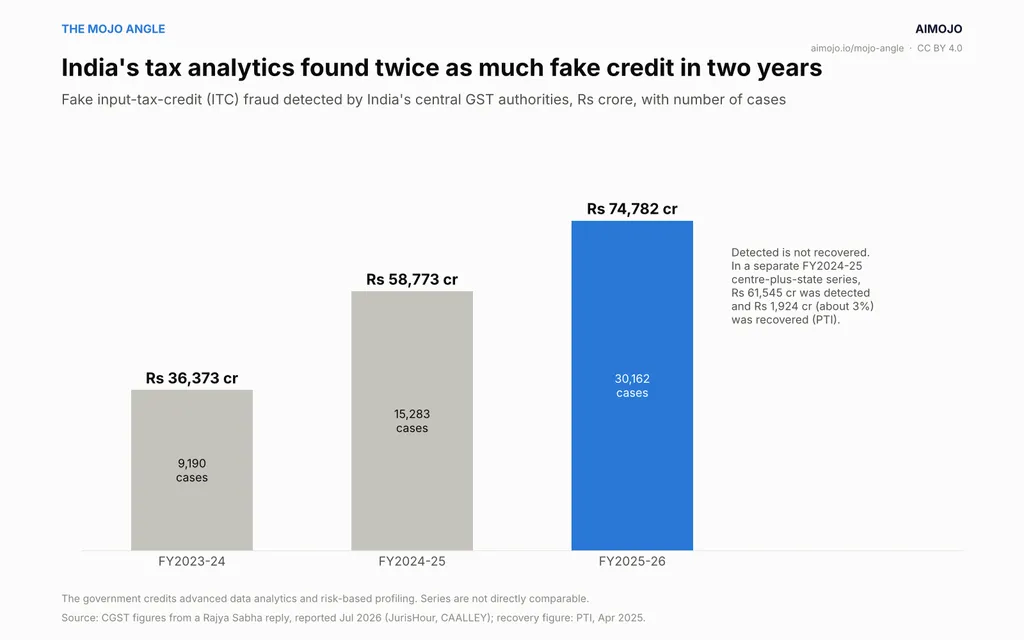
Source: Rajya Sabha reply, reported July 2026. Detected is not recovered.
Detection is not recovery, though. In a separate 2024-25 series covering central and state officers, ₹61,545 crore of fake credit was detected and ₹1,924 crore, about 3%, was recovered, according to PTI.
The UK's tax authority credits AI and analytics with about £10 billion of its 2025-26 compliance yield, and a freedom-of-information release attributed £4.6 billion of recoveries to its Connect data system. The US Treasury reported more than $4 billion of fraud prevented or recovered in fiscal 2024, but only about $1 billion of that came from machine learning; the rest came from better risk screening and payment rules.
The modest truth from Korea. South Korea built one of the world's most admired e-procurement systems and, since 2006, an automated bid-rigging indicator system. In a June 2026 submission to the OECD, its competition authority reported that the system had produced just 10 bid-rigging cases in eight years, and announced an upgrade. Even good systems catch less than you would think.
Where did algorithmic government go wrong?
The failures share three features: they targeted individuals, they were opaque, and they treated a computer's suspicion as proof. Several were simple rules or data-matching rather than AI, which is a warning in itself: you do not need a neural network to do damage at scale.
The Netherlands, childcare benefits. A self-learning risk model introduced by the Dutch tax administration in 2013 used non-Dutch nationality as a risk factor, according to Amnesty International. About 26,000 parents were wrongly accused of fraud between 2005 and 2019, and the government resigned in January 2021.
The Dutch data protection authority fined the tax administration €2.75 million. By January 2024, 33,335 people had been recognised as victims, and in September 2026 more than 4,000 were still waiting for support.
The Netherlands, SyRI. In February 2020, a Dutch court ruled that SyRI, a system linking government databases to predict welfare fraud, breached the right to privacy under Article 8 of the European Convention on Human Rights because it was insufficiently transparent and verifiable.
Australia, Robodebt. From 2016 to 2020, an automated data-matching scheme averaged annual income to calculate welfare overpayments, issuing about 470,000 wrongful debts. A Royal Commission in July 2023 called it crude and cruel. The government agreed a A$1.872 billion settlement in 2021 and announced a further A$475 million in September 2025.
Michigan, MiDAS. Between 2013 and 2015, Michigan's unemployment system decided fraud cases with no human involved. A review found 85% of those 40,195 findings were wrong.
England, 2020 exam grades. When exams were cancelled during the pandemic, a statistical model lowered 39.1% of A-level grades in England, about 280,000 results, hitting state-school students hardest, until the government reversed course.
Facial recognition. A 2019 NIST study of 189 algorithms found false-positive rates for Asian and African American faces were often 10 to 100 times higher than for white faces, depending on the algorithm. The Innocence Project counted six known wrongful accusations from police facial recognition in the US by 2023, all of Black people. After Detroit settled a wrongful-arrest case in 2024 and agreed new safeguards, its police searches fell from about 100 in 2023 to 9 in 2025.
Denmark, still disputed. Amnesty argued in November 2024 that some of the up to 60 fraud models used by Denmark's welfare agency may amount to social scoring banned under the EU AI Act. The agency disputes that. It is a live test of the new rules.
The Mojo Integrity Index: what separates the wins from the scandals?
Who the system watches. I scored each of the 27 deployments from 0 to 2 on three things: independent evidence of results, transparency to outsiders, and absence of documented harm. Then I sorted them by their target.
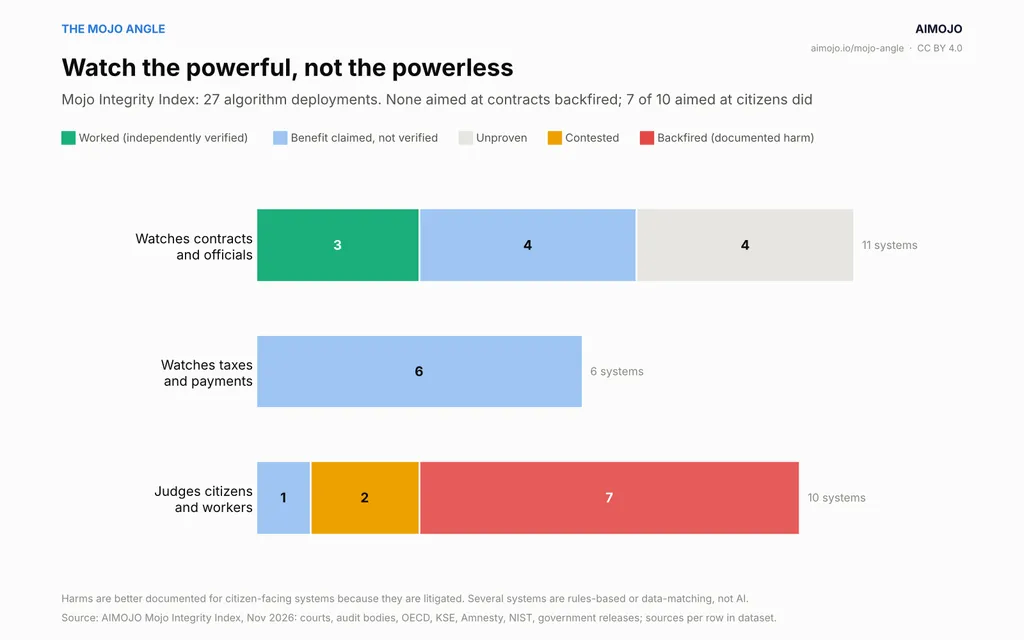
The pattern is stark. Of the 11 systems aimed at contracts and officials, none backfired and three have independently verified benefits. All six aimed at taxes and payments claim benefits that nobody outside government has audited. Of the 10 aimed at citizens and workers, seven caused documented harm. The average Integrity score was 3.9 out of 6 for systems watching contracts and officials, against 2.3 for those judging citizens and workers.
There is an honest caveat: harms to citizens get litigated and documented, while the costs of a contract-monitoring system are harder to see. But the mechanism behind the pattern is plain. Watching a contract or an official's spending in public creates accountability for the powerful. Scoring welfare claimants or drivers in private creates power over the weak, and the wrongful flag equation guarantees innocent people will be caught in the net.
What about catching negligence? The same logic applies to AI that watches workers or the public. Kerala's network of more than 700 AI traffic cameras, costing ₹232 crore, had caught about 98 lakh offences and levied ₹631 crore in fines by April 2025, though early glitches included a reading of 1,240 km/h.
The state's transport minister says road deaths fell from 4,084 in 2023 to 3,733 in 2025; no causal study has tested that claim. In US warehouses, a December 2024 Senate committee majority report found Amazon's injury rate was 6.54 per 100 workers in 2023, against 4.8 across the warehouse industry, and linked it to speed quotas set and monitored by algorithms. Amazon disputes the report.
The EU's Platform Work Directive, in force since December 2024, now bans platforms from processing workers' emotional states and private conversations, and requires human review of significant automated decisions. That is a sensible template: let AI flag the hazard, never let it be the judge.
Who governs the algorithms?
The world's big regulators are moving in different directions, and the most relevant rules for welfare and benefits scoring have just been pushed back in Europe.
| Jurisdiction | What is in force, November 2026 | Most recent change |
|---|---|---|
| European Union | AI Act in force since August 2024; bans since February 2025; general-purpose AI duties since August 2025 | Digital Omnibus, in force 27 July 2026, moved high-risk duties for areas such as welfare scoring from August 2026 to 2 December 2027 |
| United States | AI Action Plan (July 2025) with more than 90 federal actions; no comprehensive federal AI law | Executive order of 11 December 2025 seeking a national framework and challenging “onerous” state AI laws, with a Justice Department task force set up in January 2026 |
| China | Rules requiring visible and hidden labels on AI-generated content, in force since 1 September 2025 | Labelling enforcement |
| India | No binding AI law; IT Rules on labelling synthetic content in force since 20 February 2026 | Hosted the AI Impact Summit in New Delhi, February 2026 |
| United Nations | Independent International Scientific Panel on AI appointed February 2026 | First Global Dialogue on AI Governance held in Geneva, July 2026, with 163 countries |
Supporters of Europe's delay say it gives businesses time to comply with complex rules; critics, including civil-society groups, argue it leaves high-risk public-sector systems unregulated for longer.
Supporters of the US executive order say a patchwork of state laws would hobble innovation; critics, including some state officials, say it overrides democratic choices and weakens protections. Both debates turn on the same question this piece keeps returning to: who checks the system before it touches a citizen?
The public is cautious. A KPMG and University of Melbourne survey of more than 48,000 people in 47 countries, published in May 2025, found 46% willing to trust AI and 70% saying regulation is needed, while 66% said they rely on AI output without checking it.
Stanford's AI Index counted 204 AI-related laws passed across 114 countries between 2016 and 2024. The rules are multiplying. Whether they arrive before the next Robodebt is the real race.
Claim Check
| Claim | Who makes it | MES | Mojo's read |
|---|---|---|---|
| An AI minister will make tenders incorruptible | Albanian government, 2025 | 1 Claim | No public record of any tender decided by Diella |
| E-procurement saves governments money | Ukraine's ProZorro | 4 Strong | Independent evaluation found 1 to 20% savings, varying by market |
| AI found R$9.7bn of suspect bids | Brazil's comptroller | 2 Early | Government's own figure; suspended bids are not proven fraud |
| Analytics caught record tax fraud | India, UK, US tax agencies | 2 Early | Detection figures are agency-reported; recovery is often a small fraction |
| Procurement red flags predict corruption | Academic research | 4 Strong | Peer-reviewed links to political connections and overpricing; some flags are weak |
| Automated fraud detection protects public money | Many welfare agencies | 0 Didn't hold up | Robodebt, MiDAS and the Dutch scandal caused mass wrongful accusations |
| Bribery costs the world $1.5 to 2 trillion a year | Widely repeated, from a 2016 IMF note | 1 Claim | Rests on a 2005 extrapolation; scholars say the true figure is unknown |
| AI traffic cameras cut road deaths | Kerala government | 2 Early | Deaths fell, but no study links the fall to the cameras |
The Counter-Angle
The strongest objection is that I am comparing apples with oranges. Welfare and policing systems touch millions of individuals, so their errors are inevitably visible and personal. Procurement monitoring touches a few thousand firms and officials, who have lawyers but no sympathy, so its mistakes rarely make headlines.
On this view, my index measures who complains, not which systems are better.
There is something to that, which is why the index reports evidence, transparency and harm separately rather than one magic number. But the court rulings, royal commissions and audits behind the seven failures are not complaints; they are findings.
And the cases the objection cannot explain are the ones that matter most: when the same governments applied algorithms to their own contracts in the open, they did not end up apologising to tens of thousands of families.
The Human Bit
Mojo's Forecasts
- Albania publishes a verifiable record of at least one public tender decided or scored by Diella by 31 December 2027. Probability: 40%.
- The EU's high-risk obligations for Annex III systems start applying on 2 December 2027 without a further postponement. Probability: 60%.
- India's central GST authorities report fake input-tax-credit detections for 2026-27 above the ₹74,782 crore of 2025-26, by 31 December 2027. Probability: 70%.
All three are logged in the Mojo Forecast Ledger.
Where this is debated next
FAQ
Can AI detect corruption?
It can flag risk, especially in public procurement data, and some systems have independently verified results, such as Ukraine's ProZorro. It cannot prove guilt, and flags need human investigation.
What is Albania's AI minister?
Diella is an AI-generated avatar that Albania's government appointed to oversee public procurement in September 2025. As of November 2026, there was no public record of it deciding a tender.
What went wrong in the Dutch childcare benefits scandal?
A risk model used by the tax administration factored in nationality, and about 26,000 parents were wrongly accused of fraud. The government resigned in January 2021.
What was Robodebt?
An Australian automated debt-recovery scheme that issued about 470,000 wrongful welfare debts between 2016 and 2020. A Royal Commission condemned it in 2023.
Is the EU AI Act in force?
Yes, since August 2024, with bans applying from February 2025. In July 2026 the Digital Omnibus delayed most high-risk obligations, including for welfare scoring, to December 2027.
What is the Mojo Integrity Index?
An AIMOJO dataset scoring 27 government and workplace algorithm deployments on independent evidence, transparency and harm, from 0 to 6.
- bne IntelliNews, Albania names AI-generated minister (Sep 2025) and Albanian Daily News, court ruling (Oct 2026)
- OCCRP, Albania corruption case (Feb 2026)
- Transparency International, CPI 2025 (Feb 2026)
- Bosio and Djankov, World Bank, How large is public procurement? (Feb 2020) and Open Contracting Partnership
- World Bank PRWP 11007, North Macedonia procurement (Dec 2024)
- Global Anticorruption Blog, The persistence of phony statistics (Oct 2018)
- KSE Institute, The ProZorro impact (Dec 2022) and TI Ukraine on DoZorro AI (Nov 2018)
- Operation Serenata de Amor and Gazeta do Povo on Rosie's results (Jan 2017)
- OECD OPSI, Robot Alice (Jun 2024)
- Fazekas, Tóth and King, An objective corruption risk index (2016) and red-flag validity study (2023)
- India CGST fake-ITC detections: JurisHour and CAALLEY (Jul 2026); PTI via Taxonation on recoveries (Apr 2025)
- Azets on HMRC Connect (Oct 2025) and Pinsent Masons on HMRC's annual report (Jul 2026)
- US Treasury, fraud prevention and recovery FY2024 (Oct 2024)
- OECD, Korea submission on bid-rigging detection (Jun 2026)
- Amnesty International, Xenophobic machines (Oct 2021); Dutch DPA fine; DutchNews on recognised victims (Jan 2024); IamExpat on victims still waiting (Sep 2026)
- NIST face recognition demographic study (Dec 2019); Innocence Project (Sep 2023); ACLU, Williams v Detroit
- Amnesty International, Coded Injustice (Denmark) (Nov 2024)
- South First on Kerala AI cameras (Jun 2023), CPPR (Apr 2025) and Onmanorama (Jun 2026)
- CAC, AI-generated content labelling measures (Mar 2025)
- UN Global Dialogue on AI Governance
- KPMG and University of Melbourne, Trust in AI (May 2025)
- Stanford AI Index 2025, policy chapter
The best anti-corruption algorithm is a spreadsheet anyone can open. The worst is a score nobody can see.


 BONUS: Get our $200 “AI Mastery Toolkit” FREE when you sign up!