

Copyleaks Key Insights
Copyleaks is more than a basic AI detector. Its strongest advantage is bringing AI text screening and plagiarism analysis into one review process, with additional tools for images, source code and organizational content checks.
What Is Copyleaks and Who Should Use It?
Copyleaks is an AI-powered content integrity platform that detects machine-generated writing, identifies plagiarism and checks the originality of digital content.
It serves educational institutions, publishers, enterprises and developers who need evidence about where content might have originated.
From an SEO editor's standpoint, I find its combined detection approach more useful than an isolated AI percentage. A plagiarism match can identify an existing source, while an AI classification only estimates authorship.
That distinction matters when reviewing freelance submissions, academic writing or large batches of website content.
Copyleaks also offers features for identifying synthetic images, manipulated videos and reused code. However, these products do not all share the same subscription access.
How Copyleaks AI Detection Analyzes Written Content

Copyleaks examines linguistic patterns to estimate whether text was produced by a human or a language model.
Its detection technology covers major model families, including ChatGPT, Claude, Gemini and DeepSeek.
AI Logic Explains Why Text Gets Flagged
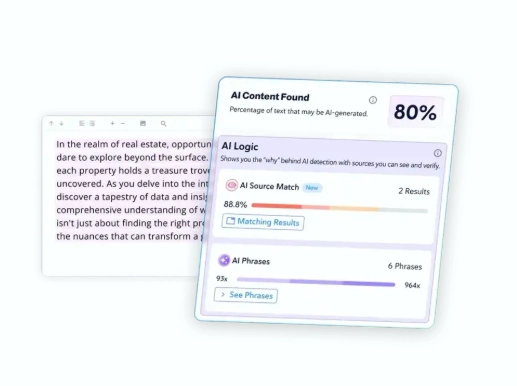
Instead of relying entirely on a percentage, AI Logic provides additional information about suspicious passages.
Its analysis includes AI-associated phrases, statistical writing patterns and matches against AI-generated content already published elsewhere.
This is useful when a document combines original reporting with machine-generated summaries.
AI text detection supports 30 languages, while detailed AI Logic explanations currently support English, Spanish, French, Portuguese, German and Italian.
How Accurate Is the AI Detector?
Copyleaks reports a 0.30% false-positive rate for its V11 model using the default Balanced sensitivity setting in its own evaluation.
Its Extra Safe setting reported 0.16% false positives, while Extra Sensitive reported 0.66%.
These figures reflect the company's controlled testing conditions, not guaranteed results for every document.
I would never treat an AI score alone as proof that someone used ChatGPT. Technical descriptions, short passages and heavily edited writing deserve additional human review.
Copyleaks Plagiarism Checker Finds More Than Exact Matches

The plagiarism checker compares submitted material against web pages, academic publications and available document collections.
It identifies direct text duplication and paraphrased passages that preserve the meaning of existing content.
The result helps reviewers identify potentially reused material and examine its source.
Cross-Language Detection for Translated Content
A particularly useful capability is translated plagiarism detection.
For example, a writer might translate an existing article into another language rather than copy its original wording.
Copyleaks offers cross-language plagiarism detection on Pro, allowing reviewers to investigate this type of reuse.
It is especially relevant for multilingual publishers, research organizations and international content teams.
AI Image and Code Verification
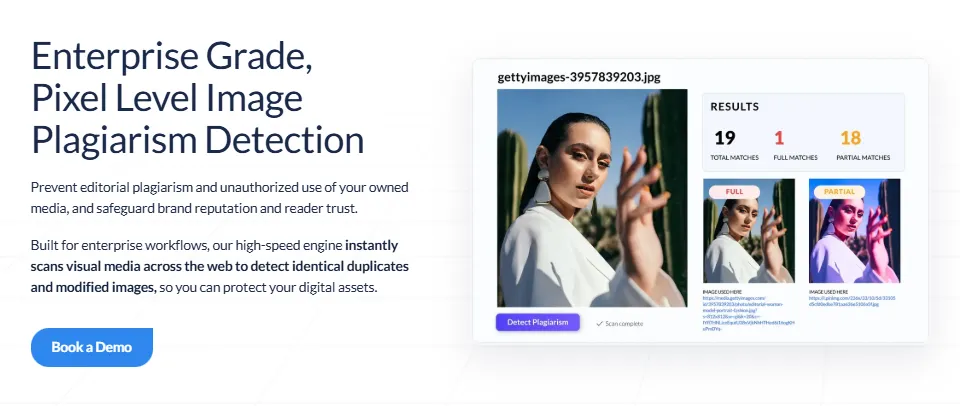
The AI Image Detector examines visual signals associated with synthetic generation and AI editing. Its reports can highlight areas of an image that appear manipulated.
Source code plagiarism checking is a separate capability that identifies matching or modified code across supported sources.
An important distinction: detecting copied code is not the same as detecting AI-written code. The AI text detector does not provide AI authorship detection for source code files.
How to Use Copyleaks for Content Quality Control
I recommend treating the software as a review checkpoint, not an automatic publishing decision.
For an editorial workflow, the practical process is straightforward:
- Open the scanning dashboard and select the text or document scanning option.
- Paste the article or upload a supported document.
- Run the combined AI and plagiarism check.
- Examine highlighted passages, matched sources and AI Logic explanations.
- Check suspicious sections against original drafts and supporting references.
- Record the findings before approving or requesting revisions.
Editorial Workflow for SEO Agencies
For a content agency handling dozens of articles, my preferred setup would be to scan after the first editorial revision and before publication.
This avoids spending credits on every incomplete draft.
The plagiarism report can identify borrowed material, while the AI detection report helps investigate writing that may require closer review.
A Practical Rule for Reviewing False Positives
When a passage is flagged, I would first examine the writer's draft history, supporting research and the actual sentence.
I would not rewrite useful content simply to lower an AI score.
Search performance depends on content quality and usefulness, not on achieving a particular third-party detector score.
Industry Applications for Content Authenticity Verification
Different industries need different evidence. An academic institution may focus on student submissions, while a software team may need source code comparisons.
| Industry | Relevant Capability | Practical Application |
|---|---|---|
| Education | LMS integration and AI Logic | Review student submissions with contextual evidence |
| SEO Agencies | WordPress scanning | Check contractor articles before publication |
| Academic Research | Academic source matching | Investigate similarity and questionable citations |
| Digital Publishing | AI text and image detection | Screen contributor articles and visual assets |
| Software Development | Code plagiarism API | Identify reused code and possible licensing issues |
| E-commerce | Plagiarism comparison | Review supplier descriptions and catalog duplication |
| Enterprise Compliance | Private document collections | Identify reuse within organizational records |
One capability I particularly value for publishing operations is website scanning through a sitemap.
Available on Pro, it allows teams to inspect multiple pages without manually submitting every article.
For an established content website, this can simplify originality audits across older and newer pages.
Copyleaks Pricing and Credit Limits
Copyleaks offers Personal and Pro subscriptions alongside custom Education and Enterprise plans.
| Plan | Price | Included Credits |
|---|---|---|
| Personal Monthly | $16.99/mo | 100 per billing cycle |
| Personal Annual | $13.99/mo, $167.88 billed yearly | 1,200 for the annual term |
| Pro Monthly | $99.99/mo | 1,000 per billing cycle |
| Pro Annual | $74.99/mo, $899.88 billed yearly | 12,000 for the annual term |
| Education | Custom quote | Institution-based |
| Enterprise | Custom quote | Usage-based |
One credit covers up to 250 words or one image.
For example, the Personal monthly subscription supports up to 25,000 words or 100 images when credits are used exclusively for one type of scan.
Pro adds 25 user seats, advanced filtering, sitemap scanning, analytics and cross-language plagiarism detection.
The annual options offer lower effective rates, while additional credits can be purchased if needed.
My pricing assessment: Personal is suitable for individual editorial checks. Pro makes more sense when multiple reviewers, website-wide scans or advanced controls justify the higher cost.
Copyleaks Integrations for Publishing and Education
Copyleaks supports browser extensions, Google Docs, WordPress, learning management systems and developer APIs.
These integrations matter because requiring editors to copy every document into another platform can slow routine reviews.
WordPress Content Scanning
The WordPress plugin supports automatic scanning when posts reach a configured status, including Pending Review or Published.
Administrators can also use manual scanning to control credit consumption.
Its Scan Center provides centralized access to results and settings, making it useful for managing multi-author websites.
API Integration for Enterprise Applications
The REST API supports custom scanning workflows, including document submission, result retrieval and asynchronous webhook notifications.
For development teams, an important implementation detail is assigning a unique scan ID and handling the completed webhook before processing scan results.
Copyleaks also provides SDKs for languages including Python, JavaScript, Java, PHP and C#.
Business users handling sensitive material can explore private cloud, regional hosting and organizational access controls. Copyleaks also publishes SOC 2 and SOC 3 security credentials.
Copyleaks Pros and Cons
The main benefits concern detection coverage and integration flexibility, while limitations relate to pricing and the interpretation of results.
- Combines AI detection and plagiarism checking.
- Identifies direct copying and paraphrased content.
- AI Logic provides explanations beyond an overall score.
- Supports AI image detection.
- WordPress, Google Docs and LMS integrations.
- Advanced capabilities for enterprise and developer workflows.
- No unlimited permanent free plan.
- AI detection can produce false positives.
- Advanced website scanning requires Pro.
- AI Logic explanations cover fewer languages than basic detection.
- Specialized video and image plagiarism APIs are separate products.
What Actual Copyleaks Customers Say
Copyleaks publishes customer testimonials from educational institutions, publishing organizations and software users.
Lowell Christensen, CEO of SafeSearchKids, explains that he uses Copyleaks to verify the authenticity of content submitted to his website.
Daniel A. Arnold of Oakland University describes Copyleaks support as “fast and effective,” highlighting the company's responsiveness to customer issues.
These testimonials illustrate editorial verification and customer support use cases, although they do not establish detection accuracy independently.
Copyleaks Alternatives Worth Comparing
For content teams considering alternatives, GPTZero, Originality.ai and Winston AI are relevant competitors.
| AI-generated content detection, plagiarism checking and content authenticity verification | Primary Strength | Best For | Key Difference |
|---|---|---|---|
| Copyleaks | AI, plagiarism and multimedia verification | Institutions and publishing teams | Broad detection products and integrations |
| Originality.ai | AI detection, plagiarism and site audits | SEO publishers and content agencies | Strong editorial and website content focus |
| GPTZero | AI detection and authorship evidence | Teachers and students | Writing-history and authorship tools |
| Winston AI | AI detection, plagiarism and OCR | Editors and educators | Document-focused scanning and OCR support |
For SEO agencies, Originality.ai is worth comparing against Copyleaks Pro because both address website content review.
For educators investigating how a document was created, GPTZero's writing-history features may be particularly relevant.
Copyleaks FAQs
Here are the most common questions about detection accuracy, subscriptions and content checking.
Is Copyleaks free to use?
Yes, new users receive limited free credits for AI and plagiarism checks. Continued scanning beyond the free allowance requires purchased access.
Can Copyleaks detect ChatGPT and Claude?
Yes. Copyleaks detects text patterns associated with ChatGPT, Claude, Gemini, DeepSeek and other supported language models, including some edited AI-generated writing.
Does Copyleaks check plagiarism and AI together?
Yes. Its combined text scanning provides AI detection and plagiarism findings within one report. Image detection uses a separate analysis process.
Can Copyleaks prove an assignment was AI-generated?
No. Its classifications provide evidence for further investigation, not definitive proof of authorship. Draft histories, references and human assessment remain important.
Final Verdict on Copyleaks
Copyleaks is a strong option for organizations that need more than a simple AI content percentage.
Its combination of source matching, AI Logic, document scanning and publishing integrations makes it particularly useful for academic institutions and editorial teams.
For individual bloggers, I would start with Personal. Agencies managing many writers should consider Pro for sitemap scanning and team controls.
The main limitation remains detection uncertainty. Copyleaks works best as a content verification assistant, with humans making the final decision.


