

Hey there, AI enthusiasts and construction tech buffs! Are you tired of project delays, budget overruns, and endless manual tracking on construction sites? The industry is grappling with inefficiencies that cost billions yearly, but here's the game-changer: AI construction softwares.
These smart tools are shaking up the sector, slashing delays by up to 50% and boosting productivity like never before. From site monitoring to predictive planning, AI is the hammer you didn’t know you needed.
Let’s explore how the top 7 AI construction software solutions are building a smarter, faster future for the trade.
Why AI Construction Softwares Matters in 2026

The construction sector faces mounting pressure to deliver projects on time and on budget. Traditional methods often fall short, with 77% of projects running over schedule and 55% exceeding their budgets.
AI construction technology addresses these challenges head-on:
- Predictive analytics identify potential delays weeks in advance
- Computer vision systems monitor safety compliance in real-time
- Machine learning algorithms optimise resource allocation across multiple projects
- Automated progress tracking eliminates manual reporting bottlenecks
Research shows that firms using AI-powered construction management tools see productivity gains of 20-22% and material waste reductions of up to 30%. These aren't just incremental improvements—they're fundamental shifts in how construction gets done.
Smarter Building Begins with the Right AI Tools
| 🏆 AI Construction Softwares | 🚀 Key Benefits | 💼 Best For |
|---|---|---|
| Buildots | Progress Tracking | Site Visibility |
| ALICE Technologies | Generative Scheduling | Preconstruction Planning |
| Autodesk Cloud | Risk Insights | Lifecycle Management |
| Procore | Unified Operations | Project Oversight |
| Togal.AI | Automated Takeoffs | Faster Estimating |
| Vitruvi | Field Integration | Infrastructure Projects |
| PlanSwift | Digital Measurements | Estimate Accuracy |
1. Buildots
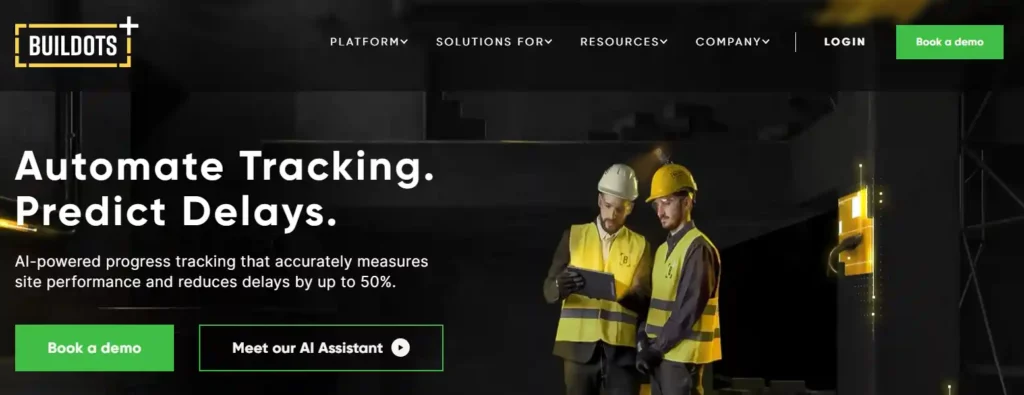
Buildots provides a granular view of construction sites by transforming visual data into actionable insights. Using hardhat-mounted 360° cameras, the platform captures daily site imagery and compares it against Building Information Modelling (BIM) and project schedules.
Its AI engine automatically detects discrepancies between the plan and reality, flagging delays and tracking the progress of various trades. This constant stream of objective data helps project managers make informed decisions, verify subcontractor work, and keep stakeholders updated with accurate, visual progress reports, reducing delays by up to 50%.
Builders are using it to:
Standout features & integrations:
Best for:
Medium to large-scale general contractors seeking to eliminate manual progress tracking and gain real-time visibility into complex project sites.
2. ALICE Technologies
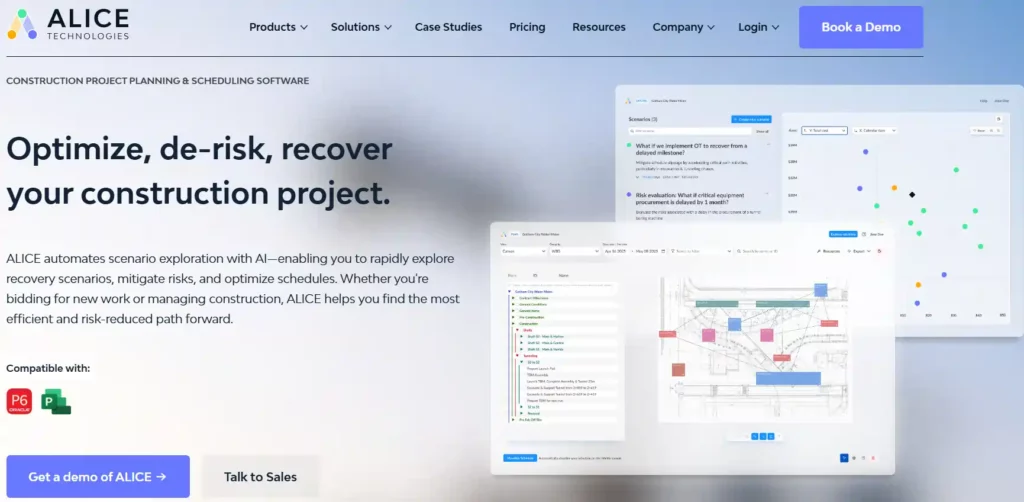
ALICE Technologies introduces a transforms approach to construction planning and scheduling called “optioneering”. This AI-powered platform uses generative algorithms to simulate thousands of potential construction sequences in a fraction of the time it would take manually.
By exploring different resource allocations, crew sizes, and methodologies, ALICE helps contractors identify the most efficient and cost-effective path forward before breaking ground. It is a powerful pre-construction tool that allows teams to stress-test their plans and find optimal solutions to complex logistical challenges.
Builders are using it to:
Standout features & integrations:
Best for:
Large-scale infrastructure and commercial projects that require intensive, AI-assisted schedule simulation and optimisation during the pre-construction phase.
3. Autodesk Construction Cloud
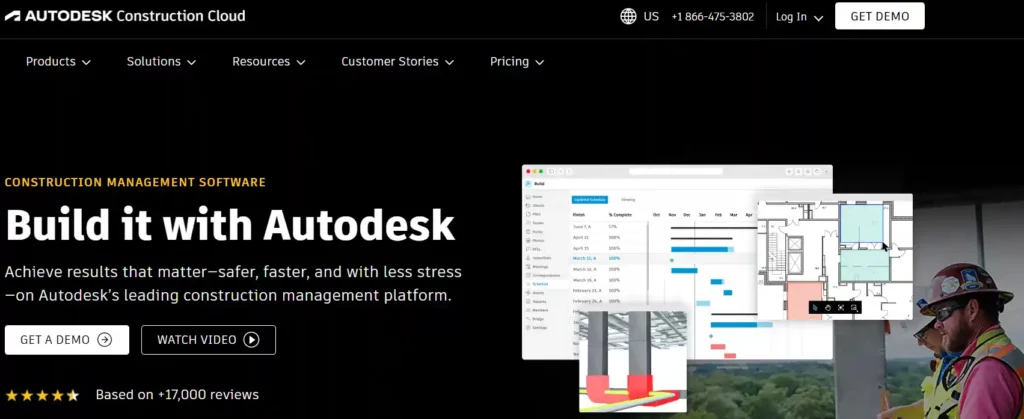
Autodesk Construction Cloud integrates AI across its entire project management suite to connect workflows, teams, and data. Tools like Construction IQ use machine learning to scan project information, automatically identifying and prioritising design, quality, and safety risks.
The platform also features the Autodesk Assistant, a conversational AI that helps users quickly find information and summarise project data. By embedding AI into everyday tasks like document management and submittal reviews, Autodesk automates tedious processes, allowing teams to focus on problem-solving rather than administrative work.
Builders are using it to:
Standout features & integrations:
Best for:
Construction teams of all sizes looking for a unified platform that embeds AI-powered assistance and risk management across the entire project lifecycle.
4. Procore

Procore delivers a comprehensive construction management platform enhanced with AI features to centralise project operations. It connects all stakeholders—from the office to the field—on a single system, ensuring everyone works from the most current information. Procore’s AI capabilities analyse project data to generate predictive insights for budgeting, productivity, and risk.
The platform's robust mobile app allows field teams to capture and upload data on the go, which the AI then uses to provide real-time updates and analytics, helping to streamline decision-making and keep projects on track.
Builders are using it to:
Standout features & integrations:
Best for:
Mid-sized to enterprise-level construction firms that need a centralised hub to manage every aspect of complex, multi-phase projects.
5. Togal.AI

Togal.AI specialises in automating the time-consuming process of construction takeoffs and estimating. The software uses machine learning to analyse architectural drawings and PDFs, automatically detecting, measuring, and quantifying project spaces and materials.
According to a report by McKinsey, AI-driven estimating tools like Togal.AI can reduce errors by up to 90% and speed up the takeoff process by 80% compared to manual methods. This allows estimators to generate more accurate bids in a fraction of the time, increasing their competitiveness and freeing them up to focus on more strategic tasks.
Builders are using it to:
Standout features & integrations:
Best for:
General contractors and subcontractors who want to dramatically speed up the estimating process and improve the accuracy of their bids.
6. Vitruvi

Vitruvi is an AI-enhanced construction management platform designed specifically for infrastructure and utility projects. It integrates GIS-based planning with real-time field data capture and financial controls, offering a complete end-to-end solution.
Vitruvi’s AI features include intelligent photo classifiers that can automatically identify specific field assets or conditions, speeding up quality assurance and documentation. The platform excels at aligning office planning with field execution, providing live dashboards and production tracking to ensure complex infrastructure projects stay on schedule and within budget.
Builders are using it to:
Standout features & integrations:
Best for:
Infrastructure and utility construction companies managing complex, geographically dispersed projects that require strong GIS integration and real-time field visibility.
7. PlanSwift

PlanSwift streamlines construction estimating workflows with its powerful digital takeoff software. It allows users to perform accurate measurements and calculations directly from digital blueprints. Estimators can simply click and drag to measure areas, lengths, and volumes, with the software automatically generating material and labour quantities.
While a long-standing tool in the industry, its focus on digitising and simplifying the takeoff process has laid the groundwork for more advanced AI applications. It helps cut down on manual calculation time and improves the precision of cost estimates for both residential and commercial projects.
Perform fast takeoffs Builders are using it to:
Standout features & integrations:
Best for:
Residential and commercial contractors who are primarily focused on improving the speed and accuracy of their estimating and procurement processes.
KPIs and Benchmarks: Measuring the Impact of AI Construction Softwares
The impact of AI construction Apps is measured through specific Key Performance Indicators (KPIs) that track improvements in efficiency, cost, safety, and quality. The AI in construction market is projected to grow from $4.86+ billion in 2026 to $22.68 billion by 2032, reflecting its proven ability to drive measurable returns.

Key metrics to measure impact include:
AiMojo Recommends:
Your Blueprint for Success
The takeaway is clear: AI construction software isn't just a trend; it's essential for staying competitive. These platforms solve the industry's biggest headaches, from schedule slips to budget blowouts, by automating tasks and providing sharp, data-driven insights.
Adopting this tech gives you a serious advantage, upgrading everything from planning to on-site work. Ready to build smarter, not harder? Explore these AI tools to find the right fit for your projects and leave inefficient, old-school methods behind. It’s time to future-proof your construction business.


 BONUS: Get our $200 “AI Mastery Toolkit” FREE when you sign up!