

GPTConsole Key Insights
What is GPTConsole?
GPTConsole is an AI agent platform built specifically for developers who need to generate production-ready web applications from the command line. Rather than offering simple code completions or snippet suggestions, GPTConsole deploys autonomous AI agents that execute long-running development tasks end to end.
Its three core agents are Pixie (full web app generation), Chip (codebase analysis and pull request review), and Doodle (animated visual content creation). Installed as an npm package, it runs directly in your terminal, keeping you inside your native workflow.
The platform also provides an SDK and API for developers who want to build, share, and monetise their own custom agents. For solo developers, startups, and small teams looking to automate repetitive front-end development work, GPTConsole offers a focused, credit-based solution that turns natural language prompts into deployable ReactJS applications.
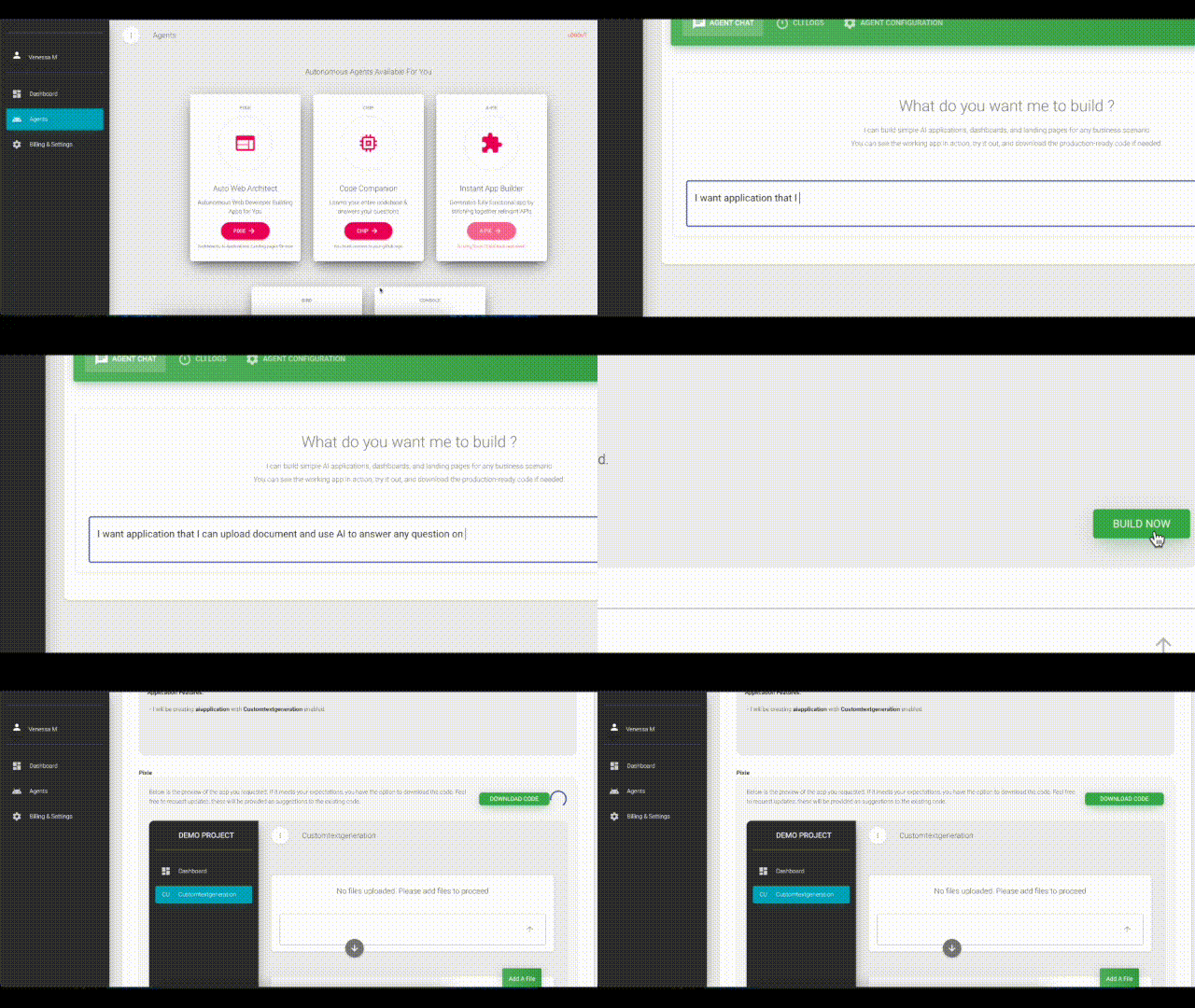
Pixie is the standout agent. You feed it a one-line business description and it generates a full, multi-section ReactJS web application. We are not talking about a single HTML file. Pixie outputs complete dashboards, AI applications, and landing pages with header, features, pricing, testimonials, and contact sections. You can iteratively update individual sections using plain English commands. This removes the need to scaffold projects manually, saving hours of boilerplate setup time.

Chip connects to your GitHub repository via OAuth and learns your entire codebase. You can ask it questions about specific code errors, optimisation strategies, or architectural decisions. It also reviews pull requests automatically, flagging issues before human reviewers even open the diff. For teams managing large repositories, Chip acts as an always-on code companion that reduces review bottlenecks.
GPTConsole installs as a global npm package (yarn global add gpt-console or npm i gpt-console -g). Once installed, you run gpt-console in any terminal and start issuing prompts. There is no browser tab to switch to and no separate IDE to configure. The CLI also supports infinite context input and auto-copies responses to your clipboard. This is built for developers who live in the terminal.
Doodle generates animated doodles rather than static images. This is useful for creating quick visual assets, explainer graphics, or social media content without opening a design tool. It fills a niche gap that most coding-focused AI platforms completely ignore.
GPTConsole handles event chaining, lifecycle management, and memory handling through its SDK. Developers can build their own agents, define objectives, and eventually share or monetise them on the platform. This positions GPTConsole not just as a tool but as an extensible agent ecosystem.
GPTConsole Pricing Plans
| Plan Name | Cost | Key Limits and Features |
|---|---|---|
| Free Tier | $0 | 100 credits on sign-up |
| Flexi-Plan | $1 per 10 credits | Top-up anytime, no lock-in, pay as you go |
How GPTConsole Handles Full App Scaffolding
Most AI code assistants stop at suggestions and snippets. GPTConsole takes a fundamentally different approach by generating entire multi-section web applications from a single prompt. Pixie does not just write a component. It builds out eight distinct sections including headers, feature blocks, pricing tables, team profiles, blog layouts, testimonials, project showcases, and contact forms.
Each section is editable through follow-up natural language commands. This makes GPTConsole particularly effective for rapid prototyping, MVP launches, and marketing page creation where speed matters more than pixel-perfect custom design. The output is production-grade ReactJS, not throwaway mockup code.
GPTConsole for Codebase Management and PR Reviews
Chip, the code intelligence agent, adds genuine value for teams managing active repositories. By connecting through GitHub OAuth, Chip reads and indexes your full codebase. Developers can query it about implementation patterns, debug specific errors, or request optimisation recommendations.
The pull request review capability is where Chip earns its keep. It analyses diffs, flags potential issues, and provides contextual code suggestions before human reviewers step in. This reduces review cycle times and catches low-hanging bugs early. For teams running lean with limited senior review bandwidth, Chip serves as a reliable first-pass quality gate across the development pipeline.
Pros and Cons
- Full app generation from prompts.
- Simple credit-based pay model.
- CLI-native developer-first workflow.
- GitHub integrated PR reviews.
- Custom agent SDK available.
- No subscription lock-in required.
- Limited to ReactJS output.
- No IDE plugin available.
- Small community and user base.
- Credit costs can be unpredictable.
GPTConsole Agent Marketplace and Ecosystem Potential
GPTConsole is building toward something larger than a single-use tool. Its SDK handles the hard parts of agent development including event chaining, lifecycle management, and memory handling. This allows third-party developers to focus purely on setting objectives for their custom agents.
A waitlist is currently open for developers interested in building and publishing agents on the platform. If the marketplace gains traction, GPTConsole could evolve from a developer utility into a full agent distribution platform. The early infrastructure is in place, but the ecosystem needs more builders and more use cases to reach critical mass. This is the area to watch going forward.
Best GPTConsole Alternatives
| AI Agent Platform / Code Assistant | Full App Generation | GitHub PR Review |
|---|---|---|
| Cursor | ❌ (Code editing only) | ❌ |
| GitHub Copilot | ❌ (Autocomplete and suggestions) | ✅ (Via Copilot agent mode) |
| Claude Code | ❌ (Terminal-native code tasks) | ❌ (Manual workflow) |
| Bolt.new | ✅ (Browser-based full apps) | ❌ |