

Hugging Face Key Insights
What is Hugging Face?

Hugging Face is an open source AI collaboration platform that acts as the central repository for machine learning models, datasets, and deployment tools. It gives data scientists, ML engineers, and AI product teams instant access to over 500,000 pre-trained models across text generation, computer vision, speech recognition, and multimodal tasks.
Built on a Git-based infrastructure, the platform lets teams version control model weights, share training datasets, and deploy live AI demos via Spaces in minutes. For businesses building AI products, Hugging Face removes the infrastructure overhead of managing private model registries and provides production-ready hosting, an inference API, and collaborative workflows that speed up the entire model development lifecycle from research to release.
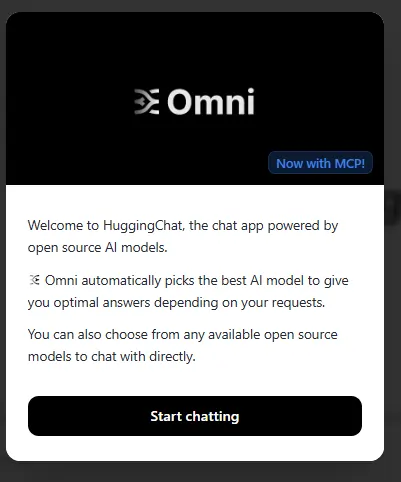
HuggingChat is Hugging Face's own free, open source AI chat interface that gives anyone access to 119+ open source models including Llama, Mistral, and Qwen through a single, unified platform. It includes built-in web search for real-time grounding, MCP support for calling external tools mid-conversation, and a Community Tools feature that lets you plug any public Hugging Face Space directly into the chat.

AutoTrain removes the need to write complex training scripts when adapting a pre-trained model to a custom dataset. You upload labelled data, select a base model, configure hyperparameters through a clean UI, and the platform handles distributed training automatically. In real use, fine-tuning a BERT classifier via AutoTrain took under 15 minutes versus 3 or more hours required by a manual training loop setup. For teams without dedicated ML infrastructure engineers, this is a significant capability gain.

Spaces lets teams deploy Gradio or Streamlit applications directly from Python scripts, with the platform automatically managing containerisation, HTTPS certificates, and auto-scaling. A working sentiment analysis demo can be live in under an hour. Built-in OAuth support, secret management, and persistent storage remove most of the DevOps configuration burden. For client demos, proof-of-concept builds, or internal ML tools, this is one of the most productive features on the platform.

Every model and dataset on Hugging Face is stored in a Git repository with LFS support for large binary files. This means teams get full version history, branching, pull requests, and collaborative review for model weights and configurations, not just training code. It brings proper software engineering discipline to ML asset management, allowing teams to track experiments, roll back checkpoints, and accept community contributions through pull requests.
The Accelerate library allows teams to run distributed training across multiple GPUs and TPUs with minimal code changes. A standard single-GPU training script can be adapted for multi node distributed training in around five lines of code. This is critical for teams working with large language models or high-volume computer vision pipelines where single-device training is not viable in production.
The platform supports PyTorch, TensorFlow, JAX, Scikit-learn, and ONNX out of the box, with automatic library detection that runs the same model across environments without modification. The Optimum library adds production model optimisation including ONNX conversion and quantisation, which can reduce inference latency by up to 40%. For teams deploying to diverse infrastructure, this cross-platform portability is essential.
Hugging Face Pricing Plans
| Plan Name | Cost | Key Limits / Features |
|---|---|---|
| Community | Free | Unlimited public hosting, 100GB storage, Inference API, Spaces deployment, 10k API calls/day |
| PRO Account | $9/month | Enhanced storage, $50+ dedicated inference credits, private repos, priority Spaces hosting |
| Team | $20/user/month | All PRO features plus SSO, role-based access control, usage analytics, collaborative private repos |
| Enterprise | From $50/user/month | SOC2/HIPAA compliance, dedicated support, SLA guarantees, advanced access controls, custom storage |
Pros and Cons
- 500,000+ pre-trained models available.
- AutoTrain needs zero coding knowledge.
- Supports all major ML libraries natively.
- Git-based version control for model assets.
- Production-ready Spaces deployment included.
- World-class documentation and tutorials.
- Steep learning curve for ML beginners.
- Free tier API rate limits apply.
- Reinforcement learning model coverage lags.
Is Hugging Face Worth It vs Building Your Own Stack?
Teams that consider building their own model registry, inference pipeline, and deployment infrastructure should factor in the real cost before skipping Hugging Face. Setting up equivalent capabilities with private Git LFS hosting, containerised inference endpoints, access control, and model documentation typically consumes 40 or more developer hours per month in maintenance.
At $9 to $20 per user per month, Hugging Face delivers immediate ROI against any self-hosted alternative. The only scenario where a custom stack wins is when deeply proprietary infrastructure requirements cannot be met by any managed platform.
Best Hugging Face Alternatives
| Open Source AI/ML Collaboration Platform | Open Source Model Access | Deployment Portability |
|---|---|---|
| AWS SageMaker | Limited to AWS-hosted and curated models | Deep AWS integration but introduces vendor lock-in |
| Weights and Biases | Focused on experiment tracking, no public model library | Strong MLOps tooling but no built-in hosting layer |
| Google Vertex AI | Google-curated model garden with narrow open source variety | Tight GCP-only integration with limited export flexibility |