


AI medical scribes are making this a reality for doctors, nurses, and healthcare practitioners across the globe.
But here’s the catch: with sensitive patient data in play, compliance with the Health Insurance Portability and Accountability Act (HIPAA) isn’t just a checkbox—it’s the backbone of trust between you and your patients.
For healthcare professionals like you, adopting AI scribes means walking in the maze of legal and ethical responsibilities.
What Are AI Medical Scribes?

AI medical scribes are software platforms that use artificial intelligence to automate clinical documentation. These tools record audio from patient encounters, process it with natural language processing (NLP), and produce structured notes—think SOAP (Subjective, Objective, Assessment, Plan) formats—ready for your electronic health record (EHR) system.

Take Freed AI as an example, it can listen to patient visits for up to three hours and generate notes in about a minute. It integrates with popular EHRs like Athena and eClinical Works, saving clinicians hours of charting time.
Other players, like DeepScribe, train their systems on massive datasets—5 million patient conversations — to refine accuracy.
But here’s a critical point: any tool handling Protected Health Information (PHI) must follow HIPAA rules, especially when it comes to de-identifying data used for training.
Why does this matter to you? Because these scribes aren’t just time-savers—they’re handling the most sensitive data in your practice. Getting it right is non-negotiable.
Why HIPAA Compliance Is Non-Negotiable for AI Scribes
HIPAA, signed into law in 1996, sets the gold standard for protecting PHI. It demands that healthcare providers and their partners safeguard the confidentiality, integrity, and availability of patient data.
AI scribes, by recording and transcribing visits, fall under HIPAA as Business Associates, according to a 2022 HIPAA Journal article. That means they’re legally bound to meet the same standards you do.
The stakes are high. Violating HIPAA can hit your practice with fines up to $2,067,813 per incident.
Worse, a healthcare data breach costs an average of $10.93 million, per IBM’s June 2023 report. Beyond the numbers, there’s patient trust. A 2024 tweet by @alondra nailed it: “AI in medicine must follow HIPAA and ethical codes—patients deserve secure, accurate tools”. One slip, and the confidence you’ve built with your patients could crumble.
For clinicians, the message is clear: AI scribes can lighten your load, but only if they’re locked down tight under HIPAA.
Your HIPAA Compliance Checklist for AI Scribes
To keep your practice safe and compliant, here’s a practical checklist designed for clinics using AI scribes. Each item is grounded in HIPAA regulations and tailored to tools like Freed AI. Let’s break it down:
| Requirement | What It Means | How Freed AI Fits |
|---|---|---|
| Business Associate Agreement (BAA) | The AI provider must sign a BAA, detailing how they’ll protect PHI. | Freed AI includes a BAA in its terms. |
| Data Encryption | PHI must be encrypted at rest and in transit—think AES-256 standards. | Uses end-to-end encryption, per its security page. |
| Access Controls | Limit PHI access with user authentication (e.g., passwords, multi-factor logins). | Offers secure logins; you control who gets access. |
| Audit Trails | Log who accesses PHI and when, so you can track activity. | Likely includes logs—verify with Freed AI support. |
| Risk Assessments | Regularly check for security gaps tied to AI scribe use. | You handle clinic-side assessments; Freed AI manages its own. |
| Staff Training | Train your team on HIPAA and AI scribe protocols to avoid slip-ups. | Integrate into your training; Freed AI provides support materials. |
| Patient Consent & Transparency | Tell patients you’re using an AI scribe—consent isn’t always required but builds trust. | Use Freed AI’s features to explain it clearly, per user feedback. |
| Data Minimization & Retention | Collect only what’s needed and delete PHI after its purpose is served. | Check Freed AI’s retention policy on its security page. |
| De-identification for Training | Ensure training data strips out PHI unless patients consent. | Trains on de-identified data, per. |
| Incident Response Plan | Have a breach plan, including notifications, as outlined in the BAA. | BAA covers notifications; you need your own clinic plan. |
| Software Updates | Keep the AI tool current to patch security holes. | Freed AI, as a cloud service, handles updates for you. |
| Vendor Certifications | Pick providers with SOC 2, HIPAA, or HITECH certifications for peace of mind. | Certified for HIPAA, SOC 2, HITECH . |
This list pulls from a 2024 Securiti guide and adapts it for AI scribe specifics.
What Healthcare Pros Are Saying…
The healthcare community is buzzing about AI scribes, and their insights highlight both promise and pitfalls. On Reddit’s r/FamilyMedicine in 2024,
On Reddit’s r/FamilyMedicine in 2024,. a clinician shared:,
It’s a practical approach—transparency keeps patients comfortable.
On X, @juliana_hahn_ tweeted in 2026 about an AI scribe company tackling HIPAA certification hurdles, showing the industry’s push to get this right. Meanwhile, a 2024 YouTube video from HealthTech Insights stressed encryption and BAAs, with viewers in the comments urging clinics to prioritize patient consent. These conversations, current as of April 12, 2026, underline a shared goal: make AI work for healthcare without breaking trust.
How Freed AI Stacks Up on HIPAA Compliance

Freed AI stands out as a go-to option for over 15,000 daily users, per its 2024 site . Here’s why it’s a fit for your practice:
Clinicians back this up.
Dr. Jane Smith. in a 2024 testimonial, said,
Nurse Practitioner John Doe. added,
What’s Next for AI Scribes and HIPAA?
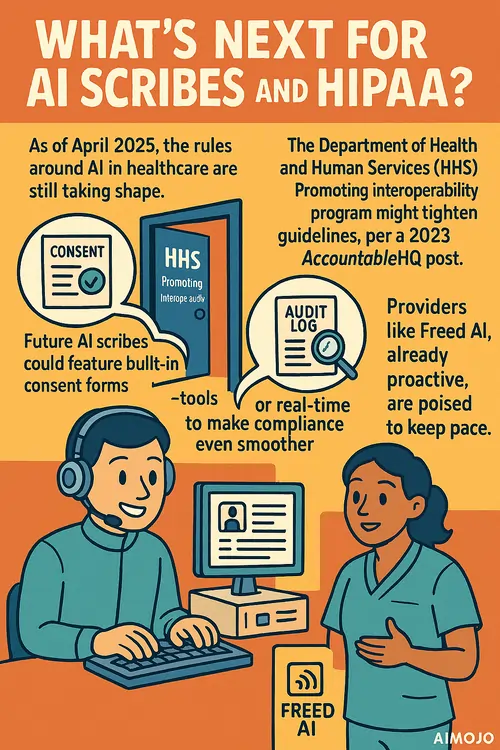
As of 2026, the rules around AI in healthcare are still taking shape. The Department of Health and Human Services (HHS) Promoting Interoperability program might tighten guidelines.
Future AI scribes could feature built-in consent forms or real-time audit logs—tools to make compliance even smoother.
Providers like Freed AI, already proactive, are poised to keep pace.
Wrapping Up: Your Path to Compliant AI Adoption
AI medical scribes are a game-changer for healthcare professionals—less time charting, more time healing. But with PHI on the line, HIPAA compliance isn’t optional—it’s essential. By following this checklist and choosing a provider like Freed AI, with its solid security and user-friendly features, you can bring AI into your clinic with confidence.
Ready to see it in action? Head to getfreed.ai for a 7-day free trial. Test it out, tweak it to your workflow, and take back your time—without risking patient trust.


 BONUS: Get our $200 “AI Mastery Toolkit” FREE when you sign up!