

OpenHands Key Insights
What is OpenHands?
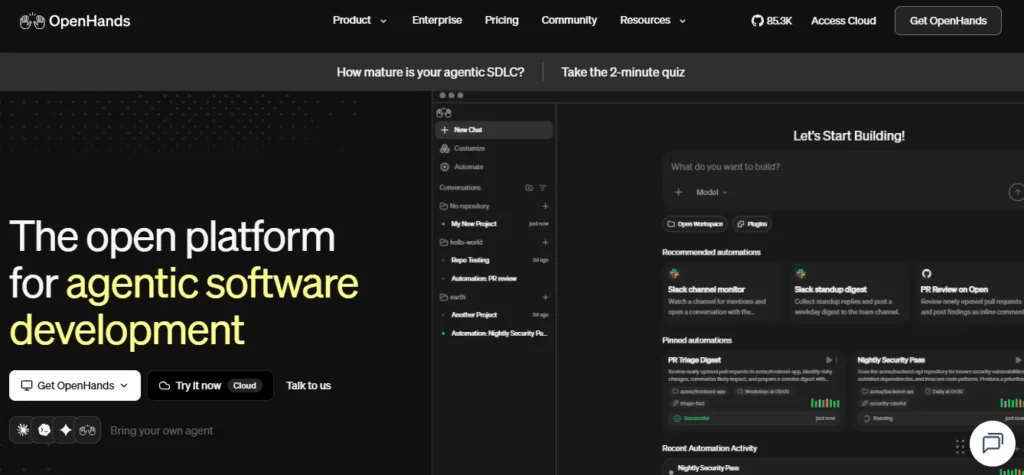
OpenHands is an open source AI agent platform purpose built for software engineering teams that need to automate real coding work, not just generate code suggestions. Formerly known as OpenDevin, the platform runs autonomous agents that can plan tasks, write and edit code, execute shell commands, run tests, and open pull requests across entire codebases.
It connects to any LLM through LiteLLM, giving teams full model choice across Claude, GPT, Gemini, DeepSeek, Qwen, and local open weight models. OpenHands supports deployment locally, in the cloud, or self hosted inside a private VPC. With over 87,000 GitHub stars, 565+ contributors, and 9 million+ downloads, it has become the most popular open source AI coding agent.
The platform integrates with GitHub, Slack, Jira, and Linear to trigger agent workflows from events already happening in your engineering stack, making it a genuine productivity tool for development automation at scale.
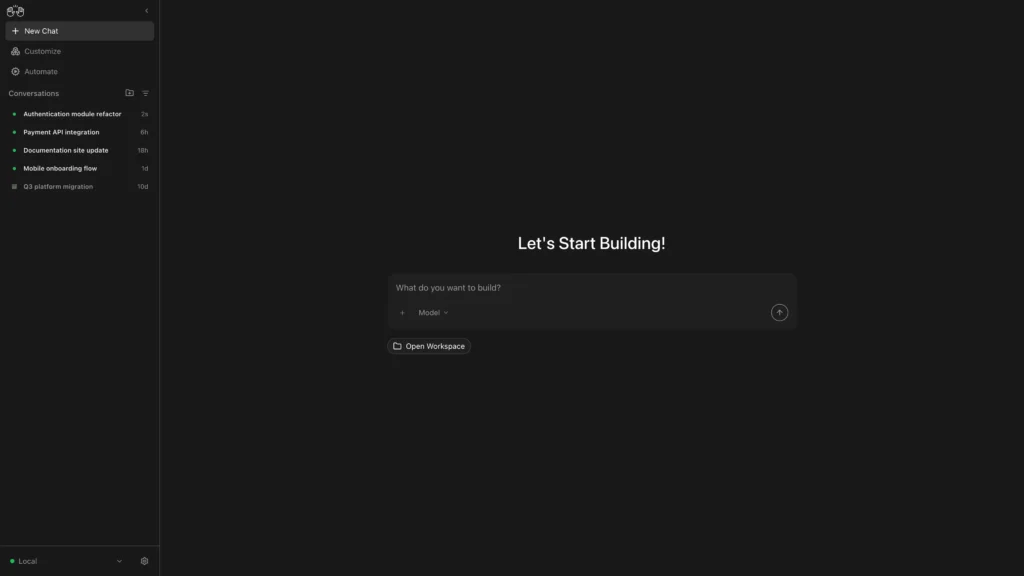
Agent Canvas is the browser based control surface where developers manage conversations, files, terminals, and automations in one place. It supports not only the native OpenHands agent but also external agents like Claude Code, OpenAI Codex, and Gemini CLI through the Agent Client Protocol (ACP). This means you are not locked into a single agent. You can route tasks to the best agent for the job while keeping a single operational view, saving significant context switching time.

OpenHands turns signals from your engineering stack into end to end agent workflows. A new Jira ticket, a failed CI run, a Slack mention, or a Linear issue can automatically trigger an agent to investigate, write a fix, and open a pull request. These automations run in the background, even after you close your laptop, handling the repetitive parts of the software development lifecycle and freeing engineers to focus on higher value design and review work.
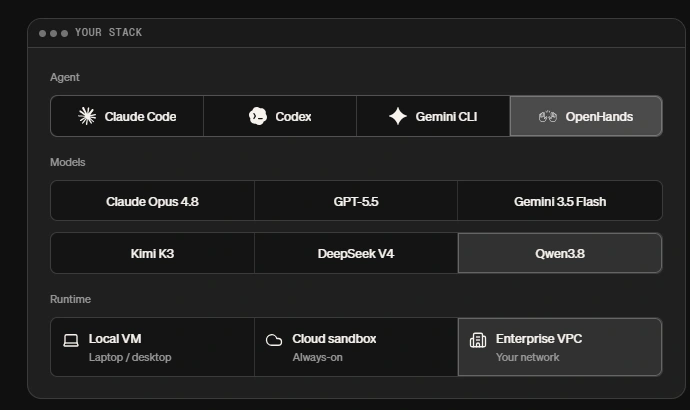
Unlike proprietary competitors that lock you into a single LLM provider, OpenHands connects to any model through LiteLLM. Teams can use Claude Opus for complex planning tasks, switch to a cheaper model for routine edits, and even run fully local models through Ollama or vLLM when sensitive code must never leave the network. This flexibility directly impacts both cost efficiency and data governance.

For organisations scaling agent use across multiple teams, the Enterprise tier provides a centralised governance layer. This includes role based access control (RBAC), SAML/SSO authentication, audit logs, usage monitoring, budget enforcement, and self hosted VPC deployment. Platform and security teams get full visibility into who is running agents, what they can access, where they execute, and what they spend.
The Large Codebase SDK maps dependencies across an entire system and orchestrates changes in the correct order. Multiple agents can safely work in parallel without conflicts, making OpenHands particularly effective for large enterprise codebases and legacy system modernisation projects that would overwhelm simpler tools.
OpenHands can watch for labelled pull requests, inspect the full PR context, and post an AI generated review comment. When CI pipelines fail, it can automatically detect the failure, inspect logs, identify the root cause, and open a fix PR. These features close the loop on two of the most time consuming bottlenecks in engineering workflows.
OpenHands Pricing Plans
| Plan Name | Cost | Key Limits and Features |
|---|---|---|
| Open Source | Free | Full MIT licensed agent, Web GUI, Terminal UI, CLI, Git integrations, community support, model agnostic |
| Individual (SaaS) | Free (BYOK) or pay as you go | Hosted cloud access, API support, Jira and Slack integrations, BYOK or OpenHands models at cost, $20 free trial credit |
| Enterprise (SaaS or Self Hosted) | Custom | Self hosted VPC, SAML/SSO, unlimited concurrent conversations, Large Codebase SDK, RBAC, audit logs, priority support, shared Slack channel |
OpenHands for Team Productivity and SDLC Automation
OpenHands excels when engineering teams move beyond individual use and adopt agent workflows across the full software development lifecycle. By connecting GitHub, Slack, Jira, and Linear as trigger sources, teams can automate issue triage, incident investigation, documentation updates, dependency upgrades, and release note generation.
The outer loop model means agents continue working on scheduled or event triggered tasks even when engineers are offline. This makes OpenHands a genuine force multiplier for platform engineering teams looking to reduce toil, speed up cycle times, and maintain code quality without adding headcount. The shared automation layer ensures consistent execution across repositories.
Pros and Cons
- Fully open source MIT core.
- Model agnostic with BYOK support.
- Self hosted and VPC deployment.
- 87,000+ GitHub stars and active community.
- Event driven workflow automations.
- Enterprise grade governance controls.
- Initial Docker setup required.
- Enterprise features behind paid tier.
- No built in IDE experience.
- Dark theme only on web UI.
OpenHands Performance Benchmarks and Community Adoption
OpenHands consistently ranks among the top performing AI coding agent harnesses on the SWE bench benchmark, which is the industry standard for evaluating autonomous software engineering. The platform is used as the official evaluation harness for many SWE bench leaderboard submissions.
With over 87,000 GitHub stars, 565+ contributors, and 9 million downloads, OpenHands has built one of the largest open source communities in the AI coding space. Testimonials from engineers at Oracle, Walmart, and numerous startups confirm real world production usage. The project maintains an active community Slack and averages roughly 60 commits per week, making it one of the fastest moving open source projects in developer tooling.
Best OpenHands Alternatives
| AI Coding Agent Platform | Model Flexibility | Deployment Control |
|---|---|---|
| Devin | Proprietary models only | Cloud managed, no self hosting |
| GitHub Copilot Coding Agent | GitHub ecosystem, limited model choice | GitHub cloud only |
| Cursor | Claude and GPT via editor | Local editor, no server automation |
| Aider | Broad via LiteLLM, local models | Terminal and local only, no team governance |