

Hebbia Key Insights
What is Hebbia?

Hebbia is an AI powered institutional intelligence platform built for finance, legal and consulting professionals who need to analyse vast quantities of unstructured documents with full accuracy and traceability. Founded in 2020 and backed by $161 million in funding from Andreessen Horowitz and Index Ventures, Hebbia’s flagship product Matrix functions as a tabular AI workspace where analysts can run complex queries across thousands of files simultaneously.
It uses a proprietary method called Iterative Source Decomposition to break questions into parallel subtasks, execute them across best fit models and return cited, auditable answers in a spreadsheet style grid.
The platform integrates directly with FactSet, PitchBook, Preqin, Fitch and Third Bridge, making it functionally similar to an AI powered Bloomberg terminal for document heavy research. Hebbia helps firms reduce analyst hours on diligence, screening and memo creation from days to minutes.
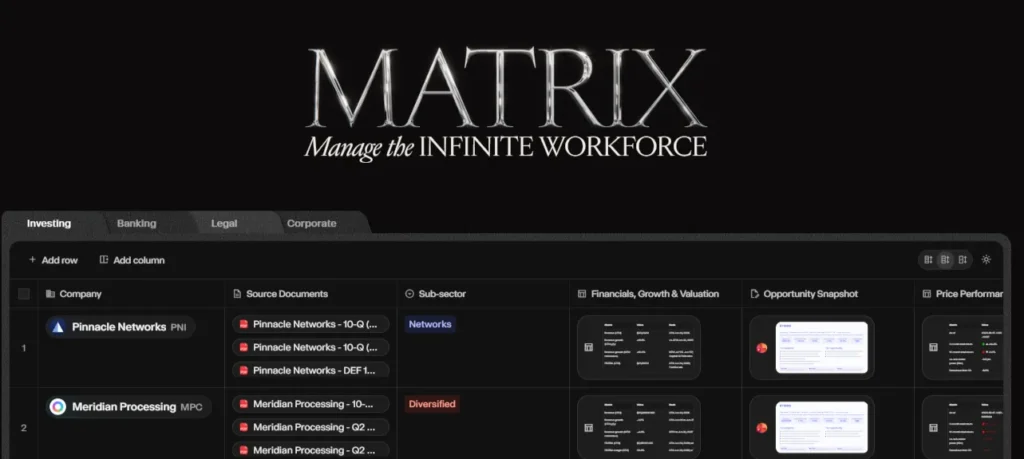
Matrix is the core of Hebbia and it works exactly the way a deal team thinks. Instead of a chat window, it presents a spreadsheet where every column becomes an AI powered query and every row becomes a company, filing or document.
Analysts can drag in thousands of PDFs and immediately run structured extraction across the entire set. This means a credit analyst screening 200 CIMs no longer copies figures by hand. Matrix fills the grid with sourced, cited answers in near real time.
ISD is what separates Hebbia from generic RAG tools. When a user poses a complex question, ISD breaks it into discrete subtasks, routes each to the appropriate model and reassembles a complete answer. This eliminates the hallucination problem that plagues single pass retrieval systems. For a private equity associate running a quality of earnings check across a virtual data room, ISD ensures every figure is traced back to its source page and paragraph.
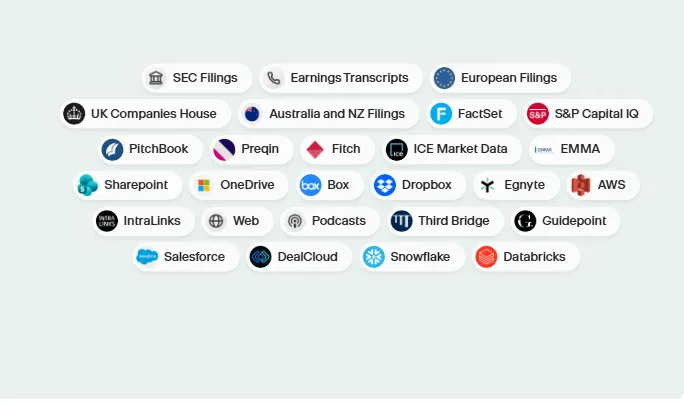
Hebbia connects natively with FactSet market data, PitchBook deal intelligence, Preqin private markets data via BlackRock Aladdin, Fitch credit ratings, ICE equity pricing and Third Bridge expert transcripts. Users query all these sources in a single workflow alongside their own uploaded files. This eliminates the toggle between six different terminals and brings all the data into one analysis surface.
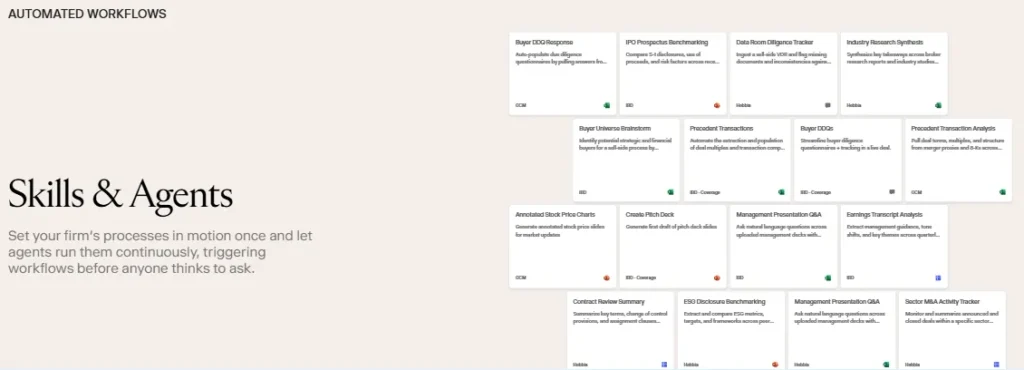
Teams can build custom agents for repeatable tasks or select from hundreds of pre built templates covering credit agreement abstraction, VDR screening, precedent transaction analysis and more. Analysts can also drop in an existing deliverable and Hebbia will auto create a reusable agent that reproduces that output format on new data. This turns institutional knowledge into scalable, repeatable AI workflows.
Through its acquisition of FlashDocs, Hebbia now generates polished PowerPoint decks, memos and reports directly from analysis results. The June 2026 update added inline citation markers to every slide, so each claim remains traceable. A tick and tie agent also verifies figures in presentations against source files, which is critical for regulated outputs.
The Hebbia API allows firms to connect the platform directly into internal systems for automated, real time intelligence. The MCP (Model Context Protocol) integration lets users query their Hebbia projects and data sources from within Claude and ChatGPT with inline citations. This extends Hebbia’s analytical power beyond its own interface.
Hebbia Pricing Plans
| Plan Name | Cost | Key Limits and Features |
|---|---|---|
| Professional Seat | ~$10,000/seat/year | Unlimited reasoning, agent building, advanced data integrations, workflow automation |
| Lite Seat | ~$3,000 to $3,500/seat/year | Run pre built agents, deep search, consume outputs |
| Enterprise Custom | Quote based | Custom deployment, forward deployed services team, bespoke data integrations, minimum 1 year contract |
How Hebbia Automates Deal Workflows
Hebbia's Matrix platform is built to compress entire deal workflows from days into minutes. Investment bankers save 30 to 40 hours per deal on marketing materials, meeting prep and counterparty responses. Private equity teams cut 20 to 30 hours per deal on screening, due diligence and expert network research. The platform achieves this through agent swarms that break a single complex task into parallel subtasks, each routed to the best fit model.
A credit analyst reviewing 200 loan agreements no longer reads each one manually. Instead, Matrix extracts covenants, benchmarks terms and flags risk across every document in one pass. Law firms have reported a 75% reduction in credit agreement review time, translating into roughly $2,000 per hour in saved legal fees. These are not theoretical gains. Hebbia's customers processed more unstructured data in a single recent month than in the prior twelve months combined.
Pros and Cons
- Unmatched multi document reasoning at scale.
- Full citation trails on every output.
- Premium financial data integrations built in.
- Matrix grid interface suits analyst workflows.
- Forward deployed onboarding team included.
- Rapidly expanding agent and template library.
- No free tier or self serve access.
- Pricing opaque and enterprise only.
- Steep learning curve for non finance users.
- Limited use outside document heavy industries.
Hebbia’s Growth and Market Position
Hebbia has scaled from $10 million ARR in 2023 to an estimated $48 million ARR in August 2026, reflecting strong enterprise traction. The platform has processed over 1 billion pages, up from 47 million just one year prior. Over 40% of the largest global asset managers by AUM now use Matrix.
EMEA revenue grew 373% year over year from FY25 to FY26 as international advisory and PE firms adopted the platform. Valued at $700 million after its 2024 Series B led by Andreessen Horowitz, Hebbia sits firmly as the category leader in AI for institutional knowledge work. Its data partnerships with FactSet, PitchBook, Fitch and Third Bridge create switching costs that most competitors cannot replicate.
Best Hebbia Alternatives
| Enterprise AI Platform for Knowledge Work | Financial Data Depth | Multi Document Reasoning |
|---|---|---|
| AlphaSense | Extensive (broker research, transcripts, filings) | Limited to search and summarisation |
| Rogo | Moderate (sell side research focus) | Single document and memo generation |
| Glean | Minimal (general enterprise data) | Broad enterprise search, not finance specific |
| Harvey | Minimal (legal focused, no financial data feeds) | Strong in legal document analysis |