

Signal House is an SMS and voice API for developers building AI agents that communicate beyond a chat window. Its SDK, inbound webhooks, delivery logs and programmable calling support appointment assistants, customer service agents and account updates.
A useful agent must do more than write a convincing reply. Your software needs to send that reply, receive an answer, recognise delivery failures and know when a person should take over.
Signal House supplies messaging and calling infrastructure while your application controls model selection, memory and business rules. Its integration path suits AI coding tools, so you can build around conversations instead of treating telecom setup as a separate engineering project.
Quick AIMOJO Verdict
Build on Signal House when your agent needs two way messaging and programmable calls alongside application logic you control. Its strongest developer advantage is the combination of an SDK, agent skills, webhooks and visible delivery states. Start with an approved support or appointment workflow, prove a complete conversation, then add channels. Voice transport still needs a suitable speech stack before becoming a live conversational voice agent.
AI Native Starts Inside Your Coding Workflow
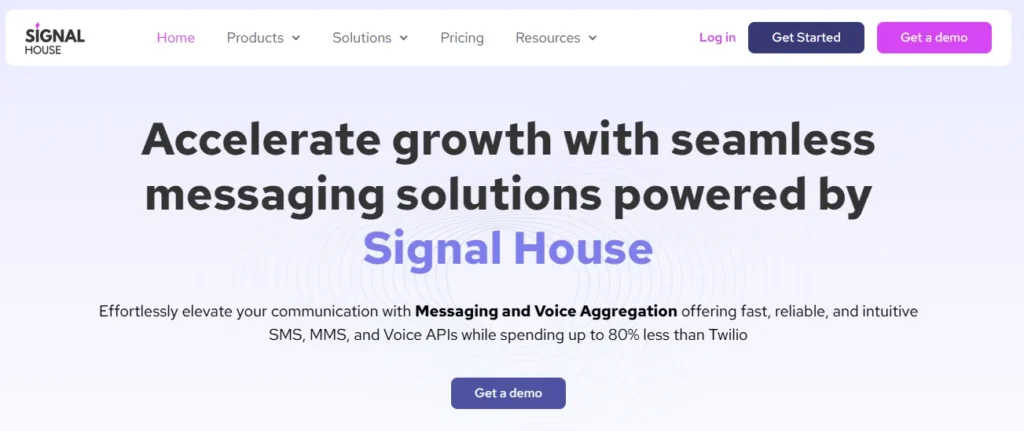
In precedenza communications API workflows typically started with reference pages, manual endpoint wiring and callback configuration. Signal House approaches integration through AI assisted development, including a setup path for Cursor and Lovable. Developers can ask a coding assistant to inspect its SDK and implement a messaging feature against actual method signatures.
The distinction is not that established communications platforms cannot support agents. A better question is how much integration context your strumento di codifica receives before producing code.
Signal House’s SDK package includes an agents.skills entry and bundled instructions covering setup, SMS, webhooks, numbers and 10DLC. Those are concrete building blocks behind AI native communications infrastructure, not just a slogan.
| Developer task | Signal House component | Your application’s responsibility |
|---|---|---|
| Send customer messages | SDK di messaggistica | Approve recipients and content |
| React to replies | Inbound webhooks | Retrieve conversation context |
| Separate customer projects | Sub Groups | Enforce tenant permissions |
| Add telephone interactions | API vocale | Choose conversation and handoff logic |
Sub Groups organise numbers, brands and campaigns by customer or use case. Do not treat an organisational group as a replacement for application authorisation. Keep ownership checks beside every messaging tool your model can invoke.
Build a Signal House SMS Agent Step by Step
Use an appointment assistant as your first project. A customer requests a time change, your agent checks availability, offers a permitted slot and sends confirmation only after a successful booking.
That scenario tests two way SMS automation without inventing a complicated sales funnel.
Step: Register a Permitted Messaging Use Case
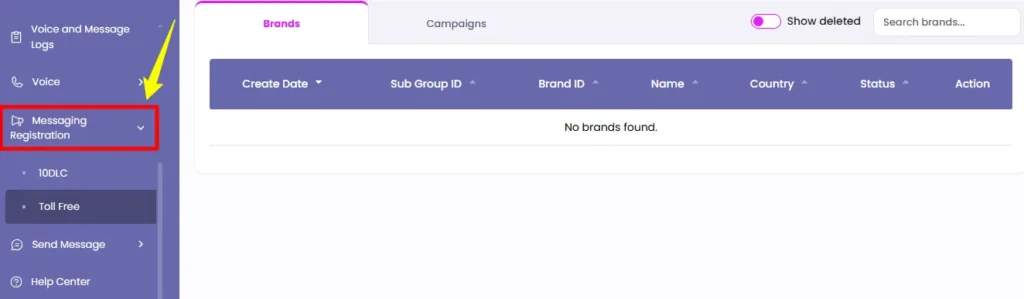
Create your account and prepare business identity details, website information, message samples and a clear consent journey. US local business messaging requires a registered brand and approved 10DLC campaign. Signal House also requires a KYC call during onboarding.
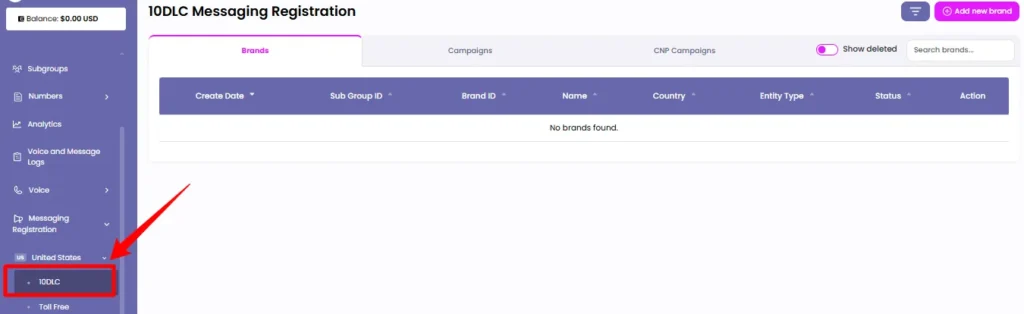
One boundary matters especially for AIMojo readers building commercial automations. Signal House prohibits lead generation and marketing di affiliazione campaigns. Do not assume an AI qualifier or prospecting sequence is eligible simply because messages sound personal. Obtain explicit approval for a proposed sales workflow before committing engineering time.
Build consent storage into your own database. Record purpose, source, timestamp and any withdrawal. Your agent should consult those records before every outbound action.
Step: Connect a Number to Its Campaign
Buy or port a number, assign a Sub Group and connect the appropriate brand and campaign. Complete activation before testing outbound traffic. Under Numbers, open Your Numbers and Configure to inspect capabilities, assignments and incoming webhook settings.
Use separate application records for tenant ID, assigned sending number and campaign ID. Resolve these server side rather than accepting whichever sender a model supplies.
Step: Give Your Coding Assistant Real SDK Context
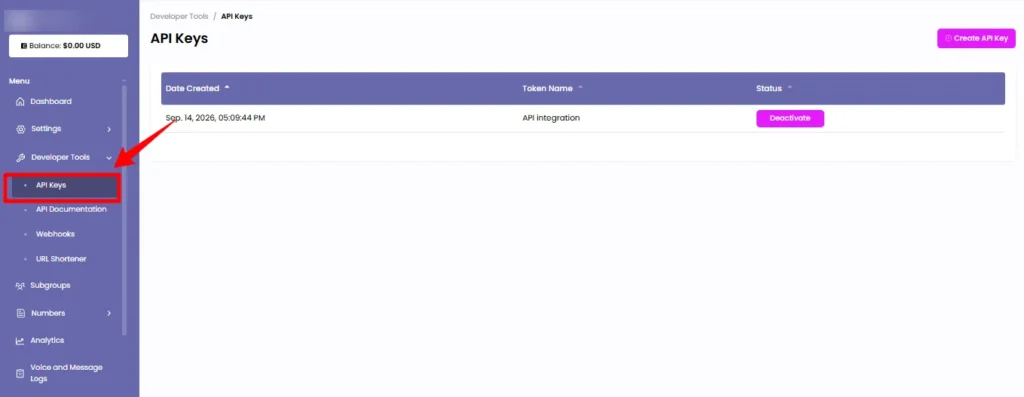
Retrieve credentials from Developer Tools → API Keys. Keep the secret in your backend environment or secret store, never in browser code or a chat prompt.
Installa il pacchetto:
npm install @signalhousellc/sdk
Then give your coding assistant a constrained task:
Inspect the installed Signal House SDK and its SMS instructions. Create a server endpoint for appointment confirmations using verified SDK methods. Read credentials from environment variables. Resolve sender ownership and customer consent before sending. Return a provider message identifier, and add tests for rejected recipients and unavailable credentials.
Keep the SDK version in your lockfile and review changes before an upgrade. Let your coding assistant read the installed package rather than assume a remembered interface. A reproducible dependency set makes a failed request easier to investigate than an untracked package update.
Signal House’s AI app setup follows this inspect first approach. Review generated imports, method arguments and error paths before deployment; a plausible method name is not an API contract.
Step: Prove Delivery Before Adding a Model
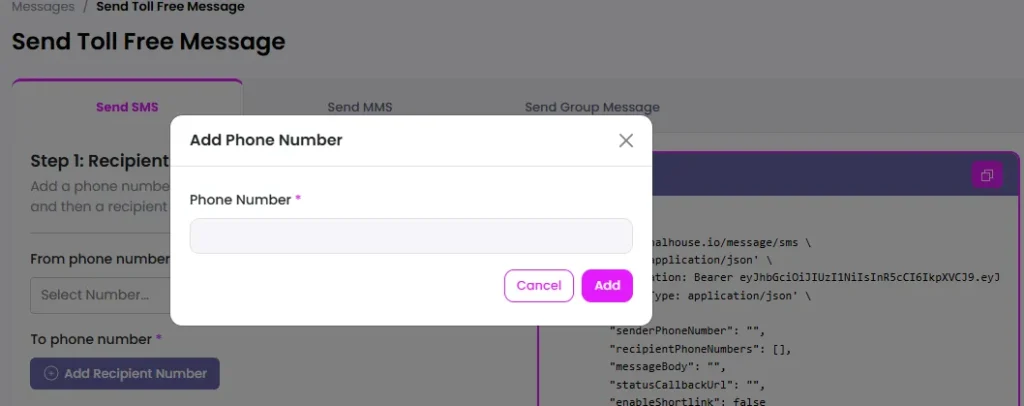
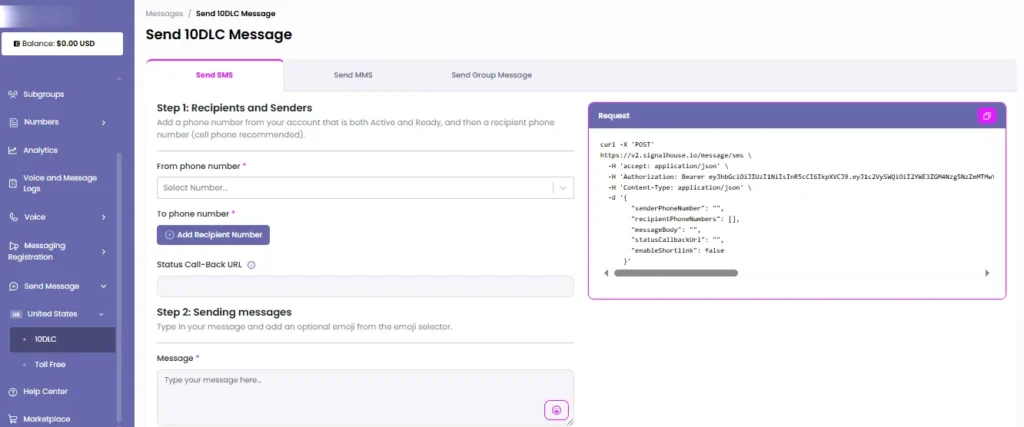
Open Send Message → Send SMS. Select an active number associated with an active campaign, enter your test recipient in E.164 format and supply a Status Callback URL. Keep Group Messaging off for an individual conversation.
Send a short message to an authorised test handset. The dashboard generates a cURL request, giving you a concrete request to reproduce from your backend without guessing endpoint names or payload fields.
Check Message Logs, then reply from that handset. Outbound success alone proves only half your integration.
Do not add an LLM until a plain message can travel both directions. Otherwise, debugging becomes a guessing game between model behaviour, application code and carrier delivery.
Step: Process Webhooks Without Blocking on AI
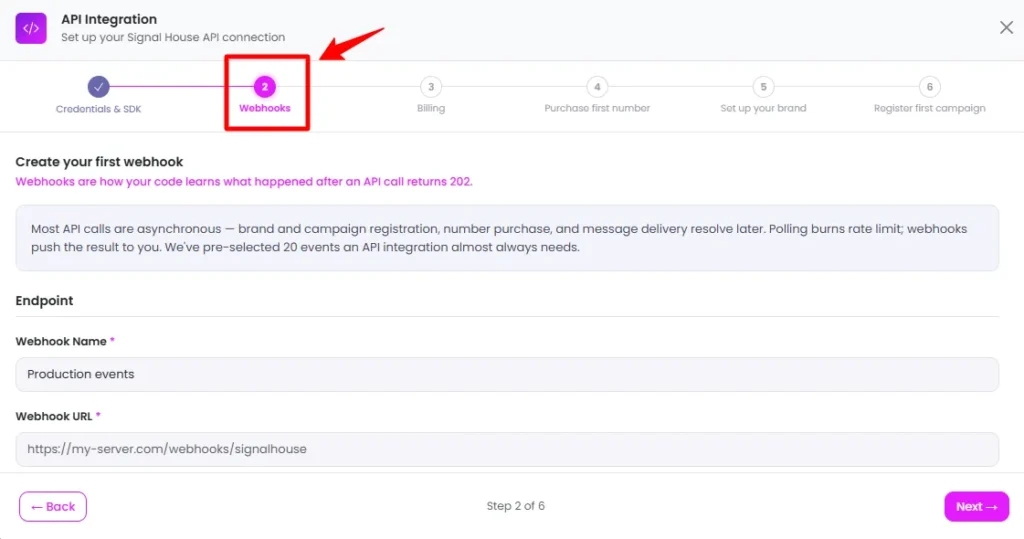
Create event subscriptions under Developer Tools → Webhooks, set an HTTPS destination and enable the relevant events. Inspect webhook activity to check successful responses and failures. Signal House treats HTTP 200 as a successful response.
Use this application design:
Give inbound message events a deduplication key based on their actual identifiers. A repeated callback must not produce another customer reply. Conversely, several delivery states for one message should update the same record, not disappear as duplicates.
Store conversation state by customer and business number, not phone number alone. Otherwise, one person contacting two client accounts can acquire mixed context. Track event time, provider identifier, processing status and chosen next action. Serialise work within each conversation so two rapid replies do not create competing bookings.
These are application safeguards, not assumed guarantees about Signal House’s retry schedule or event ordering.
Step: Restrict Agent Actions Before Sending Replies
Expose a narrow internal tool such as send_appointment_reply. Let the model propose text, but resolve recipient, sender and booking permissions in server code.
mantenere LLM tool calling controls outside the prompt. Reject unsupported actions, suppress messages after consent withdrawal and require a successful calendar operation before confirming an appointment.
An opt out should cancel pending sends, not just prevent new ones. Check consent again when a queued job reaches dispatch. Otherwise, a message approved earlier can still leave after a customer withdraws permission. Keep that final consent check deterministic, outside any model generated reasoning.
Treat incoming SMS content as customer data, never as permission to change system instructions or contact another number.
Test three complete journeys before release: a successful booking, an unavailable appointment and a request for human help. Include duplicate events and provider failures in each test suite.
The practical target is not “AI sent a text”. Your target is “a customer completed a permitted task, and every state change is traceable”.
Add Programmable Voice Without Confusing Calls With Conversation
Signal House supports backend initiated calls, browser calling and SHML call control. SHML uses XML responses to instruct a call to speak text, play audio, collect keypad input, record audio or connect another number.
For a backend call, install the SDK above and use an ES module. Set the four environment variables referenced below. The sender must be your voice enabled number; ANSWER_URL must be an HTTPS endpoint that returns your call instructions.
import { SignalHouseSDK } from "@signalhousellc/sdk";
const required = ["SH_API_KEY", "CALL_FROM", "CALL_TO", "ANSWER_URL"];
for (const name of required) {
  if (!process.env[name]) throw new Error(`Missing ${name}`);
}
const client = new SignalHouseSDK({
  apiKey: process.env.SH_API_KEY,
  baseUrl: "https://v2.signalhouse.io",
});
try {
  const { data } = await client.voice.calls.create({
    callData: {
      from: process.env.CALL_FROM,
      to: process.env.CALL_TO,
      answer_url: process.env.ANSWER_URL,
    },
  });
  console.log({ callId: data.call_id, status: data.status });
} catch (error) {
  console.error("Call request failed", {
    status: error?.response?.status ?? "unknown",
  });
  process.exitCode = 1;
}
This example initiates a call; it does not implement a live speech agent. Add destination authorisation before exposing it through an application endpoint.
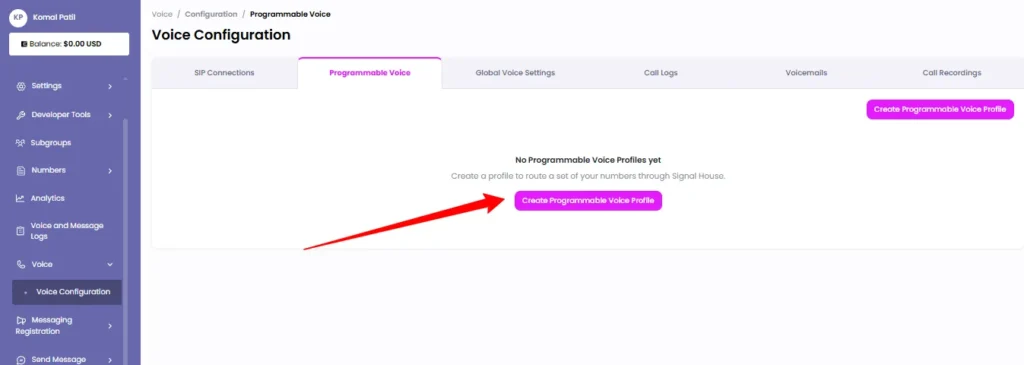
Inbound calls need a programmable voice profile. Set routeAction to CALL_CONTROL, point webhookUrl at your handler and assign the number. Callbacks include CallSid, From, To and CallStatus. Save the call identifier beside your conversation record so a subsequent SMS confirmation belongs to the same customer task.
For browser calling, install jssip alongside the SDK. Your server issues a temporary voice token, and the browser uses Device from @signalhousellc/sdk/voice-browser to register and connect. Authenticate your token endpoint and keep permanent credentials on the server.
Live conversation needs more than call initiation. Confirm a compatible audio connection, riconoscimento vocale, response audio and interruption handling before choosing a voice model stack. SHML keypad collection is not proof of bidirectional model audio streaming. A documented media integration must settle that decision.
Begin with a bounded reminder or human transfer. Add live conversational speech only after that connection is verified.
Delivery Receipts Should Drive Your Agent’s Next Move
Signal House Message Logs expose message identifiers, segment counts, cost, carrier responses and delivery progress. Use those records to separate API acceptance from handset delivery.
| Message state | Significato | Suggested application action |
|---|---|---|
| Creato | Accepted into Signal House | Save the message identifier |
| Enqueued | Waiting for dispatch | Keep delivery pending |
| Dequeued | Removed from the queue | Continue awaiting carrier progress |
| Inviati | Passed onward for delivery | Do not mark as delivered |
| consegnato | Delivery receipt received | Update transport outcome |
| fallito | Error recorded | Classify before retrying |
A delivered message is not evidence that a customer read or understood its contents. Keep business outcomes, such as “appointment accepted”, separate from transport states.
An absent receipt should not automatically trigger a second SMS or a phone call. Set an explicit waiting policy and escalation path in your application.
Price Agent Conversations by Segments, Not Replies
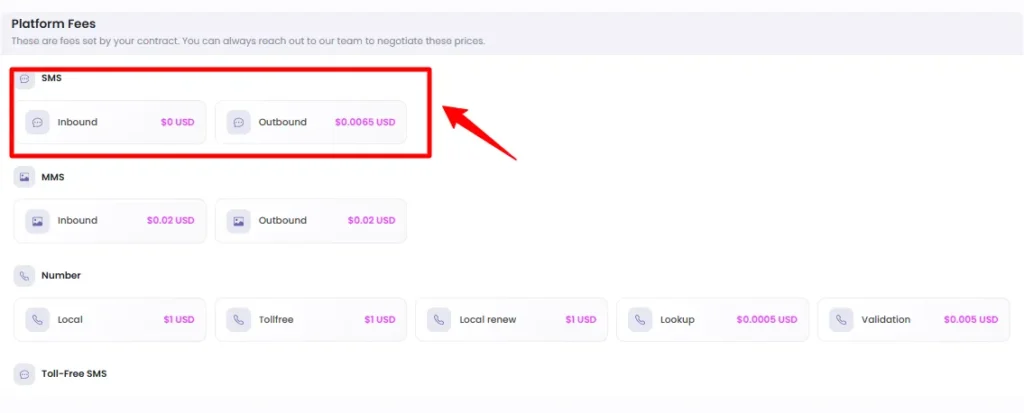
Signal House’s 2026 entry local 10DLC SMS rate is $0.0065 per outbound segment, before carrier charges. AT&T adds $0.0035; Verizon and T-Mobile each add $0.0045. Higher volume tiers reduce platform rates.
| Componente di costo | Entry charge |
|---|---|
| Local outbound SMS | $ 0.0065 per segmento |
| Toll free outbound SMS | $ 0.0079 per segmento |
| Verifica del marchio | $4.50 per verification attempt |
| Registrazione della campagna | $ 15 una volta |
| Low volume campaign | $ 1.50 al mese |
| Campagna standard | $ 10 al mese |
Carrier fees, number charges and any additional services sit outside those messaging base rates. Confirm account specific MMS, number renewal and voice charges before funding production traffic.
Consider 10,000 outbound single segment local messages, all charged a $0.0045 carrier fee. Platform charges total $65 and carrier charges total $45, producing $110 before numbers, registration, traffico in entrata, voice and model costs. That is an example calculation, not a complete quote.
Now add model verbosity. GSM 7 messages fit 160 encoding units in one segment, or 153 per part once concatenated. UCS 2 messages allow 70 in one segment and 67 per concatenated part. Unicode content can therefore change costs sharply.
Misura SMS segment based pricing before dispatch, using an encoding aware counter. Give your agent a length budget and send detailed material through an approved link when appropriate.
A shorter response is not merely a cleaner copy. At scale, it can reduce both billed segments and pressure on sending allowances.
Keep Throughput and Human Handoff Under Control
Campaign choice affects capacity. Signal House’s low volume mixed option permits up to 6,000 daily segments overall, including a 2,000 daily T-Mobile limit. A low volume campaign cannot simply become a standard campaign; a new registration is required.
Build queues around approved carrier, brand and campaign allowances rather than a guessed universal requests per second limit. A burst of model responses should create queued work, not uncontrolled send attempts.
Before broader release, require three observable checks:
Plan the handoff as carefully as booking. Set conversation ownership to human before starting transfer, cancel queued automated messages and expose previous SMS context in the operator interface. Release ownership only through an explicit action.
Maintain a shared conversation record across SMS and voice. Include pending appointments, previous contact attempts and current ownership, but restrict sensitive content to roles that need access.
Measure completed customer tasks alongside cost per conversation. Send counts alone reward activity, not useful outcomes.
Build the Communications Layer Your Agent Can Actually Use
An agent built to contact customers needs more than a capable model. Signal House gives developers a practical route from generated text to SMS exchanges and programmable calls, supported by SDK context, webhooks and delivery visibility.
Start with one approved workflow. Connect a number, prove replies, constrain model actions and inspect costs before adding complexity. Let working results, rather than impressive promises, decide when to scale.
Se stai costruendo un AI agent that needs SMS or voice, build its communications layer on Signal House. Keep intelligence in your application and make every customer interaction accountable.
AiMojo consiglia:


 BONUS: Ottieni i nostri 200$ "AI "Mastery Toolkit" GRATIS se ti registri!