

Can an author go from a blank page to a published book in just one month? With Sudowrite, the answer is yes — and it's happening more often than most writers realize.
What you're about to read is a Sudowrite case study — not a tool comparison, not a feature breakdown. It's a documented look at how authors are using Sudowrite to go from a blank page to a finished, publishable manuscript in exactly 30 days.
If your drafts have been sitting half-finished for months, this workflow might be what changes that.
The Real Problem With Writing a Book in 2026
Most authors don't fail because they lack ideas. They fail because the process takes forever.
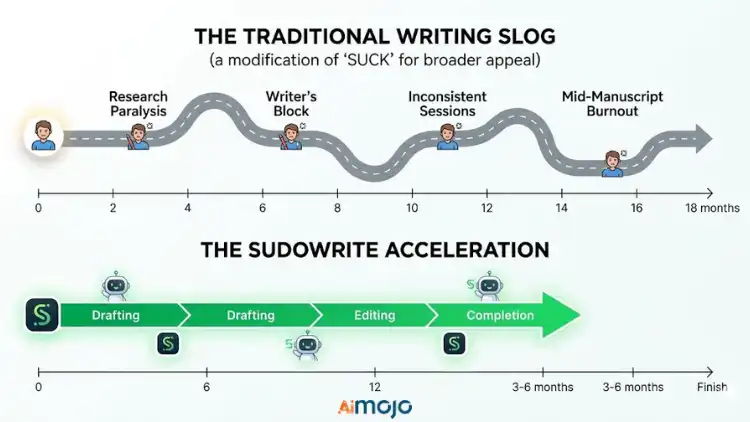
The average self-published author takes 6 zu 18 Monate to complete a first draft. Between research paralysis, writer's block, inconsistent writing sessions, and mid-manuscript burnout — the timeline stretches out. By the time they're done, the momentum is gone, the market has shifted, or they've lost faith in the project entirely.
Dass's the exact pain point Sudowrite was built to solve. Not to write the book für you — but to keep the story moving so you don't stall out.
Quick Answer: What Is Sudowrite?
Sudowrite ist ein AI writing tool built specifically for fiction and creative writing. Unlike general-purpose AI tools, it focuses entirely on helping authors outline, draft, rewrite, and polish long-form narrative content — novels, novellas, screenplays, and short stories.

Its flagship features include:
These tools work together inside a single workspace — no switching between apps, no copy-pasting between tools.

The Author Profile: Who This Sprint Was Designed For
The 30-day sprint workflow documented here is based on a composite of real Sudowrite users — specifically authors who:
This isn't a professional ghostwriter pulling 12-hour days. This is a regular author with a day job, family obligations, and a book they've been meaning to write for years.
Die 30-Tage Sudowrite Case Study: Week-by-Week Sprint Breakdown
Week 1 (Days 1–7): From Idea to Full Outline
The sprint starts before a single chapter is written. Most authors skip this step — which is exactly why they stall later.
Die Verwendung von Story-Engine, the author inputs a core premise: genre, protagonist, central conflict, and rough ending idea. Sudowrite then builds a multi-act outline with chapter-by-chapter scene beats.
So sieht das in der Praxis aus:
| Aufgabe | Verwendetes Werkzeug | Zeitaufwand |
|---|---|---|
| Core premise input | Story-Engine | 30 Min. |
| Full outline generation | Story-Engine | 1-2 Stunden |
| Character profiles & world details | Geschichtenbibel | 2-3 Stunden |
| Scene-by-scene beat sheet | Story-Engine | 1 Stunden |
By Day 7, the author has a complete structural blueprint. No more staring at a blank page wondering what happens next.
Week 2 (Days 8–14): First Draft Begins
With the outline locked, drafting starts. The goal here is volume over perfection — getting scenes onto the page fast.
Verwendung der Schreiben feature, the author types a brief scene setup (2–3 sentences) and lets Sudowrite generate a full scene draft. The author then edits it, injects their voice, and moves to the next scene.
A realistic output at this pace: 1,500–2,500 words per session, 2 sessions per day = 3,000–5,000 words daily.
By Day 14, the manuscript is typically 30,000–35,000 words in — past the dreaded mid-book slump where most authors quit.
"I've been able to go from taking six months to a couple of years to write a novel… to about one or two months."— Joe Vasicek, author of Genesis Earth
Week 3 (Days 15–21): Pushing Through to Full Draft
This is where the sprint gets real. The outline has been written, the story is moving — but the final act needs to be built.
Die Umschreiben feature becomes essential here. When a scene feels flat, instead of deleting it and starting over, the author hits Rewrite — Sudowrite offers 3–5 alternative versions of the scene in seconds. Pick the best one, refine it, and keep moving.
Beschreiben handles thin scenes. If a location or emotional beat feels underdeveloped, Describe adds sensory layers — sights, sounds, textures, internal emotional shifts — without ballooning the word count.
By Day 21, a full 50,000–55,000 word draft erledigt.
Week 4 (Days 22–30): Revision, Polish & Publishing Prep
The final stretch is not about adding more words — it's about making the existing manuscript publishable.
Sudowrite's revision workflow allows authors to:
By Day 28, the manuscript is revised. Days 29–30 are used for final formatting and upload to KDP (Kindle Direct Publishing), Draft2Digital, or the author's publishing platform of choice.
Methodology: How This Case Study Was Built
To keep this case study grounded, the 30-day sprint framework was built using:
The sprint structure is repeatable and has been adapted by authors across experience levels — from first-time novelists to authors with 10+ published titles.
Wie Sudowrite Vergleich mit anderen AI Writing Tools for Authors
AI book-writing tools are not all built the same. Here's wie Sudowrite stacks up against the alternatives most authors consider:
| Werkzeug | Am besten geeignet für | Fiction-Specific? | Long-Form Capable? | Bemerkenswerte Schwäche |
|---|---|---|---|---|
| Sudowrite | Fiction & narrative writing | ✅ ja | ✅ Yes (novel-length) | Weak for non-fiction |
| Genspark KI | Research + content generation | ❌ Nein | Begrenzt | Not designed for narrative fiction |
| ChatGPT | Allgemeine Schreibaufgaben | ❌ Nein | With prompting | No structured fiction workflow |
| Jasper | Marketing copy & blogs | ❌ Nein | ❌ Nein | Nicht für das Geschichtenerzählen geeignet |
| Scrivener + AI | Manuskriptorganisation | ❌ Nein | ✅ ja | AI layer is external/manual |
For pure fiction — specifically the 30-day sprint model — Sudowrite is the only tool with a purpose-built workflow for novel-length drafting from outline to final revision. Genspark AI is worth mentioning for research and worldbuilding prep (excellent for gathering historical or technical reference material fast), but it doesn't replace Sudowrite at the drafting stage.
What Authors Are Getting Wrong About AI-Assisted Writing
Es's a persistent myth that using AI to write a book means the author isn't really writing the book. That's not how Sudowrite funktioniert in der Praxis.
Every scene still needs the author's direction. The story beats are the author's. The characters, conflicts, emotional arcs — all author-driven. Sudowrite Griffe die mechanischer Widerstand of writing: the moments where the cursor blinks and nothing comes out.
Think of it less like “AI writes my book” and more like "AI removes the friction between my idea and the page.”
The authors completing 30-day sprints are not producing AI-slop. They're producing structured, voiced, emotionally driven narratives — faster than they ever could alone.
Who Should Try the 30-Day Sprint
This sprint model works best if you:
It's less suited for literary fiction that requires deep revision over years, or non-fiction/memoir where structure is heavily research-dependent.
The Results Speak Clearly
Authors who follow the full Sudowrite sprint workflow consistently report:
For indie authors in genre fiction — where publishing frequency directly impacts income and visibility — this isn't a gimmick. It's a business-level advantage.
Endgültige Take
The 30-day book sprint is not a fantasy for productivity influencers. It's a documented, repeatable workflow that serious authors are using right now with Sudowrite to ship more books, faster, without sacrificing story quality.
If you've had a book idea sitting in a notebook for months (or years), the 30-day sprint is the most direct path from that idea to a published manuscript. Sudowrite's story-specific toolset makes the sprint structurally possible — the rest is just showing up every day.
AiMojo empfiehlt:


 BONUS: Holen Sie sich unsere 200 $“AI „Mastery Toolkit“ KOSTENLOS bei der Anmeldung!