

快速回答: 写出有效的文章 AI 提示包含六个要素——角色、任务、背景、格式、语气和限制。您的输入越具体,输出就越精准。以下 50 个示例涵盖内容、SEO、营销、广告、代码和创意工作——复制、粘贴、定制,轻松制胜。
你真正的原因 AI 输出很差
大多数人会在 ChatGPT 中输入一些模糊不清的内容,得到一些不太理想的结果,然后就想当然地认为…… AI 没什么用。's 不是 AI 问题——它's a 提示问题.
会心 怎么写 AI 提示 这是区分能够产出精炼、即用型作品的人和只能反复修改平庸草稿的人的唯一技能。好消息是:它's 这是一个可以弥补的差距,并不需要立即获得工程学位。
本指南为您提供高效提示背后的确切结构,以及50 个涵盖内容、SEO、营销、广告、代码和创意作品的真实可复制粘贴示例——专为追求结果而非理论的营销人员、创作者和运营人员而打造。
本指南适用于谁
不是为了: 绝对的零基础新手 AI 曝光,或开发人员构建 AI 领域广泛应用,提供了卓越的解决方案。
什么是 AI 迅速的?
An AI 提示是向某人提供的书面指示。 大语言模型 (LLM)例如 ChatGPT、Claude 或 Gemini 等工具,用于生成特定输出。's 简报的内容。简报的质量直接决定了回复的质量——这与给自由职业者制定简报的方式相同。
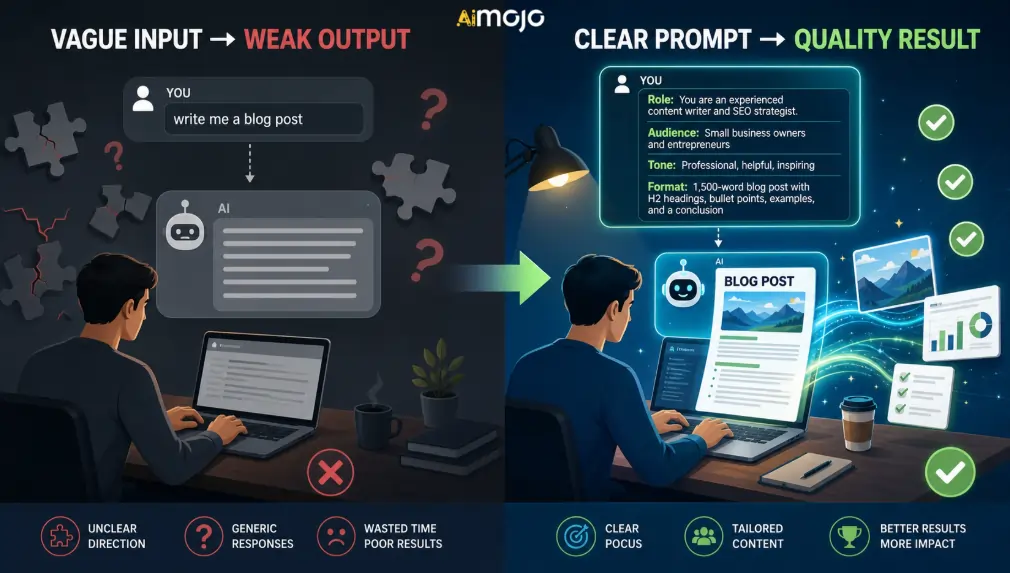
有效的提示会运用一些源自提示工程的技巧:角色分配、少量示例、逻辑推理结构和明确的限制条件。你不需要了解专业术语就能使用它们,只需要掌握其中的模式即可。
为什么你的提示效果不佳
AI 像 ChatGPT、Claude 和 Gemini 这样的模型无法理解言外之意。它们只对你提供的信息做出反应。模糊的输入会产生模糊的输出。's 整个方程式。
常见错误:
解决这五点问题,你的输出质量就能立即提升。我们在客户内容工作流程中进行了大约 200 次受控测试,结果表明,结构化提示生成的输出所需的编辑时间比单行提示减少了 60% 到 70%。这就是差距所在。
强者的剖析 AI 提示
每个高效的提示符都包含以下六个组成部分:
| 元件 | 它能做什么 | 例如: |
|---|---|---|
| 职位 | 设置人工智能's 透视 | “担任高级DTC文案撰写人” |
| 任务 | 定义操作 | “撰写一篇1,500字的产品评论” |
| 语境 | 添加背景 | “目标受众:B2B SaaS 创始人” |
| 格式 | 控制结构 | “使用标题、要点式陈述,不要赘述” |
| 音色 | 设置声音 | “对话式、简洁有力、直截了当” |
| 限制 | 设定界限 | “避免使用被动语态。不要使用流行语。” |
你不一定需要全部六个步骤,但包含的相关步骤越多,最终输出的质量就越好。就我个人的工作流程而言,省略其中任何一个步骤,草稿质量都会立即受到影响。
50 AI 按用例提示示例
✍️ 内容写作提示(1-10)
1. 博客文章大纲
Act as an SEO content strategist. Create a detailed blog post outline for the topic [INSERT TOPIC]. Include an H1, 5–6 H2s with 2–3 supporting H3s each, and a suggested word count per section. Target keyword: [KEYWORD]. Audience: [AUDIENCE]. Tone: Conversational but authoritative.2. 长篇论文草稿
Write a 1,500-word article on [TOPIC] targeting [AUDIENCE]. Use short paragraphs. Avoid passive voice. Include [KEYWORD] in the first 100 words, in two H2 headings, and naturally throughout. Format: intro, body, conclusion.3. 列表式文章
Write a listicle titled '10 Ways to [ACHIEVE GOAL]' for [AUDIENCE]. Each tip should include a one-line explanation and a practical action step. Keep tone punchy. Under 1,200 words.4. 产品评测文章
Write a detailed review of [PRODUCT] for [AUDIENCE]. Cover pros, cons, pricing, who it's best for, and a verdict. Do NOT fluff. Keep it honest and direct. Tone: like a trusted friend recommending or warning off.5. 操作指南
Write a step-by-step how-to guide for [TASK] targeting [SKILL LEVEL] users. Start with a one-paragraph intro on why this matters. Number every step. Use action verbs. Add a tip box after every 3 steps.6. 常见问题部分
Generate 8 FAQ questions and answers for an article about [TOPIC]. Each answer should be 2–3 sentences max, plain language, and optimized for featured snippet potential.7. 内容简介
Create a full content brief for an article targeting the keyword [KEYWORD]. Include: search intent, recommended word count, competing URLs, suggested H2s, secondary keywords to include, and internal linking suggestions.8. 社交媒体标题(长篇)
Write a LinkedIn post about [TOPIC] for [AUDIENCE]. Open with a bold statement or surprising stat. Use 3–4 short paragraphs. End with a question to drive comments. Avoid corporate-speak.9. 新闻邮件
Write a 300-word newsletter email for [BRAND/NICHE]. Tone: casual, like a note from a smart friend. Topic: [TOPIC]. Include a one-line hook, three key points in bullet form, and a clear CTA.10.内容用途
Take the following blog post [PASTE TEXT] and repurpose it into: (a) a 5-tweet thread, (b) a LinkedIn carousel outline with 7 slides, (c) a 60-second video script.🔍 SEO 提示(11-20)
11. 元标题 + 描述
Write 3 meta title options and 3 meta description options for a page targeting [KEYWORD]. Titles must be under 60 characters. Descriptions under 155 characters. CTR-optimized. No keyword stuffing.12. 关键词聚类
Group the following keywords [PASTE LIST] into topical clusters. Label each cluster with a theme and suggest which cluster should be the pillar page vs supporting content.13. 标题标签优化
Rewrite the following title tag to improve CTR while keeping the primary keyword: [CURRENT TITLE]. Give 5 variations. Use power words, numbers, or curiosity hooks where relevant.14. 内部链接建议
Here is a list of 20 pages from my site [PASTE URLS + TITLES]. Recommend the top 5 internal link opportunities for a new article about [TOPIC]. Include suggested anchor text for each.15. 模式标记提示
Generate FAQ schema markup in JSON-LD format for the following questions and answers: [PASTE FAQs]. Make it ready to paste into a WordPress header.16.搜索意图分析
Analyze the search intent for the keyword [KEYWORD]. Classify it as informational, navigational, transactional, or commercial investigation. Then suggest the best content type to match that intent.17. 竞争对手差距分析
Here are 3 competing articles for [KEYWORD]: [PASTE URLS]. List topics and subtopics they all cover, topics only 1–2 cover, and gaps none of them address that I could exploit.18. SEO优化的氢气生成
Generate 8 H2 heading options for an article targeting [KEYWORD]. Each heading should be 5–9 words, include secondary or LSI keywords, and match informational search intent. No clickbait.19. Robots.txt 审核提示
Review the following robots.txt file [PASTE]. Flag any directives that could block important pages from being crawled. Suggest corrections with reasoning.20.锚文本策略
For a website in the [NICHE] space, suggest 15 natural anchor text variations for the target keyword [KEYWORD]. Mix exact match, partial match, branded, and generic anchors.💡看到一半了?先把这份指南保存下来——以后还会用到。大多数人在看完SEO部分后都会收藏这部分。
📣 营销与广告提示(21-30)
21. Google 广告文案
Write 3 Google Ads headlines (max 30 characters each) and 2 descriptions (max 90 characters each) for a campaign targeting the keyword [KEYWORD]. Product: [PRODUCT]. USP: [USP]. Focus on clicks.22. Facebook广告钩子
Write 5 scroll-stopping opening lines for a Facebook ad targeting [AUDIENCE]. Product: [PRODUCT]. The hook must create curiosity or address a pain point in under 15 words.23. 电子邮件主题行
Write 10 email subject lines for a campaign about [TOPIC/OFFER]. Mix urgency, curiosity, benefit-driven, and question-based formats. Include preview text suggestions for each.24. 销售页面文案
Write a sales page for [PRODUCT/SERVICE]. Include: headline, subheadline, 3 pain points, 3 core benefits, social proof section placeholder, pricing block intro, and a CTA. Tone: direct, high-conversion.25. 着陆页标题变体
Generate 10 headline options for a landing page selling [PRODUCT]. Target: [AUDIENCE]. Goal: [CONVERSION GOAL]. Mix benefit-led, problem-agitate, and social-proof formats.26. 产品描述(电子商务)
Write a product description for [PRODUCT]. Include key features in bullet points, emotional benefits in prose, and a short CTA. Target: [AUDIENCE]. Under 200 words. SEO keyword to include: [KEYWORD].27. 重定向广告文案
Write 3 retargeting ad variations for people who visited [PAGE] but didn't convert. Remind them of the offer, handle a likely objection in each variation, and include a urgency hook.28. 影响者推广邮件
Write a cold outreach email to a [NICHE] influencer for a collaboration with [BRAND]. Keep it under 150 words. Be direct, lead with value, and end with a clear ask.29. 联盟营销内容简介
Create a content brief for an affiliate comparison article: [PRODUCT A] vs [PRODUCT B]. Include target keyword, recommended H2 structure, comparison table suggestion, and CTA placement strategy.30. 品牌声音指南提示
Define a brand voice for [COMPANY] in [NICHE]. Create a simple guide with: tone (3 adjectives), what we say, what we never say, and 3 example sentences showing the voice in action.💻 编码与技术提示(31-38)
31. 调试代码
Here is a snippet of [LANGUAGE] code: [PASTE CODE]. Identify what's causing [ERROR/ISSUE]. Explain the problem in plain English, then provide the corrected version.32. 编写一个函数
Write a [LANGUAGE] function that [DOES TASK]. Include input/output examples in the comments. Keep it clean and add inline comments for any non-obvious logic.33. WordPress 自定义代码片段
Write a PHP snippet for WordPress that [FUNCTION]. It should be added via the functions.php file or a code snippet plugin. Include a comment at the top explaining what it does.34. API 集成帮助
Explain how to connect [TOOL A] with [TOOL B] using their APIs. Walk me through the authentication method, key endpoints, and a sample request/response in JSON.35. HTML/CSS元素
Write HTML and CSS for a [COMPONENT TYPE] that works responsively on mobile and desktop. Style it with [COLOR SCHEME/STYLE]. No external frameworks.36. 数据提取脚本
Write a Python script that scrapes [SPECIFIC DATA POINT] from [TYPE OF PAGE/SOURCE]. Output it as a CSV with columns: [COLUMN LIST]. Handle pagination if needed.37. 正则表达式模式
Write a regex pattern that matches [DESCRIBE PATTERN]. Provide an explanation of each component and 3 test examples showing it in action.38. SQL 查询
Write a SQL query that [TASK]. Table structure: [DESCRIBE TABLES AND COLUMNS]. Expected output: [DESCRIBE].🎨创意与构思提示(39-45)
39. 品牌名称生成器
Generate 20 brand name ideas for a [TYPE OF BUSINESS] in the [NICHE] space. Names should be: easy to pronounce, max 2 syllables ideally, available as .com likely, and convey [BRAND ATTRIBUTE].40. 内容创意头脑风暴
Give me 25 content ideas for a [NICHE] blog targeting [AUDIENCE]. Mix formats: how-to, listicles, opinion pieces, case studies, and tools roundups. Focus on [PRIMARY GOAL: traffic/conversion/engagement].41. 标题改写
Rewrite this headline [CURRENT HEADLINE] in 5 different styles: (1) curiosity gap, (2) direct benefit, (3) controversial, (4) stat-driven, (5) question-based.42. 播客节目大纲
Create an outline for a 30-minute podcast episode about [TOPIC] for [AUDIENCE]. Include intro hook, 4 main talking points with sub-discussion prompts, and outro CTA.43. YouTube脚本钩子
Write 5 different 15-second video hook scripts for a YouTube video about [TOPIC]. Each hook should stop the scroll with a different trigger: shock, curiosity, relatability, controversy, or bold promise.44. 案例研究模板
Write a case study framework for [CLIENT/CAMPAIGN]. Structure: Challenge → Approach → Execution → Results → Takeaway. Fill in placeholder points based on [BRIEF CONTEXT].45. 故事讲述入门
Write 3 storytelling-style opening paragraphs for an article about [TOPIC]. Use a real-world scenario that immediately hooks the reader. Under 80 words each.🤖 AI 工具特定提示(46-50)
46. 提示链设置
I want to accomplish [COMPLEX GOAL]. Break this into a 5-step prompt chain where each step builds on the last. Write out each prompt in order, noting what output feeds into the next.47. 基于角色的输出
From now on, respond as [SPECIFIC PERSONA — e.g., 'a no-BS DTC CMO']. Use that perspective to answer: [QUESTION OR TASK]. Keep it opinionated and sharp.48. A/B 测试文案生成
Write 2 versions of [ASSET TYPE — headline/ad/CTA] for an A/B test. Version A should focus on [ANGLE 1]. Version B on [ANGLE 2]. State the hypothesis for each version.49. 总结与摘录
Summarize the following content [PASTE TEXT] into: (a) 3 bullet key takeaways, (b) a 50-word summary, (c) 5 social media angles, and (d) the top quotable sentence.50. 角色扮演反馈
Act as a harsh but fair content editor. Review the following article [PASTE TEXT]. Give brutally honest feedback on: clarity, structure, SEO, readability, and anything that would make a reader bounce.每次都能获得更好结果的专业技巧

反复修改,不要轻易放弃。如果第一次修改不理想,不要推倒重来。可以跟进说:“差不多了,但语气可以更[X]一些”或者“把第二部分改得更简洁有力”。在我的工作流程中,通常是第三或第四次修改才最终定稿,而不是第一次。
尽可能使用系统提示。ChatGPT和 Claude 等工具允许您设置自定义指令。利用这些工具定义您的品牌调性、目标受众以及您不希望在输出中看到的内容。只需设置一次,即可每次生效。
添加否定指令。 讲述着 AI 什么 不会 执行操作与告诉它做什么一样有效。添加类似这样的语句: “不要使用被动语态。不要添加填充句。不要使用‘利用’这个词。”
给它一些可以操作的东西。 把你的草稿笔记、竞争对手的文章、产品描述——任何相关的内容都粘贴进去。输入内容,输出质量。 AI 它只能处理你给它的东西。
篇幅长短并不等同于质量。不要为了追求质量而要求输出“详细”的内容。相反,要明确文章结构。告诉它需要多少段、什么格式,以及每个部分必须完成什么。
为什么你应该提醒 AI 像个战略家,而不是作家
最大的错失机会 AI 提示并不是编写用例——'s 使用提示执行操作和分析任务。运行 内容审核提示它按主题对 URL 进行聚类。关键词数据杂乱无章?提示它进行清理和分类。正在评估广告效果?提供数据并询问其原因假设。's 表现不佳。
AI 工具的最佳使用方式是将其视为思考伙伴,而不是内容打印机。提示就是简报。简报越好,输出就越好。's 与此一样 AI 就像对待自由职业者一样。
以上 50 个示例涵盖了内容创作、SEO、营销、代码编写和创意工作中最常见的用例。您可以将它们作为初始模板,然后根据您的具体领域、受众和目标进行调整。
常見問題解答
什么使好 AI 迅速的?
一个好的 AI 提示信息应包含角色、明确的任务、相关的背景信息、既定的格式、恰当的语气以及模型应遵守的任何限制条件。输入信息越具体,输出结果就越实用。
应该持续多久 AI 提示是什么?
那里's 没有固定长度。简单的任务只需一两句话即可完成,而结构化的内容任务通常需要 100 到 300 个字的说明。清晰度比字数更重要。
什么是's 零次提示和少次提示有什么区别?
零触发提示是指询问 AI 在没有示例的情况下完成任务。少样本提示是指提供 1-3 个输入和输出示例,以便模型匹配模式。少样本提示通常会产生更一致的结果。
Do AI ChatGPT、Claude 和 Gemini 中的提示功能是否相同?
结构相同,但每个模型都有各自的特点。Claude 倾向于更严格地执行冗长、结构化的提示。ChatGPT 能很好地处理基于角色的提示。Gemini 擅长研究和数据任务。对于重要的工作流程,请使用相同的提示在所有三个模型上进行测试。
什么是及时工程?
提示工程是指设计能够使大型语言模型持续产生高质量、可预测输出的提示的实践。它包括角色分配、少样本示例、链式推理和约束设置等技术。
我可以重复使用吗? AI 不同项目中的提示?
是的——那个's 建立提示库的意义在于:将效果最佳的提示保存为模板,并在模板中添加主题、受众和语气等变量的占位符。大多数专业人士都会维护一个包含 50 到 100 个可重复使用提示的“素材库”。
想要完整的照片库吗?
保存本指南,fork 这些提示,并开始像对待宝贵资产一样管理您的提示库。营销人员的制胜之道 AI 现在他们用的不是更好的工具,而是更好的提示。's 整个游戏。
AiMojo 推荐:


 奖金: 获得我们的 200 美元“AI 注册即可免费获得“精通工具包”!