

Ollama Key Insights
奥拉玛是什么?
奥拉马 is an open-source local LLM runtime platform that lets developers, researchers, and businesses download, manage, and run large language models directly on their own hardware without sending a single token to an external server. It wraps model weights, configuration files, and runtime dependencies into a single, clean package exposed via a command-line interface and a fully OpenAI-compatible REST API at localhost:11434.
把它当作你的个人 AI inference server with zero per-token billing. It supports over 200 open-weight models including Llama 3, Mistral, DeepSeek R1, Gemma 4, and Qwen, runs across macOS, Linux, and Windows, and integrates with over 40,000 community tools including 浪链, LlamaIndex, and Open WebUI. For any team or solo developer that needs private, cost-controlled AI inference, Ollama is the industry baseline.
Ollama exposes a local REST endpoint at http://localhost:11434/v1 that mirrors the 可选AI 在线聊天 Completions API structure exactly. This means you can build and test your entire LLM-powered application locally using the OpenAI SDK, then flip two environment variables to go live in production. No refactoring, no adapter layers. For API-first developers building agents or automation pipelines, this is the single biggest time saver in the local AI 空间。
奥拉马's Modelfile is its equivalent of a Dockerfile for LLMs. You define base model, system prompt, inference parameters like temperature and top-p, and context window size in a single declarative file. You then build and version that configuration as a named model. This is critical for teams that need reproducible, project-specific model behaviour without ad-hoc prompt engineering at runtime.
Ollama auto-detects and utilises NVIDIA CUDA, AMD ROCm, and Apple Metal GPU backends to deliver accelerated inference on consumer hardware. On Apple Silicon, this is especially notable as M-series unified memory allows large 7B to 13B parameter models to run at practical generation speeds without a 独立显卡. The tool auto-offloads layers to GPU VRAM and CPU RAM intelligently, maximising throughput on mixed hardware.
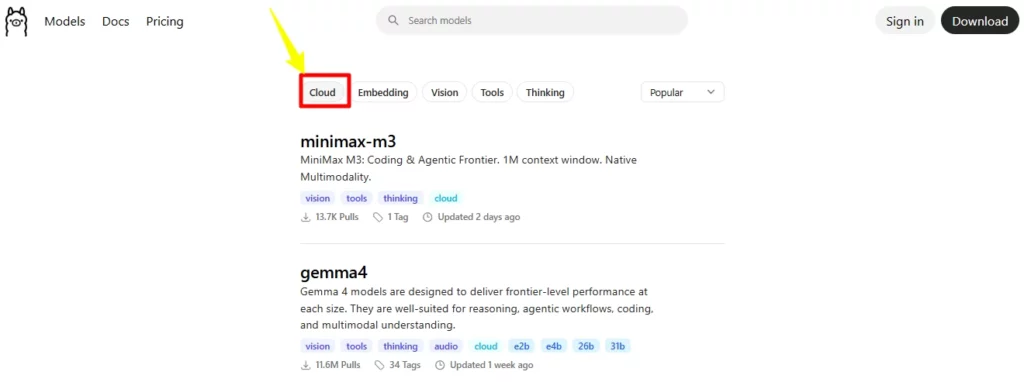
Beyond local inference, Ollama's cloud tier serves models hosted on NVIDIA Cloud Provider infrastructure using native weights and accelerated data formats including NVFP4 on Blackwell architecture. This gives users access to frontier-level models too large for consumer hardware, with a guarantee of zero prompt logging and zero training on user data.
奥拉马's API-first design has resulted in an enormous integration surface area. It plugs directly into coding assistants, RAG pipelines via LangChain and LlamaIndex, frontend GUIs like Open WebUI, and IDE extensions. For any developer building AI-native products, this breadth of tooling eliminates the integration tax that plagues narrower local AI 平台。
Ollama Pricing Plans
| 租赁计划 | Cost | 关键限制和功能 |
|---|---|---|
| 自由 | $0 | Unlimited local inference, 1 concurrent cloud model, light cloud usage, CLI and API access, 40,000+ integrations |
| 专业版 | $ 20 /月 | Everything in Free, 3 concurrent cloud models, 50x more cloud usage than Free, private model upload and sharing |
| max. | $ 100 /月 | Everything in Pro, 10 concurrent cloud models, 5x more cloud usage than Pro, suited for continuous agent tasks |
| 团队 | 即将推出 | Shared usage, centralised billing, SSO, model access controls, MDM installer, priority support |
Ollama for Privacy-Critical Industries
Healthcare, legal, and financial teams face strict data residency and compliance requirements that make cloud AI services a liability. Ollama eliminates this risk entirely. All inference happens on your own infrastructure, meaning patient records, legal documents, and financial data never leave your network.
Paired with enterprise-grade models like Llama 3 or DeepSeek R1, teams get LLM capability that satisfies internal security audits without sacrificing output quality. This is not a theoretical benefit. It is a production-ready deployment model.
Ollama for Agentic and Automation Workflows
奥拉马's concurrency support on the Pro and Max tiers unlocks true multi-agent architectures. Running three or ten cloud models simultaneously means orchestration frameworks like LangGraph or AutoGen can spawn specialist sub-agents for coding, research, and summarisation in parallel.
Combined with the OpenAI-compatible API, you can connect orchestration logic written against any major LLM framework without modification. For developers building autonomous pipelines, this is the infrastructure foundation that removes cloud cost as a constraint.
利与弊
- 可选AI API drop-in replacement.
- 200+ supported open models.
- Runs fully offline.
- Fast GPU auto-detection.
- Massive integration ecosystem.
- Zero data logging on cloud tier.
- No native built-in chat UI.
- No native image generation support.
- Team plan not yet live.