
Dust Key Insights
Toz Nedir?
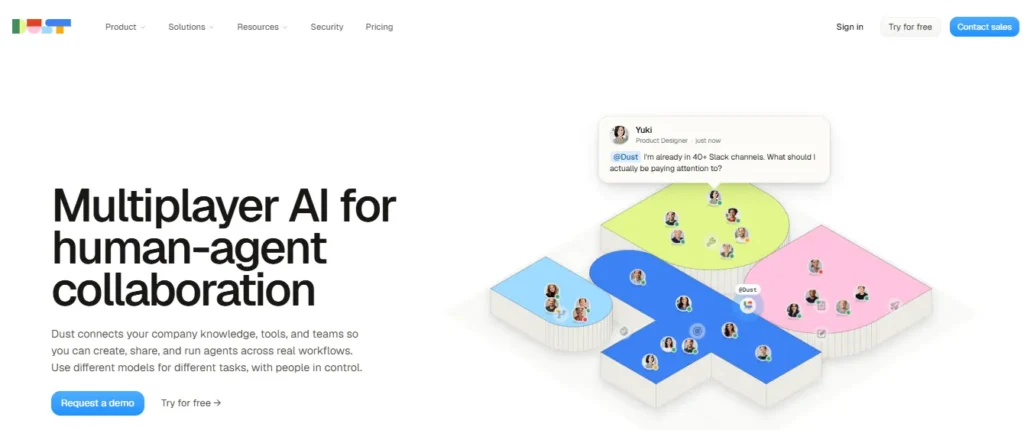
Toz bir AI agent platform built for teams that need to connect company knowledge, internal tools, and large language models into one unified workspace. It allows technical and non-technical users to build custom AI assistants that pull context from sources like Slack, kavram, Google Drive, Salesforce, and Zendesk through over 70 connectors.
Agents use Retrieval Augmented Generation (RAG) to ground their responses in your actual company data rather than producing generic outputs. The platform supports çoklu ajan orkestrasyonu, meaning multiple agents can work together across departments on complex workflows.
Dust is designed around what the company calls “multiplayer AI,” where people and agents collaborate in shared spaces. With SOC 2 Type II, GDPR, and HIPAA compliance built in, the platform meets enterprise security requirements out of the box.
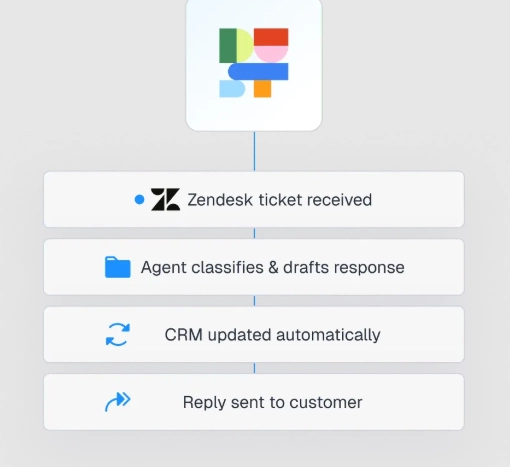
Dust lets any team member build an AI agent tailored to a specific workflow. You define the agent’s instructions, choose from 20+ LLMs, connect it to relevant data sources, and set its permissions. This means a support team can create a Zendesk response drafting agent while engineering builds a GitHub incident summariser, all within the same workspace. Over 50 pre-made templates speed up initial setup significantly.
Rather than running isolated chatbots, Dust supports workflows where multiple agents communicate and hand off tasks. You can set up scheduled triggers (for example, a Friday Slack digest agent) or event-driven triggers that fire when a CRM record changes. This moves the platform beyond simple Q&A into genuine process automation across departments.
Dust connects to the tools teams already use. Google Drive, Slack, Notion, Confluence, GitHub, HubSpot, Salesforce, Snowflake, BigQuery, and Zendesk are all available as native connectors. For tools without a built-in connector, Dust supports the Model Bağlam Protokolü (MCP), allowing custom integrations. This breadth of connectivity means agents can pull the right context from wherever it lives.
Pods are collaborative workspaces where team members and agents share context, conversations, and outputs. This is where Dust distinguishes itself from single-user AI assistants. Multiple people can work with the same agent, see shared conversation history, and build on each other’s work. The result is a genuine team tool rather than an individual productivity hack.
Dust uses a dual-layer permission model separating what agents can access from who can use them. SCIM-synced groups, role-based access (Admin, Builder, Member), domain verification, SSO enforcement, and audit logs give IT and security teams full control. Data encryption uses AES-256 at rest and TLS in transit. For regulated industries, this level of governance is a hard requirement, not a nice-to-have.
Frames allow users to build interactive dashboards and lightweight apps directly within Dust. Business plan users get standard Frames while Enterprise customers receive white-labelled versions. This feature turns agent outputs into actionable, shareable visual tools without needing a separate BI platform.
Dust Pricing Plans
| Plan Adı | Ücret | Başlıca Sınırlamalar ve Özellikler |
|---|---|---|
| Ücretsiz | $0 | 500 lifetime credits, 20+ models, custom agents, up to 3 connectors |
| başına | $24/koltuk/ay | 8,000 credits/seat/month, 5 remote MCP servers, 5 Spaces, SSO on 5+ seats |
| maksimum | $120/koltuk/ay | 40,000 credits/seat/month, expanded limits on all Pro features |
| Enterprise | görenek | Unlimited connectors, pooled credits, SCIM, single-tenant deployment, dedicated CSM, SLA |
How Dust Handles Data Retrieval and Accuracy
Dust uses Retrieval Augmented Generation (RAG) to ground every agent response in your connected data. The system performs anlamsal arama across your knowledge base and returns cited sources alongside its answers. This approach significantly reduces hallucinations compared to standard LLM outputs.
However, retrieval quality depends heavily on the underlying data. Outdated documents, duplicate sources, vague file names, and non-textual content can all degrade accuracy. Teams should invest in clean, well-organised documentation before connecting it to Dust. The platform itself does not currently flag stale content automatically, so periodic data hygiene reviews are recommended.
Who Gets the Most Value From Dust?
Dust works best for mid-size to enterprise teams with established documentation and repeatable workflows. Support and operations teams benefit from standardised answer agents. Product and engineering teams use it for incident summaries and internal documentation search. Sales teams build agents that draft outreach using CRM data and call transcripts.
Leadership teams synthesise insights from internal reports. Solo users, teams without existing knowledge bases, or organisations needing heavy no-code automation beyond agent creation may find Dust less useful. The platform rewards teams that have already invested in structured documentation and clear data ownership.
Artıları ve eksileri
- 20+ frontier LLMs included.
- 70+ native data connectors.
- Strong enterprise security compliance.
- Intuitive no-code agent builder.
- Multiplayer collaboration with Pods.
- 50+ pre-built agent templates.
- Yeni başlayanlar için dik öğrenme eğrisi.
- Per-seat pricing adds up quickly.
- No built-in agent versioning.
- Ücretsiz erişim oldukça sınırlıdır.
Best Dust Alternatives
| Enterprise AI Ajan Platformu | Çoklu Ajan Orkestrasyonu | Kurumsal Uyumluluk |
|---|---|---|
| Gumloop | ✅ Workflow + Agent combined | SOC 2, GDPR |
| hayır | ❌ Workflow-focused, not multi-agent | Self-hosted option, no SOC 2 by default |
| Mürettebat AI | ✅ Purpose-built for agent crews | SOC 2, SSO, PII masking |
| StackAI | ❌ Document-workflow focused | HIPAA, SOC 2 Type II, GDPR |