


In 2025 India texted AI-based monsoon forecasts to 38.8 million farmers.
Pooled trials of phone-based farm advice, almost all of it from before today's AI, find yield gains of 4 to 6%: real, cheap, and nowhere near enough on their own.
Açı: AI already reaches farmers in their tens of millions, mostly through the humblest channel there is: a message on a phone.
Where that channel has been tested properly, trials find it lifts yields by a few % at a cost of a dollar or two a year, and good forecasts change what farmers plant and spend.
But almost every big number about AI itself, from chatbot queries to farmers reached, is the provider's own count, and where the chain has been measured, the weak link is rarely the model.
It is the last mile to a farmer who receives the message, trusts it and can afford to act.
Numara
The monsoon arrived early in 2025, then stopped. For 20 days its march north across India stalled, the government says, and an AI tahmin saw the pause coming.
Hindistan's agriculture ministry told the Lok Sabha it had texted that forecast, in Hindi, Odia, Marathi, Bangla and Punjabi, to 38,845,214 farmers in parts of 13 states, to help them decide when to sow (PIB, March 2026).
The forecast blended two open AI weather models, Google's NeuralGCM and the European Centre's AIFS, with 125 years of Indian rainfall records.
It may be the most impressive AI farm story of the decade, and it comes with a gap. In July 2026, Ramnath Thakur, Minister of State for Agriculture, gave a written reply to the Rajya Sabha, India's upper house.
He said that “no specific assessment has been undertaken to comprehensively evaluate the impact” of AI-based technologies in farming (IndiAgri, 2026).
The same reply listed AI projects from pest surveillance to crop insurance, and said the government helps states put such tools within reach of small and marginal farmers.
By then, the government said, the India Meteorological Department's AI-based weather advisories had reached about 52.8 million farmers.
That gap is the subject of this piece. The series' science piece nasıl kapsadığını kapsar AI weather models score against physics; here I follow the forecast, the chatbot answer and the leaf photo to the farm gate.
Farms under two hectares make up five in every six farms in the world and grow about 35% of its food on about 12% of its farmland (FAO, 2021).
Their owners are skilled managers of risk with thin margins. The question is not whether AI is clever. It is whether it changes a decision for the better, often enough to matter.
Mojo's Law: Advice Is Worth What It Changes
Information has value only when it changes what someone does. Economists call this the value of information. For a farmer I write it like this:
V = P(\text{advice changes a decision}) \times G \;-\; CV is the value of one piece of advice to one farmer. P is the chance the advice makes her do something different. G is the gain when it does: a crop not lost, a spray not wasted, a sowing not repeated.
C is the cost of getting the advice to her.
A worked example, with illustrative numbers. Say a monsoon text costs Rs 5 to send to one farmer for a season.
Say 1 farmer in 10 waits a fortnight to sow because of it, and each one who waits avoids re-sowing that would have cost Rs 3,000. Then V = 0.1 × 3,000 − 5 = Rs 295 per farmer reached.
Now say the message only repeats what farmers already believed. P falls to 1 in 100, and V falls to Rs 25. If the advice is wrong, G turns negative and V can drop below zero.
Two lessons fall out. Cheap delivery lets small effects pay, which is why phone advice can pass a cost test with modest yield gains.
And a forecast's accuracy score is not its value: value needs a decision that changes, and changes for the better.
Does phone advice change what farmers do?
Yes, modestly and cheaply: two meta-analyses put the average yield gain from digital farm advice at 4 and 6%.
The programmes behind them ran before 2020, by text message, voice call, video or app, and none was an AI chatbot. They matter here because they are the pipes that farm AI now flows through.
The older pooled study, of seven trials, found yields 4% higher, with a 95% confidence interval from 0 to 8 (Fabregas, Kremer and Schilbach, Science, 2019, as summarised by GiveWell).
GiveWell, which reviewed the evidence in 2020, cut that to about 1.6% for its own cost-effectiveness model.
A 2025 meta-analysis of 20 studies, 15 of them in sub-Saharan Africa, found yields up 6%, incomes up 6% and fertiliser adoption up 23% (Beach and colleagues, Global Food Security, 2025).
Together they find (MES 4) a small, positive average effect.
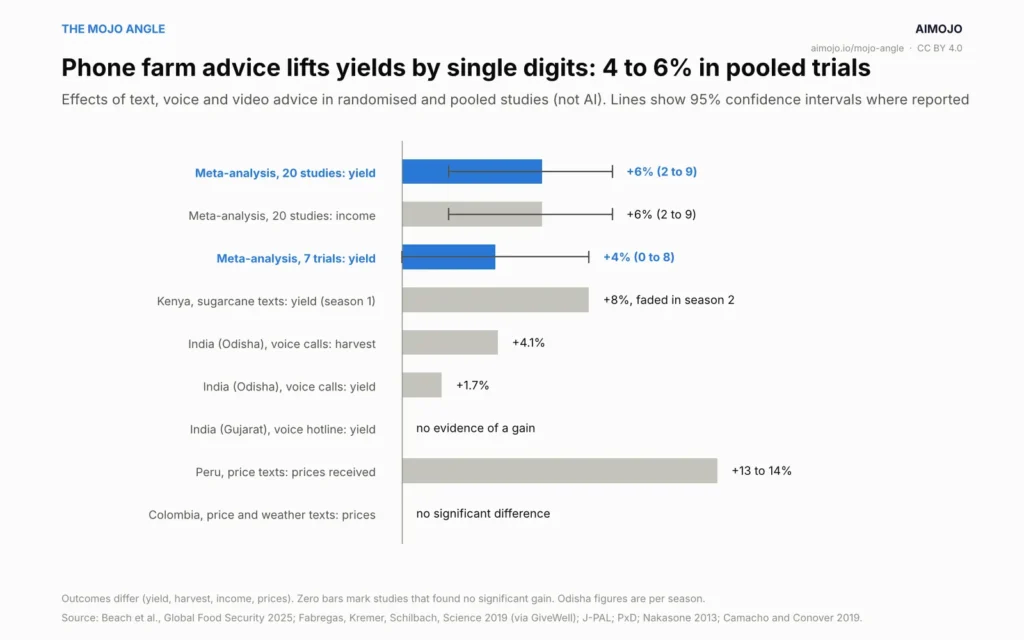
Source: Beach et al. (2025); Fabregas, Kremer and Schilbach (2019) via GiveWell; J-PAL; PxD; Nakasone (2013); Camacho and Conover (2019).
Single trials show the spread. In Odisha, an evaluation of voice advisory calls to 13,675 rice farmers suggests they raised yields 1.7% and harvests 4.1% a season, about 100 kg per farmer.
Severe crop losses were also 10% less common (PxD summary of Goldberg and Cole, 2025). In Kenya, text reminders lifted sugarcane yields 8% in the first season, then the effect faded (J-PAL).
In Gujarat, 90% of farmers offered a voice hotline used it, and they were 12.5% more likely to adopt recommended technologies and seeds, but there was no evidence of higher yields (Cole and Fernando, via J-PAL).
In Ethiopia, extension videos raised uptake of new practices by 6 percentage points (IFPRI).
Latin America adds a warning. In Colombia, 500 farmers who got eight texts a week with prices and weather found them useful, but the prices they received did not change (Camacho and Conover, World Development, 2019).
Peru'da's highlands, a field experiment suggests price texts lifted prices received by 13 to 14% (Nakasone, 2013).
J-PAL's review of 41 trials counts only 12 that found gains in yields or profits.
The costs are tiny. GiveWell put the cost of PxD's phone advice at about $1.80 per household a year in 2020, and Kenya's texts cost two cents each.
Mı AI chatbots good farm advisers yet?
They are popular and sometimes good, but I found no published trial showing that a farm chatbot raises yields or incomes.
Hindistan's Kisan e-Mitra, a voice chatbot first built for questions about the PM-KISAN income-support scheme, had answered more than 9.3 million queries in 11 languages by December 2025, the government says (PIB, February 2026).
Bharat-VISTAAR, a çok dilli AI advisory platform launched in Jaipur on 17 February 2026, had served over 300,000 farmers and handled more than 7.2 million queries by July, according to a parliamentary reply (IndiAgri, 2026).
Both figures are government counts of use, not outcomes (MES 2).
Dijital Yeşil's FarmerChat says it has about 1 million users in India. In a third-party survey by 60 Decibels, about 60% of active users said they act on its advice (Digital Green, via AgroSpectrum, 2026).
Digital Green claims advice costs about Rs 33 per farmer a year by chatbot, against Rs 3,300 in person. Acting on advice is a good sign; it is not a bigger harvest.
On quality, one careful test suggests promise and a limit. Four local experts rated answers to 32 rice farmers' questions in northern Nigeria.
ChatGPT's answers were generally rated higher than those of six extension agents, but it stumbled on numbers: planting dates, seed rates, fertiliser doses (Ibrahim and colleagues, Scientific Reports, 2024).
Those numbers are exactly what a farmer pays for.
The real test is under way. Researchers from IFPRI and the University of Chicago are running a randomised trial of Farmer.Chat across 600 villages in Kenya's Nakuru County, about 3,000 farmers.
Its main outcomes are use, knowledge and adoption; yields and income come second. It runs until 31 March 2027, with no results posted (AEA registry, 2026).
In Brazil, the farm research agency Embrapa is building an assistant on decades of its own research, a four-year project (Globo Rural via MundoCoop, 2026).
Do AI forecasts reach the field, and do farmers act?
They reach millions, and the best evidence says forecasts do change decisions, but a forecast on a server is not a warning in a field.
In Telangana, a randomised trial gave farmers in 250 villages an accurate monsoon-onset forecast four to six weeks ahead.
Those for whom it was bad news cut the land they farmed by 22% and their farm spending by 10%, and ended with $560 more in net savings.
Those for whom it was good news farmed 15% more land (Burlig and colleagues, NBER, 2024). The trial finds (MES 4) that forecasts move real money, in both directions.
Hindistan's 2025 programme scaled that idea with AI. The ministry calls it a pilot. In March 2026, it told Parliament it would fold the approach into a national system built by its own institutes.
That would include physics-based models from the Indian Institute of Tropical Meteorology that it says showed better skill at local onset (PIB, March 2026).
The developers report that their blend beat each of its parts at longer lead times and caught the 2025 dry spell (Aitken and colleagues, preprint, 2026).
That is the developers grading their own work over one live season (MES 2).
After the forecasts, Kisan Call Centre phone surveys in Madhya Pradesh and Bihar found 31 to 52% of farmers said they had changed planting decisions (PIB, March 2026).
There was no control group, and no sample size was published (MES 2). In May 2026 the India Meteorological Department launched its own AI onset model for 3,196 blocks in 15 states and one union territory.
Forecasts were issued weekly, up to four weeks ahead. A minister cited an error of about four days (Business Standard, 2026). Until the season is verified, that is a claim.
Floods tell a sharper story. By Google's own figures, its AI flood forecasts grew from India and Bangladesh in 2020 to 80 countries and 460 million people in 2023, and over 100 countries and 700 million people in 2024.
Its research site now claims river basins in more than 150 countries and about 2 billion people in at-risk areas, a wider definition (Google, accessed November 2026).
A peer-reviewed study by its developers suggests (MES 3) its five-day forecasts are as reliable as a leading global system's same-day ones, and that in Africa they bring skill close to Europe's (Nearing and colleagues, Nature, 2024).
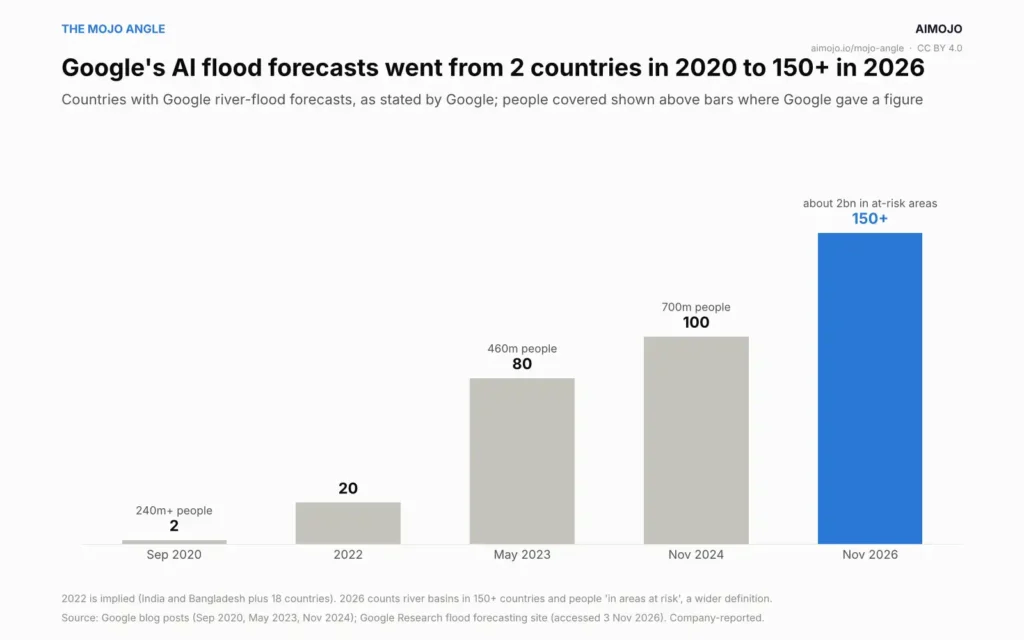
Source: Google blog posts (2020, 2023, 2024); Google Research flood forecasting site (accessed 3 November 2026). Company-reported.
Coverage is not receipt. Maulik Jagnani and Rohini Pande randomly assigned 319 village councils in 12 flood-prone districts of Bihar.
In 159, households had only Google's phone alerts, which reach Android phones with location turned on. In the other 160, trained volunteers also passed the warnings on by loudspeaker, flags and WhatsApp.
In 2023, 22.9% of households in the alerts-only villages said they got any alert, and 16.3% got one before the water arrived.
In volunteer villages those shares were 39.9 and 30.6%, and complete trust in alerts nearly doubled, from 13.3 to 25.2% (Jagnani and Pande, working paper, 2024).
Because the villages were assigned at random, the trial finds (MES 4) that the volunteer programme made the difference.
The payoff is narrower. Among the households that got the most alerts, the authors estimate spending on illness about a third lower, a subgroup result (MES 3).
They also measured household income, including from farming, and in severely flooded communities they “fail to find evidence for improved economic well-being.” They suggest two to four days' warning may be too short to protect crops.
Warnings work best when someone can act on them. In Bangladesh, a study suggests households sent cash before a forecast extreme flood were 36% less likely to go a day without eating during it (Pople and colleagues, CSAE, 2021).
In Colombia and Central America, 22 local agroclimatic committees say their seasonal bulletins reach about 510,000 farmers, though they publish no yield figures (CGIAR).
Can a phone camera diagnose a sick crop?
Sometimes, with enough leaves, but lab scores overstate field skill badly.
A 2016 model trained on 54,306 leaf photos scored 99.35% on held-out pictures from the same collection, and 31.4% on photos taken in other conditions (Mohanty, Hughes and Salathé, 2016).
The model had learned the studio as much as the disease.
Field tests are rarer and more honest. In Tanzania and Kenya, the PlantVillage Nuru app identified cassava mosaic disease from a single leaf 59% of the time and brown streak disease 21% of the time.
With six leaves per plant, that rose to 93 and 73%.
On a photo test, the app scored 65% against 49% for trained extension officers and 23% for trained farmers (Mrisho and colleagues, Frontiers in Plant Science, 2020).
The study, co-authored by the app's team, suggests (MES 3) that a well-used app can beat a busy adviser.
Hindistan's National Pest Surveillance System lets users photograph pests and get advice; the government says it covers 66 crops and more than 432 pest species, used by over 10,000 extension workers (PIB, February 2026).
An independent survey of 1,422 people in Odisha suggests only about half of its advice is followed: 49% of advisories were acted on.
For severe yellow stem borer attacks, that fell to about 10%, and uptake was lower when the recommended controls were costlier or more complex (Kumar and colleagues, Indian Journal of Extension Education, 2025).
Diagnosis was not the bottleneck; affording the cure was.
Do smart sprayers save as much as their makers say?
Roughly, yes: on large farms, university trials measured camera-guided sprayers cutting herbicide by 28 to 62%, a range that includes John Deere's own average.
Deere says its See & Spray customers saved 59% of herbicide on more than a million acres in 2024.
In 2025, they saved nearly 50% of non-residual herbicide on more than 5 million acres (Deere, company-reported). It does not publish its method.
Independent trials back the direction, though both come from one University of Arkansas team, working with a See & Spray prototype; the university's release mentions no Deere funding.
A peer-reviewed study at two sites in Arkansas and Mississippi measured See & Spray saving 28.4 to 62.4% of post-emergence herbicide against spraying the whole field (Avent and colleagues, Weed Technology, 2024).
A three-year University of Arkansas trial measured 43 to 59% less herbicide.
But at the low sensitivity setting, Palmer amaranth populations grew 280% a year as escaped weeds seeded the soil (University of Arkansas, 2025).
A rival, Greeneye, reported an 87% cut in non-residual herbicide in a University of Nebraska trial, through its own press release, which also showed slightly weaker grass control (MES 2).
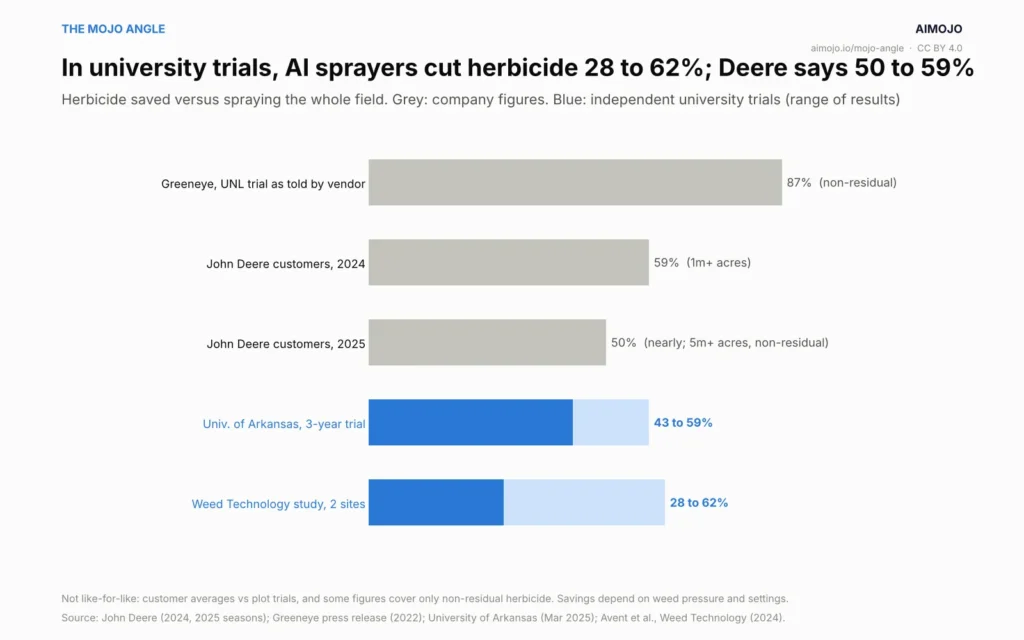
Source: John Deere (2024, 2025); Greeneye (2022); University of Arkansas (2025); Avent et al., Weed Technology (2024).
This is the one corner of farm AI where company claims and independent tests roughly agree (MES 3). It is also the corner furthest from the smallholder: these are machines for fields measured in hundreds of acres.
The Mojo formula: the last-mile product
A forecast or a diagnosis is only the first link in a chain, and every link multiplies. I call this the last-mile product:
E = A \times R \times U \times T \times DE is the share of farmers whose decision the advice improves. A is the chance the advice is right. R is the chance it reaches the farmer in time. U is the chance she understands it, in her language and units.
T is the chance she trusts it enough to act. D is the chance she can act: has seed, cash, labour or credit when it matters.
With illustrative numbers (A = 0.9, R = 0.7, U = 0.8, T = 0.6, D = 0.5), E is about 0.15. A forecast right 9 times in 10 improves about 15 decisions in 100. Lift the model from 0.90 to 0.95 and E gains less than one point.
Lift delivery from 0.7 to 0.9 and it gains about four; trust from 0.6 to 0.8, five; the means to act from 0.5 to 0.7, six.
In a product, a 10% gain in any link lifts E by 10%, so the links with the most room to grow pay most, and a model that is already right 9 times in 10 has little room left.
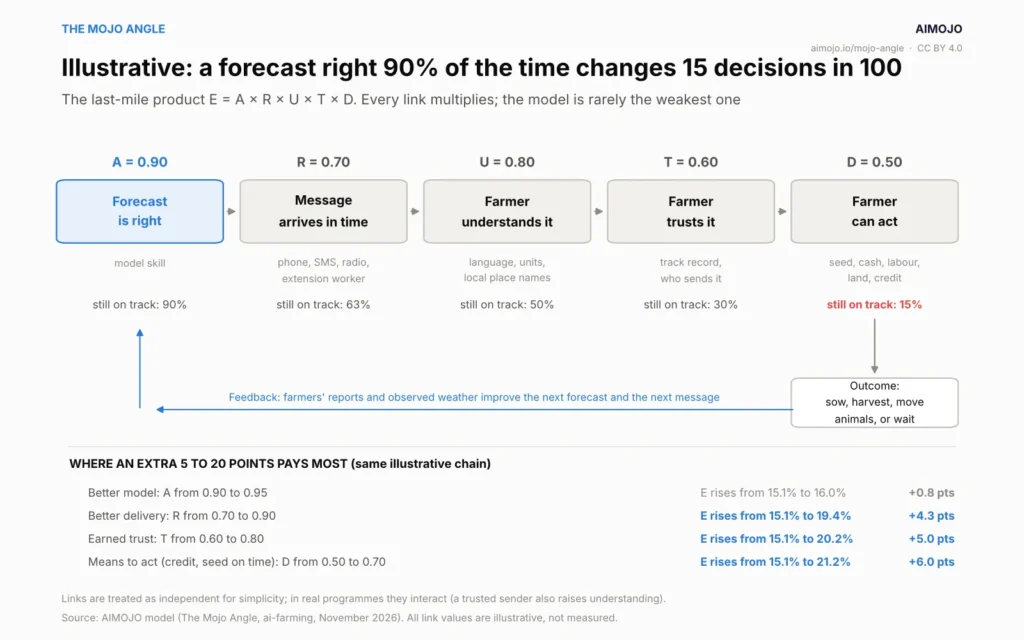
Source: AIMOJO model; values are illustrative, not measured.
Measured links are often weaker than my illustration. In Bihar's trial, the share of households warned before the water arrived was 16% without volunteers and 31% with them, far below my R of 0.7.
Complete trust was 13 and 25%. In Odisha, about half of pest advisories were acted on, and about one in ten for severe stem borer attacks. AI competes on A, because A is what benchmarks measure.
Farmers live on the product.
The Mojo Farm Evidence Board
The Board lists 34 claims and findings about digital and AI help for farmers that I opened and checked by 3 November 2026.
These cover trials, government statements, company figures and field tests across India, Africa, Latin America and the United States.
Each records who measured it, whether that was independent of the provider, whether the tool uses AI, and a Mojo Evidence Scale (MES) grade for the statement as made.
The grades run from 5 to 0. MES 5 means replicated trials or meta-analyses; MES 4 means one large randomised trial or consistent official statistics. MES 3 covers observational studies, early trials or credible audits.
MES 2 covers pilots, preprints and figures a company or government reports about its own tool. MES 1 means announcements and forecasts; MES 0 means a claim that did not hold up. I call MES 3 or above solid.
An entry counts as AI if the tool itself uses machine learning, and as independent if someone other than the provider measured it. For each group I compute a solid share and the gap between groups:
S_g = \frac{\text{entries in group } g \text{ at MES} \geq 3}{\text{entries in group } g}
\qquad
\Delta = S_{\text{not AI}} - S_{\text{AI}}| Semt | Girdileri | MES 3 or above | Bağımsız | Solid share |
|---|---|---|---|---|
| Phone and video advice (not AI) | 9 | 9 | 7 | 100% |
| AI chatbots and advisers | 6 | 1 | 2 | 17% |
| Forecasts and early warnings | 10 | 4 | 3 | 40% |
| Zararlı ve hastalık tespiti | 4 | 2 | 2 | 50% |
| Hassas püskürtme | 5 | 2 | 2 | 40% |
| Tümü | 34 | 18 | 16 | 53% |
The headline is the gap. Of the 22 entries about tools that use AI, 7 reach MES 3 or above, a solid share of 32%.
Of the 12 entries about help that does not use AI (phone advice, forecasts, cash before floods), 11 do: 92%. That is a gap of 60 points.
Yok hayır AI entry independently shows a gain in a smallholder's yield or income; the one independent trial that measured household income, Bihar's, found no evidence of improvement.
En güçlü AI evidence is about delivery (Bihar's alerts), quality (Nigeria's rice answers), compliance (Odisha's pest advisories) and big-farm sprayers.
One caution about the gap. The Board is a curated set, not a census. I included the government and company numbers about AI because they are the ones readers meet, while the entries without AI are mostly published trials.
So the gap says more about what the AI side has measured so far than about whether AI çalışabilir.
Talep Çeki
| İddia | Kim yapar | MES | Mojo's okumak |
|---|---|---|---|
| AI monsoon forecasts reached 38.8 million farmers in 2025 | Government of India (Lok Sabha reply), 2026 | 2 | A delivery count, not an outcome |
| 31 to 52% of farmers changed planting after the forecasts | Government of India, phone surveys, 2026 | 2 | Self-reported; no control group or sample size |
| Accurate monsoon forecasts change what farmers invest | Burlig et al., RCT, 2024 | 4 | Yes, in both directions |
| Digital advice raises yields | Two meta-analyses, 2019 and 2025 | 4 | By about 4 to 6%, cheaply |
| AI chatbots raise farm yields or incomes | Implied by chatbot launches | 1 | No trial results yet; first RCT ends March 2027 |
| Flood Hub covers 150+ countries and about 2 billion people | Google, 2026 | 2 | Coverage is not receipt: in Bihar's alerts-only villages, 23% of households got any alert in 2023 |
| See & Spray saved customers 59% of herbicide in 2024 | John Deere, 2024 | 2 | Plausible: university trials found 28 to 62% |
| Crop-disease AI accuracy in the lab carries to the field | Common reading of lab benchmarks | 0 | 99.35% fell to 31.4% on new photos |
| AI advisories could add Rs 70,000 crore a year for farmers | Minister Jitendra Singh, Feb 2026 | 1 | Arithmetic on an assumed Rs 5,000 each |
Karşı Açı
The strongest case against me runs like this. I am grading a fast-moving technology with yesterday's evidence. Most trials I lean on tested recorded voice messages and texts from before large language models.
A chatbot that answers a farmer's own question, in her own language, about her own field, is a different product. Waiting years for randomised trials while the climate gets less predictable has a cost.
And some things need no trial: if a flood warning arrives two days early, moving cattle to high ground is sensible.
Hindistan's monsoon programme, Google's flood forecasts and Kenya's chatbot are all being measured as they scale, with surveys and registered trials. Calling their numbers “claims” undersells serious work.
My reply: I agree about floods, and the Board gives warnings credit where the measured lead time and trust are real. But reach is not impact.
Farm advice has a long history of programmes that reached millions and changed little; J-PAL's review finds yield or profit gains in only 12 of 41 trials.
A chatbot that is fluent and wrong about fertiliser doses is worse than a recorded message that is dull and right.
Hindistan's own government told Parliament in July 2026 that it had not yet undertaken a specific assessment to comprehensively evaluate AI's impact on farming.
The registered trials are good news, and their results, not their reach, should set budgets.
İnsan Parçası
Mojo's Tahminleri
- By 31 July 2027, India's government will send AI-based or AI-blended monsoon onset forecasts to farmers for kharif 2027 in at least 15 states.
Olasılık: %80. - By 31 December 2027, no randomised trial of a generative-AI farm chatbot will report a statistically significant gain in smallholder yields or income.
Olasılık: %70. - By 30 June 2027, India's government will not have published an impact evaluation with a comparison group for Kisan e-Mitra, Bharat-VISTAAR, the National Pest Surveillance System or the AI monsoon forecasts.
Olasılık: %85.
Bu konu bundan sonra nerede tartışılacak?
SSS
Mı AI increase crop yields?
Not on its own evidence yet. Trials of phone-based advice, the channel most farm AI uses, find average yield gains of 4 to 6%; trials of AI chatbots have not yet reported results.
What is Kisan e-Mitra?
A voice-enabled AI chatbot from India's agriculture ministry, built first for questions about the PM-KISAN scheme.
The government reports more than 9.3 million queries answered in 11 languages by December 2025, but no impact evaluation.
Mü AI forecast India's 2025 monsoon?
For its onset, yes: AI-blended forecasts sent to 38.8 million farmers caught a 20-day stall, the government and developers say. Phone surveys found 31 to 52% of farmers said they changed planting plans.
Is Google Flood Hub useful for farmers?
It gives free river-flood forecasts up to seven days ahead in more than 150 countries, Google says. In a Bihar trial, alerts reached far more households when village volunteers passed them on; the study found no evidence of better economic well-being, including farm income, and did not measure crop yields.
Do AI weed sprayers really halve herbicide use?
On big farms, roughly: university trials found savings of 28 to 62%, and John Deere reports 50 to 59% customer averages.
Savings depend on weed pressure and settings.
Will AI replace agricultural extension workers?
The evidence points the other way: in Bihar, trained volunteers nearly doubled the share of households warned in time, and in Odisha the hard part was affording the cure, not naming the pest.
- Government conducts AI-based pilot for local monsoon forecasting to support kharif sowing decisions, Press Information Bureau (Lok Sabha reply), 17 March 2026.
- Hükümet's first-of-its-kind AI-based weather forecasting program for agriculture, Press Information Bureau, 12 September 2025.
- Artificial Intelligence (AI) Transforming Indian Agriculture, Press Information Bureau, 14 February 2026.
- AI reaches over 5.28 crore farmers, but Centre yet to assess impact on agriculture, IndiAgri, 25 July 2026.
- Union Agriculture Minister launches farmers' digital companion Bharat-VISTAAR, News on AIR, 17 February 2026.
- IMD launches two AI-enabled monsoon forecast models for first time in India, Business Standard, 12 May 2026.
- Designing probabilistic AI monsoon forecasts to inform agricultural decision-making, Aitken C, Masiwal R et al., arXiv, March 2026.
- Decision-oriented benchmarking to transform AI weather forecast access: application to the Indian monsoon, Masiwal R et al., arXiv, February 2026.
- Weather forecasts and farming practices in India, NBER Digest, June 2024, on Burlig F, Jina A, Kelley EM, Lane G, Sahai H, NBER Working Paper 32173.
- Meta-analysis of the impacts of digital information interventions on agricultural development, Beach RH et al., Global Food Security, 2025 (via RTI).
- Customized digital advice can help farmers reduce crop loss and manage weather shocks, Precision Development, on Goldberg J and Cole S.
- Improving smallholder agriculture with generative AI: the impact of Farmer.Chat in Kenya, AEA RCT Registry, AEARCTR-0017035, updated 27 July 2026.
- Farmer.Chat: scaling AI-powered agricultural services for smallholder farmers, Singh N et al., arXiv, 2024.
- FarmerChat: Digital Green's AI farming assistant crosses 10 lakh users in India, AgroSpectrum India, 3 August 2026.
- A big step for flood forecasts in India and Bangladesh, Google, 1 September 2020.
- How we're helping partners with improved and expanded AI-based flood forecasting, Google, 11 November 2024.
- Using deep learning for image-based plant disease detection, Mohanty SP, Hughes DP, Salathé M, arXiv and Frontiers in Plant Science, 2016.
- Machine-vision technology shows promise to reduce herbicide use, Weed Science Society of America via EurekAlert, 26 November 2024, on Avent T et al., Weed Technology, 2024.
- Union Minister Jitendra Singh on AI's value to farmers (Rs 70,000 crore a year), Free Press Journal, 23 February 2026.
- Agritechnica 2027: Connecting Agricultural Intelligence, DLG, accessed 3 November 2026.


 BONUS: 200$'lık "AI Kaydolduğunuzda “Mastery Toolkit”i ÜCRETSİZ edinin!