


The UAE has announced 20 times more AI capacity than all the data centres it had running in mid-2025.
India has released 3.9% of its AI misyonero's budget, yet the government says it has put more than 38,000 GPUs on a public, priced portal. Here is the ledger.
Ang Anggulo: Soberano AI in the Gulf and India is real, but it is not yet what the headlines say.
The Gulf is promising gigawatts it has not yet shown to be running, on chips it can only buy with Washington's pahintulot
India is promising less and spending slowly, but more of what it has announced is already working. For now, sovereignty means owning the power, the land, the language data and the money, and renting the chips.
Ang Trick
Epoch AI's latest satellite look at Stargate UAE found no running IT power.
The tracker, which follows data centres with satellite images, listed the site at 0 MW when it updated its entry in July 2026, using imagery from November 2025 (Epoch AI, 2026).
That is no capacity I could verify, which is not proof that nothing is running. G42, which is building the cluster, told Reuters in September 2026 that work is progressing as planned (Reuters via Al-Monitor, 2026).
When GITEX GLOBAL opens in Dubai on 7 December, you will see renders of gigawatt campuses, flags on stage and ministers signing memoranda, all backed by big numbers.
In May 2025 the US and UAE unveiled a 5 GW AI kampus in Abu Dhabi (US Commerce Department, 2025).
Saudi Arabia's HUMAIN now says it will reach about 6 GW by 2034 (HUMAIN CEO via Enterprise AM, 2026).
India's AI Impact Summit in February drew more than $250bn of infrastructure pledges, according to IT minister Ashwini Vaishnaw (Business Today, 2026).
Set against those pledges, the delivered numbers are smaller and more interesting. India's government has released Rs 400.94 crore of its Rs 10,371.92 crore AI mission (MeitY reply to the Rajya Sabha, figures to 9 February 2026).
And every accelerator in the three national programmes I examined was designed by a US company and ships under US export rules.
So I built a ledger: what was announced against what is plugged in, what was pledged against what was spent, and who controls each layer.
MoJo's Law: The Slowest Layer Wins
Time to go live: Tlive = max(Tchips, Tpower, Tbuild, Tlicence)In plain words: an AI data center goes live when its slowest layer arrives, not when its fastest one is announced. Chips, power, buildings and permission all have to turn up.
The press release only needs one of them.
Here is a worked example with illustrative numbers. Say the shell takes 12 months, the chips ship in 9, the export licence takes 6, and the koneksyon sa grid takes 30. The campus goes live at month 30.
If the announcement comes at month zero, the headline is two and a half years ahead of the meter.
The slowest layer differs by country. In India it has been money released and GPUs installed. In the Gulf it has been licences and, since the regional war that began in February 2026, physical security.
How much has actually been plugged in?
Less than announced, as far as anyone outside can check: by 31 October 2026 I could not verify a single operating megawatt at any flagship Gulf project, though the builders say they are on schedule.
Start with the UAE. The 5 GW campus covers about 10 square miles of Abu Dhabi, and phase one is a 1 GW data centre (US Commerce Department, 2025).
Inside it sits Stargate UAE, a 1 GW cluster built by G42 and operated by OpenAI and Oracle on Nvidia GB300 systems. Its first 200 MW was due to go live in 2026 (SoftBank press release, 2025).
In December 2025, Mubadala's chief executive said that first phase would be ready in the third quarter of 2026 (The National, 2025).
G42's chief executive claimed a build rate of about 250 MW a quarter (Khaleej Times, January 2026).
In August 2026, Khazna's chief commercial officer said two 100 MW buildings had been enclosed, with installation under way inside, and that Khazna remained on track to hand over capacity to customers this year (Khaleej Times, August 2026).
That is construction, not yet power.
Epoch AI's tracker, updated in July 2026 but based on satellite imagery from November 2025, shows 0 MW of current IT power.
It says the first two buildings are on track for 200 MW by December 2026 and puts 1 GW around January 2028 (Epoch AI, 2026). I found no commissioning notice by 31 October 2026.
That is not proof that nothing is running. It means there was no operating capacity I could verify as of that date.
Then the war intervened. Reuters reported in September 2026 that the campus is likely to become a network of hardened sites spread across the UAE.
The report followed Iranian attacks that damaged two AWS data centres in the UAE in March. Iran's armed forces also named Stargate UAE as a potential target in April (Reuters via Al-Monitor, 2026).
Reuters also reported that the first 200 MW is still due online this year, and G42 told Reuters that work is progressing as planned.
Saudi Arabia looks similar. HUMAIN, owned by the Public Investment Fund, said its first 100 MW sites in Riyadh and Dammam would go live in the second quarter of 2026 (Data Center Dynamics, 2025).
A tracker found no public evidence that either was operating by 31 July 2026, and noted that a missing announcement is not proof of delay (vision2030.ai, 2026).
On 1 September, HUMAIN, AMD and Cisco said AMD-based infrastructure was live and serving customers, without giving megawatts (joint release via TelecomTV, 2026).
For scale, all of Saudi Arabia had 467 MW of operational data-centre capacity in the first quarter of 2026, up from 68 MW in 2021, according to a Ministry of Komunikasyon at IT series (vision2030.ai, 2026).
The kingdom can build. HUMAIN's chief executive now targets 250 MW by the end of 2026 and about 1.7 GW in 2027 (Enterprise AM, 2026).
What is India actually building?
India is building a subsidised GPU rental market first and gigawatt campuses second, and its public money moves slowly.
The Cabinet approved the IndiaAI Mission in March 2024 with Rs 10,371.92 crore over five years. Compute got the biggest slice, Rs 4,563.36 crore (MeitY reply, 2026).
By 9 February 2026, Rs 21.79 crore had been released for 2024-25 against a revised estimate of Rs 173 crore, and Rs 379.15 crore for 2025-26 against Rs 800 crore.
That is 3.9% of the outlay, released in about 38% of the mission's five-year life.
Parliyamento's own committee noticed.
Its August 2026 report found only 32% of the 2025-26 revised estimate spent by 31 December 2025, and just 159 undergraduate fellowships awarded against a target of 8,000 (Standing Committee on Communications and IT via ThePrint, 2026).
Yet the compute side has moved. The original target was 10,000 GPUs. Round one empanelled 18,417 and round two took the total to 34,333 (PIB, May 2025).
By March 2026 the government said more than 38,000 GPUs were onboarded, nearly four times the original target (MeitY via TelecomTalk, 2026).
Users pay about Rs 65 to 67 an hour after subsidy (ETV Bharat, 2025; Business Standard, 2026). The government compares this with global rates of $2.5 to $3 an hour (Outlook Business, 2025).
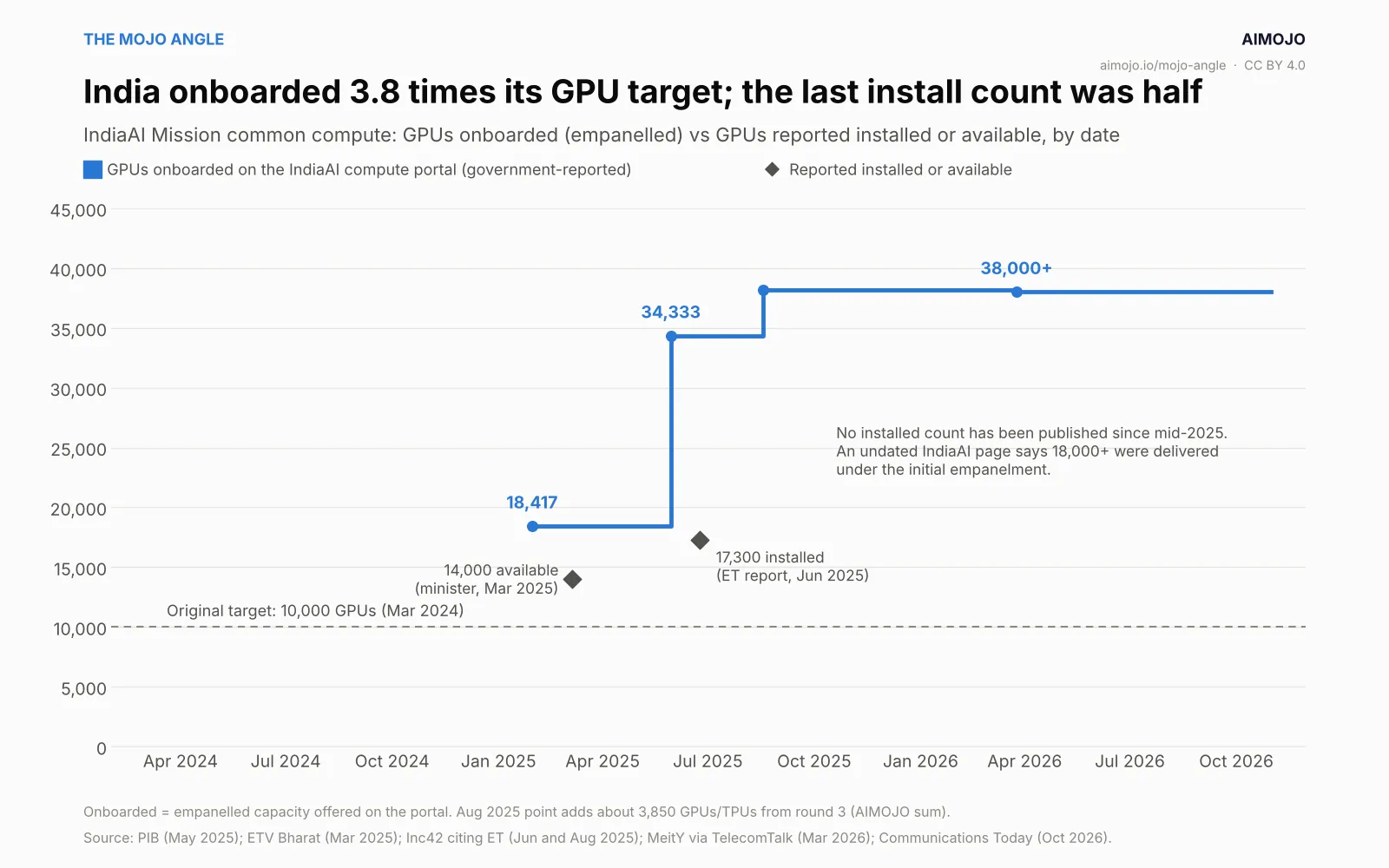
There is a catch: onboarded is not installed. In June 2025, when 34,333 GPUs were onboarded, about 17,300 were reported installed (Inc42 citing ET, 2025). No newer install count has been published (Communications Today, 2026).
What we do know is demand: 93.18 lakh GPU hours sanctioned across 237 projects by July 2026 (Lok Sabha reply via IndianTelevision, 2026). Sanctioned is not consumed.
The gigawatts are private. Google plans a $15bn, 1 GW AI hub in Visakhapatnam with AdaniConneX and Airtel over 2026 to 2030 (PTI via The Week, 2025).
Reliance says 120 MW of AI compute at Jamnagar will be commissioned by the end of 2026 (LetsDataScience, 2026).
All of India had 1.75 GW of operational data-centre capacity in the first half of 2026 (CBRE via CXOToday, 2026).
Who controls the chips?
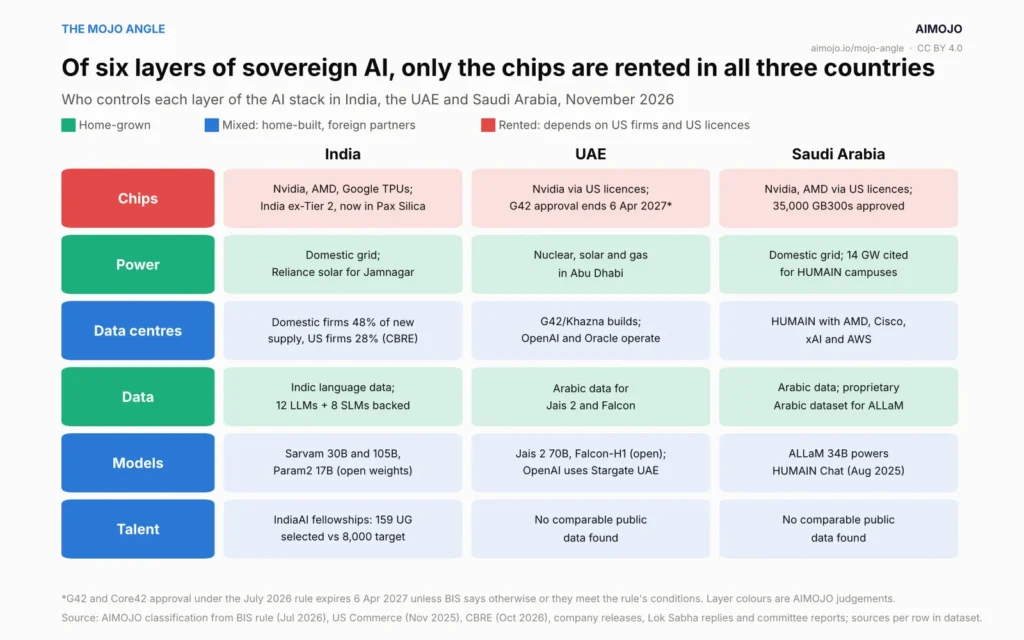
Washington does, through export licences that are looser than in January 2025 but come with conditions and expiry dates.
In January 2025, the Biden administration's AI Diffusion Rule put India in Tier 2, where advanced chips needed licences (Carnegie Endowment, 2026).
One licence route allowed about 50,000 H100-equivalents through 2027, which other routes could have raised (Takshashila Institution, 2025).
The Trump administration rescinded the rule on 13 May 2025, two days before compliance began, and promised a replacement (BIS, 2025). Policy then moved deal by deal.
On 19 November 2025 the Commerce Department authorised G42 and HUMAIN to buy the equivalent of up to 35,000 GB300 chips each, subject to “rigorous security and reporting requirements” (US Commerce Department, 2025).
Microsoft says it holds licences to ship the equivalent of 60,400 more A100 chips to the UAE (The New Arab, 2025). In July 2026 the UAE moved into Country Group A:5.
G42 and Core42 were listed as approved recipients of advanced chips, but that status expires on 6 April 2027 unless BIS gives further approval or they become US companies (Latham & Watkins, 2026).
Both sides get something. Washington gets anti-diversion controls, know-your-customer checks and compute reserved for US hyperscalers and approved providers (US Commerce Department, 2025).
Reuters reports the UAE also agreed to cut AI ties with China and invest in US Stargate data centres (Reuters via Al-Monitor, 2026). The Gulf gets the chips and a place in America's AI kadena ng suplay.
India took a different route, signing the US-led Pax Silica declaration in February 2026, which carries no licensing terms yet (Carnegie Endowment, 2026).
Do the national models matter?
Yes, mostly because of language, not size: all three countries shipped models in 2025-26, and the largest open one has about 105bn parameters.
India's Sarvam AI unveiled 30B and 105B models at the summit in February 2026 and open-sourced them under Apache 2.0, with weights on Hugging Face (Artificial Analysis, 2026).
IIT Bombay's BharatGen showed Param2, a 17B model, and Gnani.ai a voice stack (Free Press Journal, 2026). The mission now backs 20 sovereign models, 12 large and 8 small (Lok Sabha reply, 2026).
The UAE shipped two model families in a month. Inception, MBZUAI and Cerebras released Jais 2, a 70B open-weight Arabic model, in December 2025 (MBZUAI, 2025).
TII followed with Falcon-H1 Arabic at 3B, 7B and 34B in January 2026, and claims top scores on an Arabic leaderboard (TII via Business Wire, 2026).
Saudi Arabia's HUMAIN Chat, launched in August 2025, runs on ALLaM 34B, which HUMAIN says it built and trained from scratch; earlier ALLaM versions were built on Meta's Llama 2 (Middle East AI News, 2025).
This is the most sovereign layer of the stack. You can download the weights, run them on your own hardware and audit them.
Nasaan na ang pera?
Mostly undisclosed so far: of $244bn in nine headline pledges I tracked, about $7.3bn has a publicly disclosed spend.
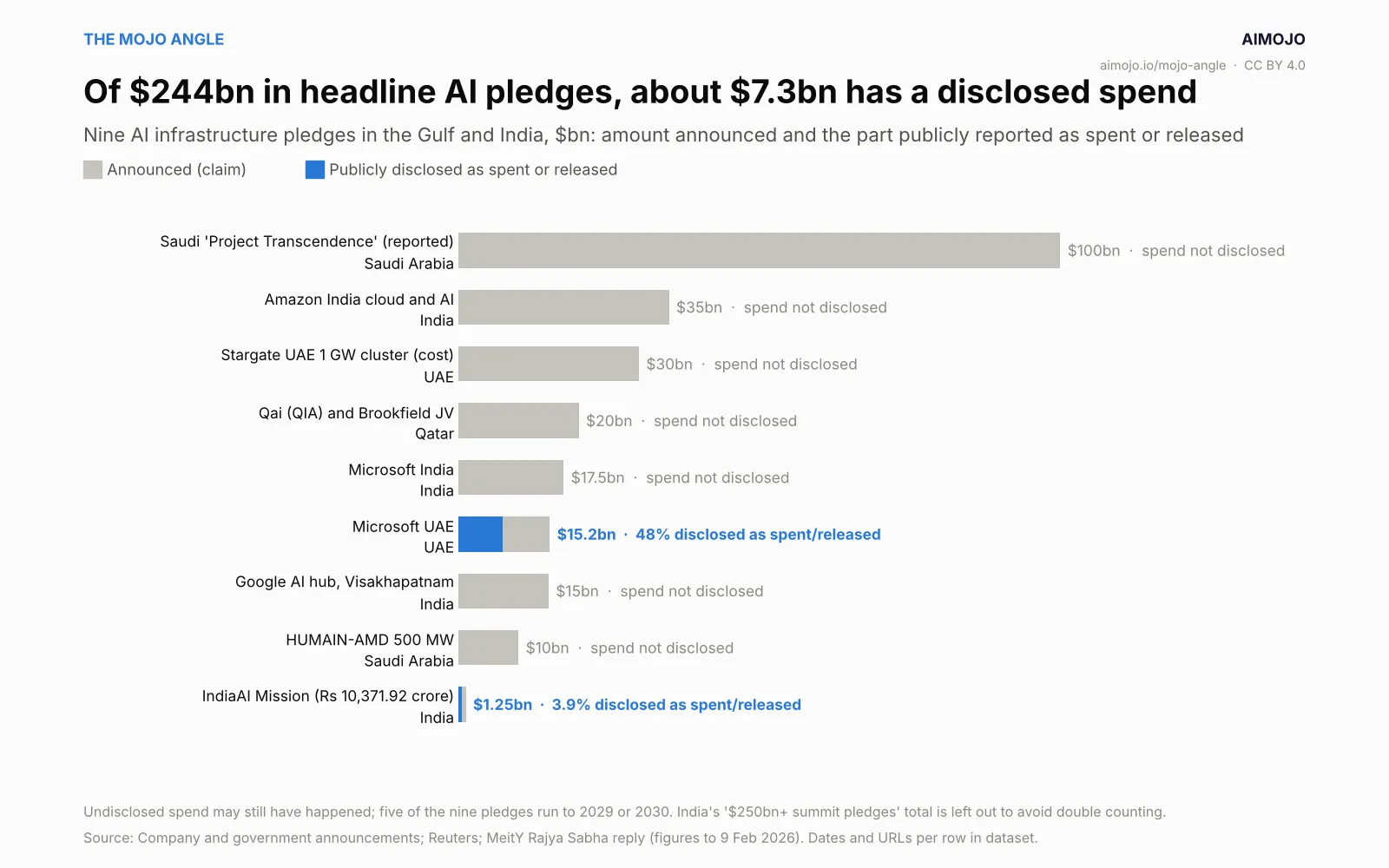
The single big exception is Microsoft. It says it has spent $7.3bn of a $15.2bn UAE commitment since 2023, money “we're spending in the UAE” (The New Arab, 2025).
Saudi Arabia's reported $100bn “Project Transcendence” came from unnamed sources in 2024 (CIO, 2024). I found no official accounting since.
Qatar joined in December 2025 with a $20bn joint venture between Qai, a Qatar Investment Authority subsidiary, and Brookfield, without a capacity figure (QIA, 2025).
Amazon ($35bn by 2030), Microsoft India ($17.5bn, 2026 to 2029) and Google ($15bn) have not published India spend figures.
Undisclosed is not the same as unspent. Cranes cost money. Timing matters too: five of the nine pledges run to 2029 or 2030, so little spend would show yet even if every one is on track.
And the biggest figure, Saudi Arabia's $100bn, is a press report rather than a pledge; leave it out and the disclosed share rises from about 3% to about 5%.
Still, a pledge with no published spend is a claim, and the ledger treats it as one.
The Mojo formula: watts to wafers
To sanity-check any announcement, I convert between GPUs and megawatts.
Facility power: MWkagamitan = (NGPU × PGPU × PUE) / 1,000
N is the number of GPUs. P is the all-in power per GPU in kilowatts, taken from rack or system specs.
A GB300 NVL72 rack draws 132 kW for 72 GPUs, or about 1.83 kW each (Supermicro datasheet). A DGX H100 draws 10.2 kW for 8, or about 1.28 kW each (Nvidia user guide).
PUE is the facility's overhead: 1.54 on average in 2025, according to the Uptime Institute survey, and 1.10 to 1.15 for hyperscalers (mgrid, 2025).
The megawatt result is a floor, because it leaves out storage and networking outside the rack. For the same reason, a GPU count worked back from megawatts is a ceiling.
| Infrastructure announcement or chip order | Estimated GPUs, IT load or facility power |
|---|---|
| UAE-US campus, 5 GW (treated as facility power) | at most about 1.8m to 2.4m Blackwell GPUs |
| Stargate UAE first phase, 200 MW of IT power | about 109,000 GB300s (Epoch: about 253,000 H100-equivalents) |
| G42's US approval, 35,000 GB300s | about 64 MW of IT load, 74 to 99 MW of facility power: 1.5 to 2.0% of 5 GW |
| MAKATAO's first Nvidia order, 18,000 GB300s | about 33 MW of IT load |
| IndiaAI's 38,000 GPUs (mixed, Hopper-class assumed) | roughly 48 MW of IT load, if all are installed |
| Timog Korea's 260,000 Blackwell GPUs | at most about 0.48 GW of IT load (some are lower-power RTX Pro 6000 cards) |
The punchline: the November 2025 approval for G42 would fill about 1.5 to 2% of the campus it was announced to build. That is not the whole chip supply.
US partners such as Microsoft ship under their own licences, and since July 2026 G42 and Core42 have been listed as approved recipients until 6 April 2027 (Latham & Watkins, 2026).
So the chip count can rise quickly. But each step runs through Washington, on Washington's petsa.
The Mojo Sovereign AI ledger
The Ledger compares five countries on one simple number, the Promise-to-Plug ratio.
Promise-to-Plug: P2P = A / OA is the headline AI capacity announced, in gigawatts. O is the verified operating data-centre capacity of the whole country, all uses, in gigawatts.
None of the five publishes running AI-only capacity, so O is the best yardstick available. It answers a plain question: how big is the promise compared with everything already running?
Read the ratio with care, because the two halves are not like-for-like. A counts only AI capacity, mostly years away: HUMAIN's 6 GW is a 2034 target and the UK's 6 GW a 2030 forecast.
O counts every kind of data centre running today, from banking to cloud storage, and each country's figure has its own date and scope. So P2P is not the share of a promise delivered.
It is the size of the ambition against the existing fleet.
What counts as verified: a third-party market survey (CBRE, Cushman & Wakefield), a government statistic (UK DSIT, Saudi Arabia's MCIT) or an independent tracker (Epoch AI).
A company saying a site is “live” without a megawatt figure counts as a claim.
| bansa | Inanunsyo AI capacity (A) | Operating data-centre capacity (O) | Promise-to-Plug ratio (A/O) | Flagship operating status and evidence | Reported public or flagship spend | Models shipped (2025–26) |
|---|---|---|---|---|---|---|
| Mga Nagkakaisang Arabong Emirado | 5 GW campus (2025) | 0.25 GW (Jun 2025) | 20x | Stargate UAE: none verified by 31 Oct 2026; builder says on track for 2026 | Microsoft: $7.3bn of $15.2bn spent | Jais 2 70B, Falcon-H1 family |
| Saudi Arabia | 6 GW by 2034 (2026) | 0.467 GW (Q1 2026) | 12.8x | HUMAIN-owned: none confirmed by 31 Jul 2026; AMD cluster live, MW undisclosed | Hindi isiwalat | ALLaM 34B |
| UK | 6 GW by 2030 (2025) | 1.6 GW (2024, colocation only) | 3.8x | No MW published | Hindi isiwalat | No state-built model |
| India | 4 GW in four campuses (2025) | 1.75 GW (H1 2026) | 2.3x | IndiaAI: 38,000+ GPUs onboarded (govt), about 48 MW if all installed | IndiaAI: 3.9% released | Sarvam 105B, Param2 17B |
| Timog Korea | 260,000 GPUs = up to 0.48 GW | 0.52 GW, Seoul only (2025) | under 1x | Govt GPUs arriving since Dec 2025 | Hindi isiwalat | hindi na-verify |
India's four campuses are Google's 1 GW hub in Visakhapatnam (2025) and Reliance's “gigawatt-scale” Jamnagar site (announced in 2024, counted here as 1 GW).
The other two are Reliance's 1 GW Andhra Pradesh site (2025) and TCS's HyperVault, “in excess of 1 GW” (TCS, 2025).
If Jamnagar is counted at the 3 GW reported in January 2025 (Maginative, 2025), India's ratio rises to 3.4x.
Each ratio has a known bias.
Ang UAE's denominator says “more than 250 MW” and dates from June 2025, so 20x is a high reading that has probably fallen since; a 350 MW estimate cuts it to 14x.
Saudi Arabia's falls to 6.4x on HUMAIN's interim target of about 3 GW by 2030 (Enterprise AM, 2026). The UK's 1.6 GW covers colocation sites only, so its ratio is overstated.
Timog Korea's denominator is Seoul only and its numerator an upper estimate, so its true ratio is lower still. I left France and Japan out because I could not verify a national operating figure for either.
South Korea is the useful contrast.
It promised chips rather than campuses, and they are arriving: the first batch of 13,000 GPUs the government is buying with a KRW 1.46tn supplementary budget landed on 1 December 2025 (Korea JoongAng Daily, 2025).
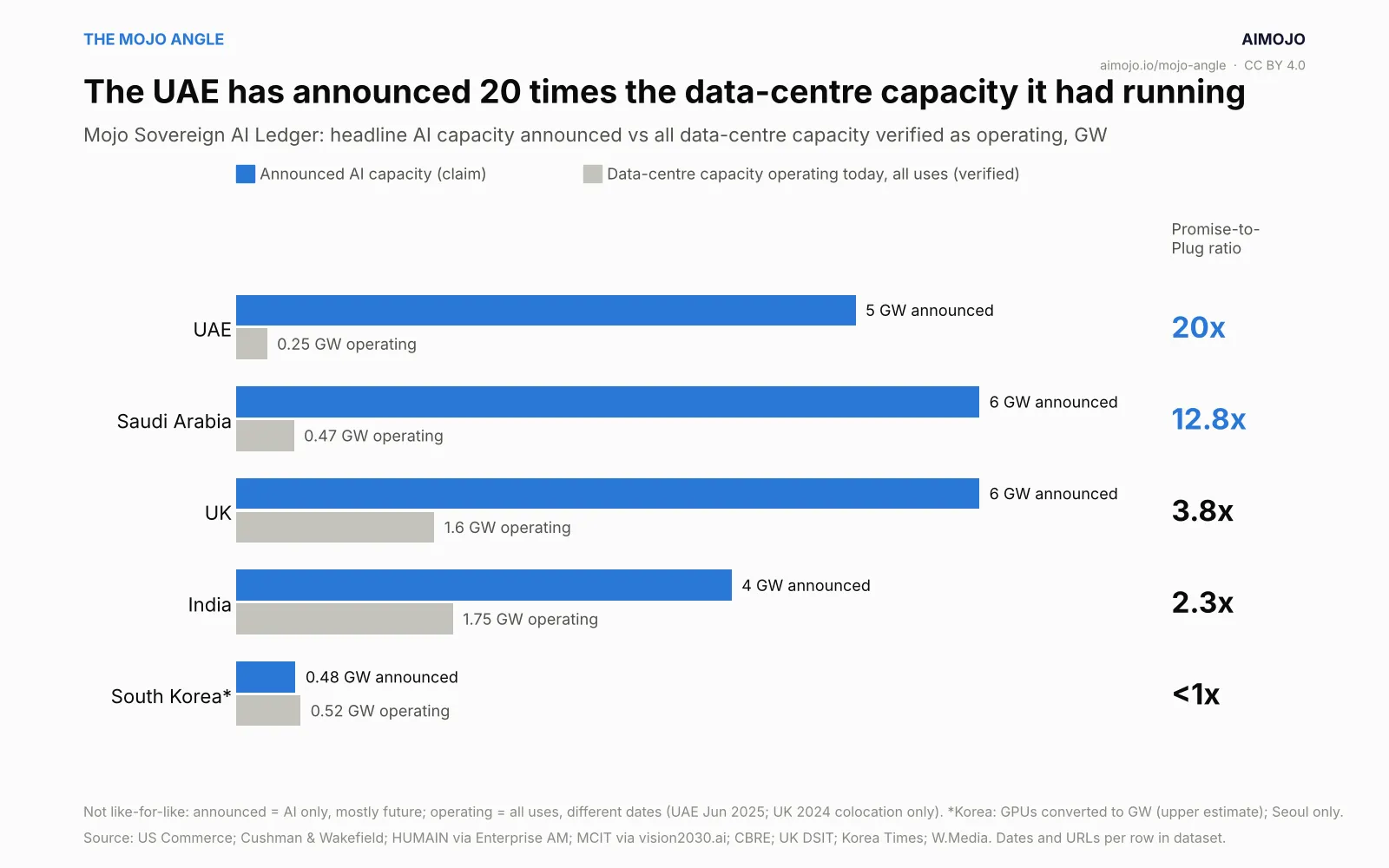
What it shows: the Gulf promises about 13 to 20 times its existing fleet, India and the UK 2 to 4 times, and South Korea less than its existing fleet, because it promised chips rather than campuses.
A high ratio is not proof of failure. It measures how much has to go right, and Saudi Arabia's near sevenfold growth since 2021 suggests a lot can.
Pagsusuri ng Claim
| paghahabol | Claim source | Mojo evidence score (MES) | MoJo's pagtatasa ng editoryal |
|---|---|---|---|
| Stargate UAE's first 200 MW will be ready in Q3 2026 | Mubadala CEO, Dec 2025 | 1 | Q3 ended with no commissioning notice I could find. Epoch (projected December 2026), Khazna and Reuters (during 2026) point later. Late on the public record, not shown to be missing. |
| MAKATAO's Riyadh and Dammam sites go live in Q2 2026 | HUMAIN, 2025 | 1 | No public evidence of operation by 31 July 2026, which the tracker says is not proof of delay. An AMD cluster of undisclosed size went live in September. |
| The UAE-US campus will reach 5 GW | US Commerce and UAE, May 2025 | 1 | An announcement; Reuters (Sep 2026) reports it is likely to become a network of distributed sites. |
| Ang AI Impact Summit drew $250bn+ in infrastructure pledges | IT minister, Feb 2026 | 1 | No breakdown published; it overlaps with company pledges. |
| IndiaAI has onboarded 38,000+ GPUs | MeitY, Mar 2026 | 2 | Government-reported; the last install count was about half the onboarded total at the time. |
| Microsoft has spent $7.3bn in the UAE since 2023 | Microsoft, Nov 2025 | 2 | Company-reported but specific, and the only large disclosed spend in the ledger. |
| US rules cap India at about 50,000 GPUs through 2027 | Commentary on the Jan 2025 Diffusion Rule (e.g. IAS Gyan) | 0 | The rule was rescinded on 13 May 2025, before compliance began (BIS), and 50,000 was one licence route, not a hard ceiling (Takshashila, 2025). |
| Subsidised GPUs cost Rs 65 to 67 an hour, under half global rates | Government of India, 2025-26 | 3 | Lowest bids are published (PIB, 2025); the global comparison is the minister's. |
| Sarvam 105B is an open sovereign model | Sarvam AI, Feb 2026 | 4 | Weights are public under Apache 2.0 (Artificial Analysis, 2026); performance claims are a separate question. |
Ang Kontra-Anggulo
The strongest case against me: announcements are how infrastructure gets financed, and the Gulf has the capital to follow through. Abu Dhabi's MGX closed a $49bn AI fund in 2026, above its $45bn target (AGBI, 2026).
Nobody raises money for 5 GW without first saying 5 GW. G42 claims it can add 250 MW a quarter, and Khazna says it will hand over capacity this year.
Even Epoch, the tracker I lean on, expects the first 200 MW by December 2026. Renting chips is universal: South Korea's 260,000 GPUs come from Nvidia too. And India's slow spending might be prudence, not failure.
I agree with most of that. The gap between promise and plug is normal, which is exactly why I measure it instead of mocking it. Two things still matter.
First, the off-switch. A power plant you own is one kind of sovereignty. A licence that expires on 6 April 2027 unless another government renews it is a different kind. Second, the referee.
Build rates and “live” announcements are company-reported. Satellite trackers and market surveys are not. Until the Gulf publishes megawatts running, the ledger counts megawatts promised.
India gets no free pass either: 93.18 lakh GPU hours sanctioned is a promise until someone publishes hours used.
Ang Bahagi ng Tao
MoJo's Mga Pagtataya
- By 30 June 2027, G42, OpenAI, Oracle or Epoch AI will publicly confirm at least 200 MW operating at Stargate UAE.
Posibilidad: 65%. - On 31 December 2027, HUMAIN-linked operating capacity confirmed by the company or an independent tracker will be below 1 GW, against its target of about 1.7 GW in 2027.
Posibilidad: 80%. - By 31 March 2027, cumulative IndiaAI Mission releases reported to Parliament will be below 15% of the Rs 10,371.92 crore outlay.
Posibilidad: 75%.
Kung saan ito susunod na pag-uusapan
Mga Madalas Itanong
What is sovereign AI?
It is a country's kakayahan na tumakbo AI on compute, data and models it controls. In practice that means owning some layers, such as power, land and language data, and renting others, such as chips.
What is the Promise-to-Plug ratio?
It is announced AI capacity divided by all data-centre capacity verified as running in the same country. The UAE scores 20x, Saudi Arabia 12.8x and India 2.3x in the November 2026 Ledger. It measures ambition against the existing fleet, not delivery, because the two figures are not like-for-like.
How many GPUs is 5 GW?
At most about 1.8 million to 2.4 million Blackwell-class GPUs, using 1.83 kW per GPU and a PUE of 1.15 to 1.54. It is an upper estimate, because the formula leaves out storage and networking outside the rack.
Is Stargate UAE running yet?
Not that I could verify by 31 October 2026. Epoch AI's tracker shows 0 MW, based on November 2025 imagery, and I found no commissioning notice. The builder and Reuters say the first 200 MW is due in 2026, and Epoch projects it by December.
How much has India spent on the IndiaAI Misyon?
Rs 400.94 crore had been released by 9 February 2026, or 3.9% of the Rs 10,371.92 crore outlay, according to MeitY's reply to the Rajya Sabha.
Can the US control Gulf AI?
It controls the supply of new advanced chips through export licences. G42 and Core42's approved status under the July 2026 rule expires on 6 April 2027 unless BIS gives further approval or they become US companies.
- What Is Sovereign AI?, Stanford HAI, university research glossary.
- Stargate UAE: operating power, satellite evidence and buildout projections, Epoch AI, independent research tracker, 22 July 2026.
- UAE and US unveil a planned 5 GW AI campus in Abu Dhabi, US Department of Commerce, official bulletin, 15 May 2025.
- Saudi operational data-centre capacity reaches 467 MW, Saudi Press Agency, 2 May 2026.
- Progress of IndiaAI Mission: parliamentary reply and released funds, Government of India, Rajya Sabha, 13 February 2026.
- India’s common AI compute capacity passes 34,000 GPUs, Office of the Principal Scientific Adviser / PIB, 30 May 2025.
- IndiaAI Mission expands affordable compute, Press Information Bureau, Government of India, 25 March 2026.
- Government update on IndiaAI GPU access and GPU-hours, Press Information Bureau, Government of India, 2026.
- US rescinds the AI Diffusion Rule, Bureau of Industry and Security, 13 May 2025.
- Ginawa ba ng AI Diffusion Rule create a 50,000-GPU cap for India?, Takshashila Institution, January 2025.
- India signs the Pax Silica declaration, Carnegie Endowment for International Peace, 3 March 2026.
- Is AI sovereignty possible? Autonomy versus interdependence, Brookings Institution, 2026.
- Inception, Cerebras and MBZUAI release Jais 2, Mohamed bin Zayed University of Artificial Intelligence, 9 December 2025.
- Falcon-H1 Arabic research overview, Technology Innovation Institute, 15 January 2026.
- Brookfield and Qai form $20 billion AI-infrastructure partnership, Qatar Investment Authority, 9 December 2025.
- UK Compute Roadmap, UK Government, 2025–26.
- Estimate of data-centre capacity in Great Britain, 2024, UK Government, 1 May 2025.
- Korea plans to secure 260,000 latest-generation GPUs, South Korea Ministry of Science and ICT, 2025.
- Korean public GPU procurement and supplementary budget, South Korea Ministry of Science and ICT, 2025.
- Energy and AI: data-centre electricity demand and grid limits, International Energy Agency, 10 April 2025.
A gigawatt is a promise until it hums. A sovereign gigawatt also needs a permission slip from Washington.


 BONUS: Kunin ang aming $200"AI Mastery Toolkit” LIBRE kapag nag-sign up ka!