

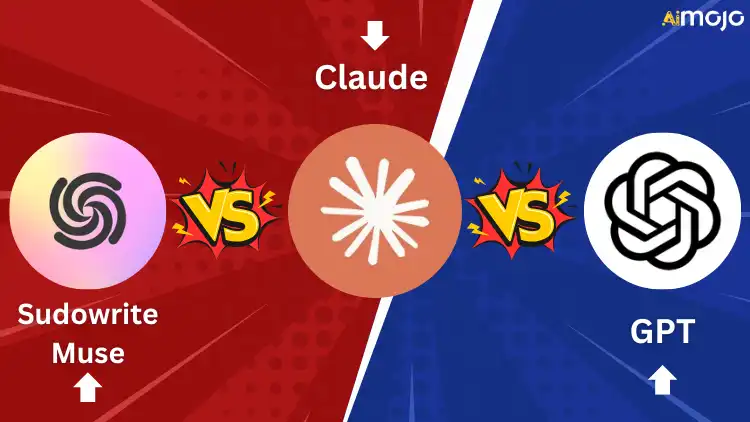
Os mais AI tools are built for blog posts and emails. Ask them to write a cold-open that hooks in the first sentence — and the cracks show fast.
Three tools actually hold up for fiction: Sudowrite Muse, Claude Opus 4.6, and GPT-5.4. We ran all three through 12 identical prompts across five genres. Here's which one earns a permanent spot in a fiction writer's fluxo de trabalho.
⚡ Resposta rápida
For raw prose — Muse wins. For editing a full manuscript — Claude. For plotting and everything around the book — GPT. Most fiction writers are best served running all three as a stack, not picking just one.
Onde Sudowrite Muse vs Claude vs GPT Stand Before You Spend a Dollar
| ferramenta | Melhor caso de uso | Maior limitação | Janela de contexto | Preço inicial | Test Score /10 |
|---|---|---|---|---|---|
| Sudowrite Muse | Novel drafting, raw prose quality | Can't handle non-fiction or research | 32k | $ 19 / mo | 9.1 |
| Claude Opus 4.6 | Dialogue, manuscript-level editing | Hedges on explicit dark content | 500k | $ 20 / mo | 8.7 |
| GPT-5.4 | Plotting, series bibles, author workflow | Flat voice without prompt scaffolding | 128k | $ 20 / mo | 8.3 |
Por que a maioria AI Writes Fiction That Reads Like a Press Release
You've seen it. The em-dash every third sentence. The “little did she know.” The villain who explains his entire plan in one tidy monologue.
General-purpose chatbots were trained on the internet — documentation, forums, cópia do produto. Fiction is maybe 5% of what they've absorbed. That shows.

Three problems kill AI fiction fast:
Fiction-specific or long-context models exist precisely because chatbots gerais hit these walls hard. Here's how the top three actually hold up.
Sudowrite Muse — Built Only for Novelists
Muse isn't a ChatGPT wrapper with a writing theme slapped on. It's a proprietary model trained specifically on fiction — and that training gap is immediately obvious in the output.
What Muse does that others don't:
Prose sample (cold-open scene prompt):
"The body was still warm. That was the part Della couldn't get past — not the blood, not the silence, not the way the kitchen light buzzed overhead like it had something to say. Warm meant minutes. Warm meant she'd been here."Aquele's out of the box. No prompt engineering. The rhythm, the restraint, the detail — Muse reads like a working novelist wrote it.
Where it drops the ball:

Claude Opus 4.6 — The Prose Stylist with a 500k Memory
Claude isn't built for fiction. But Anthropic trained it on enough literary text that it punches well above its weight — especially on dialogue, subtext, and editorial-style rewrites.

The 500k context window is the headline stat. Load your manuscrito inteiro, ask Claude where your subplot disappears, and it will tell you. Specifically. With scene references.
What makes Claude stand out for writers:
Prose sample (same cold-open prompt):
"Warm. That was the word that stayed with her — not the smell, not the stillness, but warm, like the word itself was indecent. Della's hand was still on the door frame. She hadn't decided yet what the next step meant."Slightly more restrained than Muse, more interior. Strong literary fiction energy — less thriller punch.
Refusal quirks:
Claude handles violence and moral complexity better than GPT but still hedges on explicit content. Expect occasional softening on darker material without custom system prompts.
GPT-5.4 — The Flexible All-Rounder
GPT-5.4 is the Swiss Army knife. It won't always write the best sentence — but it will help you build the best story structure, crack a plot problem at 2am, and generate 10 different ending variations before breakfast.

Where GPT-5.4 earns its place:
Prose sample (same cold-open prompt):
"The woman on the floor had been alive recently. Della registered this in a clinical way, the way you noted weather. Warm skin. No pulse. The refrigerator hummed. Somewhere outside, a car passed. Life, continuing."Clean. Functional. The craft is there but the personality isn't. GPT prose needs prompting to develop a strong voice — left alone, it defaults to efficient and neutral.
Head-to-Head on 5 Fiction Tasks

Round 1: Cold-Open Hook
Vencedora: Sudowrite Muse — the most confident, stylistically distinct opener with zero coaching.
Round 2: 3-Character Dialogue Scene
Winner: Claude Opus 4.6 — each character had a distinct verbal rhythm; subtext was present without being spelled out.
Round 3: Dark / Mature Content Handling
Vencedora: Sudowrite Muse — purpose-built for fiction, it has the loosest content tolerances of the three. GPT and Claude both softened the same scene without prompting.
Round 4: Plot-Hole Detection on a 30k-Word Draft
Winner: Claude Opus 4.6 — the 500k janela de contexto is a genuine superpower here. Loaded the full draft, flagged 4 continuity errors. GPT missed two. Muse doesn't do this at all.
Round 5: Matching an Established Author Voice
Winner: GPT-5.4 — a Custom GPT trained on sample chapters produced the most consistent style replication of the three, especially on sentence length variation and paragraph rhythm.
Real Cost Per 100k Words
| ferramenta | Custo estimado | Notas |
|---|---|---|
| Sudowrite Muse | $8–14 (Standard plan) | Credit deduction varies by feature used |
| Claude Opus 4.6 | $12–18 (Pro) | 500k context calls are heavy on tokens |
| GPT-5.4 | $10–16 (Plus) | Canvas use adds marginal overhead |
Custos ocultos a que deve estar atento:
How We Actually Tested These Tools
No spec sheets. No marketing copy. Here's exactly what the testing process looked like.
Over four weeks, the same 12 prompts — covering literary fiction, thriller, romance, sci-fi, and dark fantasy — were sent to all three tools under identical conditions. Accounts were paid out of pocket. Same hardware, same sessions, no truques de API.

The testing framework:
Affiliate relationships exist for the tools listed below. They had no role in scoring. Rankings reflect test results only.
Sudowrite Muse vs Claude vs GPT — Pick Your Fighter
Best for drafting a novel fast → Sudowrite Muse
No other tool comes close on raw prose output quality without heavy prompting.
Best for editing a finished manuscript → Claude Opus 4.6
500k context plus editorial instincts makes it the closest thing to an AI editor de desenvolvimento disponível atualmente.
Best for dialogue-heavy scenes → Claude Opus 4.6
Characters sound like different people. That's rarer than it should be across AI prose generators.
Best for dark / spicy themes → Sudowrite Muse
Built for fiction — including the parts of fiction that get awkward for general-purpose chatbots.
Best for plotting and series planning → GPT-5.4
Custom GPTs trained on your series bible are a legitimate productivity tool for multi-book authors.
Best if you can only pay for one → Sudowrite Muse
If you're here to write fiction and only fiction, Muse is the only purpose-built AI novel writing tool in this comparison. The others are excellent general tools that moonlight as fiction writers.
Perguntas frequentes relacionadas a AI for Fiction Writing
Is Sudowrite Muse better than ChatGPT for novels?
For prose drafting — yes, and it's not close. Muse was trained specifically on fiction. GPT-5.4 is more versatile overall, but Muse produces better raw prose without heavy prompt engineering.
Can Claude write a full book in one prompt?
Not reliably. The 500k context window helps manage long manuscripts, but full-book generation in a single prompt still produces structural drift. Use it chapter by chapter with a loaded story brief for best results.
Which of the three allows adult fiction content?
Sudowrite Muse has the most permissive content policy for fiction writing. Claude and GPT both apply safety filters that soften or redirect explicit scenes without carefully set system prompts.
Will editors or publishers detect AI-written prose?
AI detection tools are inconsistent and heavily debated inside the publishing industry. The real risk is voice — AI prose has patterns a trained editor spots instantly. Human editing passes are non-negotiable for professional submissions.
Is Muse worth it if I already pay for Claude or GPT?
Yes, if fiction drafting is your primary output. Claude and GPT are excellent for editing, outlining, and research. Muse is the only one in this group that actually drafts prose that doesn't need a full rewrite before it's utilizável.
O Veredicto
Sudowrite Muse writes better fiction prose than Claude or GPT straight out of the box. That's the honest conclusion after four weeks of testing.
Claude Opus 4.6 is the best editorial partner — especially once your draft exists and needs a real structural pass. GPT-5.4 is the tool you reach for when you're stuck on a plot, building a world, or managing the business side of being an author.
The most effective fiction writing stack right now: Muse to draft, Claude to edit, GPT for everything around the manuscript.
🎁 Pronto para experimentar Sudowrite Musa? Subscribe through our link exclusivo e pegue 200,000 créditos de bônus — enough to draft your first three chapters and see exactly what the writing is all about.
AiMojo recomenda:


 BONUS: Receba nossos $ 200 “AI “Kit de ferramentas de domínio” GRÁTIS ao se inscrever!