

Kluczowe spostrzeżenia modalne
Co to jest Modal?

Modalny jest bezserwerową platformą chmurową stworzoną specjalnie dla AI and machine learning workloads. It allows developers to run GPU accelerated inference, model training, batch processing, and sandboxed code execution entirely from Python, with no Docker files, Kubernetes clusters, or YAML configuration required. You define your compute environment, hardware needs, and application logic in a single Python script using simple decorators.
Modal then handles container packaging, Harmonogramowanie GPU, autoscaling, and teardown automatically. The platform bills per second and scales to zero when idle, making it especially cost effective for bursty, unpredictable traffic patterns. For engineering teams that want to deploy AI applications to production without hiring a dedicated infrastructure team, Modal removes the operational overhead so they can focus on model performance and product delivery.
Modal replaces Dockerfiles, Terraform configs, and cloud consoles with Python decorators. You specify GPU type, container image, secrets, and scheduling inside your application code. This means your infrastructure definition lives alongside your business logic, reducing drift between development and production environments and speeding up iteration cycles significantly.
Modal’s runtime can spin containers up and scale them down in response to real time demand. Idle functions cost nothing because the platform scales to true zero. When skoki ruchu, Modal routes workloads across multiple cloud providers and regions to find available GPU capacity in seconds, not minutes. This elastic behaviour is ideal for unpredictable inference loads.

Cold starts have historically been the Achilles’ heel of serverless GPU. Modal addresses this with Pamięć GPU snapshots (currently in alpha), which capture the entire GPU state including model weights in VRAM and CUDA kernels. For models that fit within a single GPU’s memory, this feature can reduce startup latency by up to 10x, making synchronous API serving far more practical.
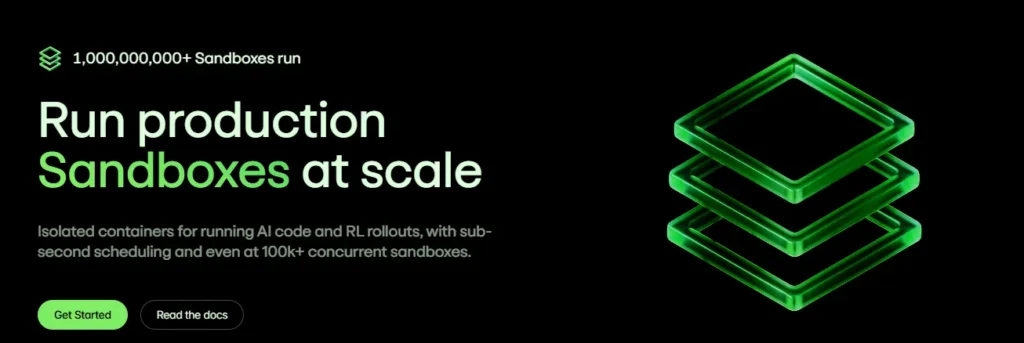
Modal Sandboxes provide isolated gVisor backed containers where untrusted or AI wygenerowany kod can run safely. Each sandbox gets its own filesystem, network restrictions, and configurable timeouts. This is a critical feature for teams building coding agents, automated data pipelines, or any application where arbitrary code must be executed without risk to the host environment.
Every function, container, and sandbox on Modal comes with integrated real time metrics and logging out of the box. The Team plan retains logs for 30 days. There is no need to bolt on a third party APM tool to debug a failed GPU job or trace a slow inference call.
Modal pools capacity across major cloud providers. The platform decides in real time where to schedule your workload based on GPU availability and cost, giving you access to the latest NVIDIA silicon (H100, H200, B200) without negotiating contracts or managing accounts with multiple providers.
Plany cenowe modalne
| Plan | Koszty: | Darmowe kredyty | Współbieżność GPU | Kluczowe ograniczenia |
|---|---|---|---|---|
| Starter | $0 + compute | $ 30 / miesiąc | 10 | 3 seats, 100 containers, limited scheduled functions |
| Zespół | $250 + compute/month | $ 100 / miesiąc | 50 | Unlimited seats, 5000 containers, custom domains, rollbacks |
| Enterprise | warunki indywidualne | warunki indywidualne | warunki indywidualne | Volume discounts, SAML SSO, HIPAA BAA, private Slack support |
GPU compute is billed per second on top of plan fees. The H100 runs at approximately $3.95/hour effective rate, the A100 80GB at $2.50/hour, and the T4 at $0.59/hour. Region pinning adds a 1.5x to 1.75x multiplier to base rates.
Modal for AI Obciążenia wnioskowania
Modal has become a go to platform for teams deploying large language model and generowanie obrazu endpoints. Its per second billing model means you only pay while a request is actively being processed, and the autoscale to zero capability eliminates idle GPU costs entirely.
For applications with variable or unpredictable traffic, such as customer facing chatbots or on demand image generators, this model can reduce infrastructure spend by 30% or more compared to always on dedicated instances. The GPU memory snapshot feature further strengthens this position by cutting cold start times dramatically for cached models.
Plusy i minusy
- True scale to zero billing.
- Exceptional Python developer experience.
- No Docker or Kubernetes needed.
- Sub second cold starts (cached).
- Broad GPU selection (T4 to B200).
- Built in observability and logs.
- SDK vendor lock in risk.
- No non preemptible GPU option.
- Region pinning inflates costs.
- No BYOC or self host path.
Modal for Training and Batch Processing
Beyond inference, Modal supports distributed fine tuning and large scale batch processing. You can request up to 8 GPUs per function for data parallel training, and the platform’s scheduler will allocate them across available capacity.
For batch jobs like dataset preprocessing, embedding generation, or hyperparameter sweeps, Modal’s ability to fan out across hundreds of containers in parallel makes it significantly faster than running sequential jobs on a single machine. The $30 monthly credit on the free tier is enough to experiment with moderate workloads before committing budget.
Najlepsze alternatywy modalne
| Bezserwerowe AI Infrastructure / GPU Cloud | Doświadczenie programisty | Scale to Zero Support |
|---|---|---|
| RunPod | Good (serverless + pod based) | ✅ Serverless only |
| Laboratoria Lambdy | Minimal, SSH and API focused | ❌ Always on instances |
| Replika | API only, no custom code | ✅ Via serverless endpoints |
| Beam Cloud | Python native, open source runtime | ✅ Full support with BYOC |