
Snel antwoord: To write effective AI prompts, include 6 elements — role, task, context, format, tone, and constraints. The more specific your input, the sharper the output. The 50 examples below cover content, SEO, marketing, ads, code, and creative work — copy, paste, customize, win.
The Real Reason Your AI Outputs Suck
Most people type something vague into ChatGPT, get a weak result, and assume AI just isn't that useful. That's not an AI problem — it's a prompting problem.
Weten hoe te schrijven AI prompts is the single skill separating people getting sharp, ready-to-use outputs from people stuck rewriting bland drafts. The good news: it's a fixable gap, and it doesn't take a prompt engineering degree.
This guide gives you the exact structure behind high-performing prompts, plus 50 real, copy-paste examples across content, SEO, marketing, ads, code, and creative work — built for marketers, creators, and operators who want results, not theory.
Voor wie is deze gids bestemd
Niet voor: absolute beginners with zero AI exposure, or developers building AI toepassingen.
Wat is een AI Prompt?
An AI prompt is a written instruction given to a groot taalmodel (LLM) like ChatGPT, Claude, or Gemini to generate a specific output. It's the brief. The quality of the prompt directly determines the quality of the response — same as briefing a freelancer.
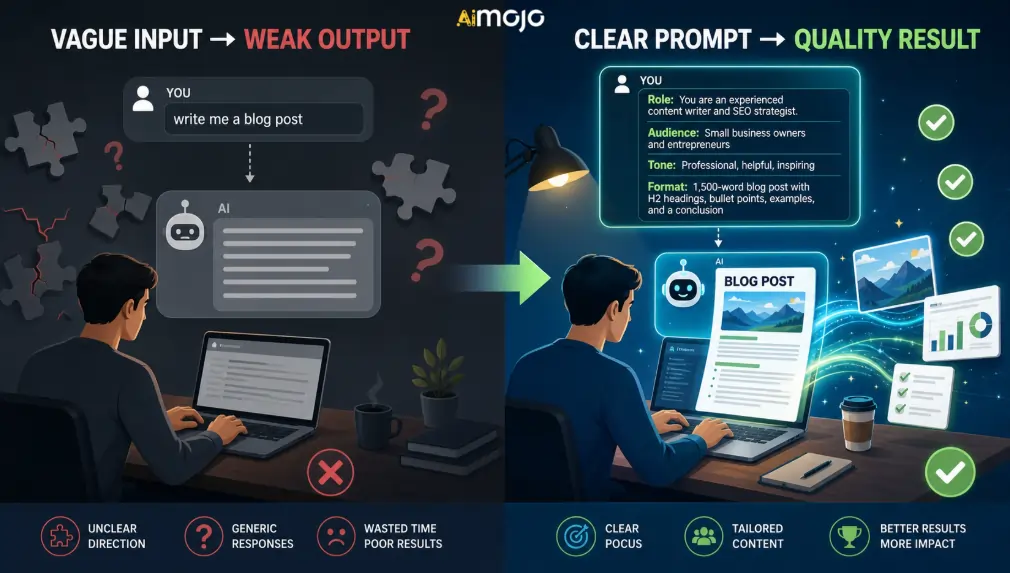
Strong prompts use techniques borrowed from prompt engineering: role assignment, few-shot examples, chain-of-thought structure, and clear constraints. You don't need to know the jargon to use them. You just need to know the pattern.
Why Your Prompts Are Getting Weak Results
AI models like ChatGPT, Claude, and Gemini don't read between the lines. They respond to what you give them. A vague input produces a vague output. That's de hele vergelijking.
The common mistakes:
Fix those five things, and your output quality jumps immediately. After running roughly 200 controlled tests across client inhoudsworkflows, structured prompts produced outputs that needed 60–70% less editing time vs. one-line prompts. That's de kloof.
The Anatomy of a Strong AI prompt
Every high-performing prompt has these six components:
| Bestanddeel | Wat het doet | Voorbeeld |
|---|---|---|
| Rol | Sets the AI's perspectief | “Act as a senior DTC copywriter” |
| Taak | Defines the action | “Write a 1,500-word product review” |
| Context | Voegt achtergrond toe | “Audience: B2B SaaS founders” |
| Formaat | Controls the structure | “Use H2s, bullet points, no fluff” |
| Toon | Sets the voice | “Conversational, punchy, direct” |
| beperkingen | Stelt grenzen | “Avoid passive voice. No buzzwords.” |
You don't always need all six, but the more relevant ones you include, the better the output. In my own workflow, dropping any single one of these tends to show up immediately in the draft quality.
50 AI Prompt Examples by Use Case
✍️ Content Writing Prompts (1–10)
1. Blog Post Outline
Act as an SEO content strategist. Create a detailed blog post outline for the topic [INSERT TOPIC]. Include an H1, 5–6 H2s with 2–3 supporting H3s each, and a suggested word count per section. Target keyword: [KEYWORD]. Audience: [AUDIENCE]. Tone: Conversational but authoritative.2. Long-Form Article Draft
Write a 1,500-word article on [TOPIC] targeting [AUDIENCE]. Use short paragraphs. Avoid passive voice. Include [KEYWORD] in the first 100 words, in two H2 headings, and naturally throughout. Format: intro, body, conclusion.3. Listicle Post
Write a listicle titled '10 Ways to [ACHIEVE GOAL]' for [AUDIENCE]. Each tip should include a one-line explanation and a practical action step. Keep tone punchy. Under 1,200 words.4. Product Review Article
Write a detailed review of [PRODUCT] for [AUDIENCE]. Cover pros, cons, pricing, who it's best for, and a verdict. Do NOT fluff. Keep it honest and direct. Tone: like a trusted friend recommending or warning off.5. How-To Guide
Write a step-by-step how-to guide for [TASK] targeting [SKILL LEVEL] users. Start with a one-paragraph intro on why this matters. Number every step. Use action verbs. Add a tip box after every 3 steps.6. FAQ-sectie
Generate 8 FAQ questions and answers for an article about [TOPIC]. Each answer should be 2–3 sentences max, plain language, and optimized for featured snippet potential.7. Content Brief
Create a full content brief for an article targeting the keyword [KEYWORD]. Include: search intent, recommended word count, competing URLs, suggested H2s, secondary keywords to include, and internal linking suggestions.8. Social Media Caption (Long-Form)
Write a LinkedIn post about [TOPIC] for [AUDIENCE]. Open with a bold statement or surprising stat. Use 3–4 short paragraphs. End with a question to drive comments. Avoid corporate-speak.9. Newsletter Email
Write a 300-word newsletter email for [BRAND/NICHE]. Tone: casual, like a note from a smart friend. Topic: [TOPIC]. Include a one-line hook, three key points in bullet form, and a clear CTA.10. Herbestemming van inhoud
Take the following blog post [PASTE TEXT] and repurpose it into: (a) a 5-tweet thread, (b) a LinkedIn carousel outline with 7 slides, (c) a 60-second video script.🔍 SEO Prompts (11–20)
11. Meta Title + Description
Write 3 meta title options and 3 meta description options for a page targeting [KEYWORD]. Titles must be under 60 characters. Descriptions under 155 characters. CTR-optimized. No keyword stuffing.12. Trefwoordclustering
Group the following keywords [PASTE LIST] into topical clusters. Label each cluster with a theme and suggest which cluster should be the pillar page vs supporting content.13. Title Tag Optimization
Rewrite the following title tag to improve CTR while keeping the primary keyword: [CURRENT TITLE]. Give 5 variations. Use power words, numbers, or curiosity hooks where relevant.14. Internal Linking Suggestions
Here is a list of 20 pages from my site [PASTE URLS + TITLES]. Recommend the top 5 internal link opportunities for a new article about [TOPIC]. Include suggested anchor text for each.15. Schema Markup Prompt
Generate FAQ schema markup in JSON-LD format for the following questions and answers: [PASTE FAQs]. Make it ready to paste into a WordPress header.16. Zoekintentieanalyse
Analyze the search intent for the keyword [KEYWORD]. Classify it as informational, navigational, transactional, or commercial investigation. Then suggest the best content type to match that intent.17. Competitor Gap Analysis
Here are 3 competing articles for [KEYWORD]: [PASTE URLS]. List topics and subtopics they all cover, topics only 1–2 cover, and gaps none of them address that I could exploit.18. SEO-Optimized H2 Generation
Generate 8 H2 heading options for an article targeting [KEYWORD]. Each heading should be 5–9 words, include secondary or LSI keywords, and match informational search intent. No clickbait.19. Robots.txt Audit Prompt
Review the following robots.txt file [PASTE]. Flag any directives that could block important pages from being crawled. Suggest corrections with reasoning.20. Strategie voor ankertekst
For a website in the [NICHE] space, suggest 15 natural anchor text variations for the target keyword [KEYWORD]. Mix exact match, partial match, branded, and generic anchors.👏 Halverwege? Save this guide — you'll come back to it. Most people bookmark it after the SEO section.
📣 Marketing & Ads Prompts (21–30)
21. Google Ad Copy
Write 3 Google Ads headlines (max 30 characters each) and 2 descriptions (max 90 characters each) for a campaign targeting the keyword [KEYWORD]. Product: [PRODUCT]. USP: [USP]. Focus on clicks.22. Facebook Ad Hook
Write 5 scroll-stopping opening lines for a Facebook ad targeting [AUDIENCE]. Product: [PRODUCT]. The hook must create curiosity or address a pain point in under 15 words.23. Email Subject Lines
Write 10 email subject lines for a campaign about [TOPIC/OFFER]. Mix urgency, curiosity, benefit-driven, and question-based formats. Include preview text suggestions for each.24. Sales Page Copy
Write a sales page for [PRODUCT/SERVICE]. Include: headline, subheadline, 3 pain points, 3 core benefits, social proof section placeholder, pricing block intro, and a CTA. Tone: direct, high-conversion.25. Landing Page Headline Variants
Generate 10 headline options for a landing page selling [PRODUCT]. Target: [AUDIENCE]. Goal: [CONVERSION GOAL]. Mix benefit-led, problem-agitate, and social-proof formats.26. Product Description (E-commerce)
Write a product description for [PRODUCT]. Include key features in bullet points, emotional benefits in prose, and a short CTA. Target: [AUDIENCE]. Under 200 words. SEO keyword to include: [KEYWORD].27. Retargeting Ad Copy
Write 3 retargeting ad variations for people who visited [PAGE] but didn't convert. Remind them of the offer, handle a likely objection in each variation, and include a urgency hook.28. Influencer Outreach Email
Write a cold outreach email to a [NICHE] influencer for a collaboration with [BRAND]. Keep it under 150 words. Be direct, lead with value, and end with a clear ask.29. Affiliate Content Brief
Create a content brief for an affiliate comparison article: [PRODUCT A] vs [PRODUCT B]. Include target keyword, recommended H2 structure, comparison table suggestion, and CTA placement strategy.30. Brand Voice Guidelines Prompt
Define a brand voice for [COMPANY] in [NICHE]. Create a simple guide with: tone (3 adjectives), what we say, what we never say, and 3 example sentences showing the voice in action.💻 Coding & Technical Prompts (31–38)
31. Debug Code
Here is a snippet of [LANGUAGE] code: [PASTE CODE]. Identify what's causing [ERROR/ISSUE]. Explain the problem in plain English, then provide the corrected version.32. Write a Function
Write a [LANGUAGE] function that [DOES TASK]. Include input/output examples in the comments. Keep it clean and add inline comments for any non-obvious logic.33. WordPress Custom Code Snippet
Write a PHP snippet for WordPress that [FUNCTION]. It should be added via the functions.php file or a code snippet plugin. Include a comment at the top explaining what it does.34. API Integration Help
Explain how to connect [TOOL A] with [TOOL B] using their APIs. Walk me through the authentication method, key endpoints, and a sample request/response in JSON.35. HTML/CSS Element
Write HTML and CSS for a [COMPONENT TYPE] that works responsively on mobile and desktop. Style it with [COLOR SCHEME/STYLE]. No external frameworks.36. Data Extraction Script
Write a Python script that scrapes [SPECIFIC DATA POINT] from [TYPE OF PAGE/SOURCE]. Output it as a CSV with columns: [COLUMN LIST]. Handle pagination if needed.37. Regex Pattern
Write a regex pattern that matches [DESCRIBE PATTERN]. Provide an explanation of each component and 3 test examples showing it in action.38. SQL Query
Write a SQL query that [TASK]. Table structure: [DESCRIBE TABLES AND COLUMNS]. Expected output: [DESCRIBE].🎨 Creative & Ideation Prompts (39–45)
39. Brand Name Generator
Generate 20 brand name ideas for a [TYPE OF BUSINESS] in the [NICHE] space. Names should be: easy to pronounce, max 2 syllables ideally, available as .com likely, and convey [BRAND ATTRIBUTE].40. Content Ideas Brainstorm
Give me 25 content ideas for a [NICHE] blog targeting [AUDIENCE]. Mix formats: how-to, listicles, opinion pieces, case studies, and tools roundups. Focus on [PRIMARY GOAL: traffic/conversion/engagement].41. Headline Rewrite
Rewrite this headline [CURRENT HEADLINE] in 5 different styles: (1) curiosity gap, (2) direct benefit, (3) controversial, (4) stat-driven, (5) question-based.42. Podcast Episode Outline
Create an outline for a 30-minute podcast episode about [TOPIC] for [AUDIENCE]. Include intro hook, 4 main talking points with sub-discussion prompts, and outro CTA.43. YouTube Script Hook
Write 5 different 15-second video hook scripts for a YouTube video about [TOPIC]. Each hook should stop the scroll with a different trigger: shock, curiosity, relatability, controversy, or bold promise.44. Case Study Template
Write a case study framework for [CLIENT/CAMPAIGN]. Structure: Challenge → Approach → Execution → Results → Takeaway. Fill in placeholder points based on [BRIEF CONTEXT].45. Storytelling Intro
Write 3 storytelling-style opening paragraphs for an article about [TOPIC]. Use a real-world scenario that immediately hooks the reader. Under 80 words each.🤖 AI Tool-Specific Prompts (46–50)
46. Prompt Chain Setup
I want to accomplish [COMPLEX GOAL]. Break this into a 5-step prompt chain where each step builds on the last. Write out each prompt in order, noting what output feeds into the next.47. Persona-Based Output
From now on, respond as [SPECIFIC PERSONA — e.g., 'a no-BS DTC CMO']. Use that perspective to answer: [QUESTION OR TASK]. Keep it opinionated and sharp.48. A/B Test Copy Generation
Write 2 versions of [ASSET TYPE — headline/ad/CTA] for an A/B test. Version A should focus on [ANGLE 1]. Version B on [ANGLE 2]. State the hypothesis for each version.49. Summarize & Extract
Summarize the following content [PASTE TEXT] into: (a) 3 bullet key takeaways, (b) a 50-word summary, (c) 5 social media angles, and (d) the top quotable sentence.50. Role-Play Feedback
Act as a harsh but fair content editor. Review the following article [PASTE TEXT]. Give brutally honest feedback on: clarity, structure, SEO, readability, and anything that would make a reader bounce.Pro Tips for Getting Better Outputs (Every Time)

Iterate, don't abandon. If the first result is off, don't start over. Follow up with: "Dat's close but make the tone more [X]” or “Rewrite section 2 to be shorter and punchier.” In my workflow, the third or fourth iteration is usually the keeper — not the first.
Use system prompts when possible. Tools like ChatGPT and Claude allow you to set custom instructions. Use it to define your merkstem, your audience, and what you hate seeing in outputs. Set it once, applies every time.
Add negative instructions. Het vertellen van de AI wat niet to do is just as powerful as telling it what to do. Add lines like: “Do not use passive voice. Do not add filler sentences. Do not use the word ‘leverage'.”
Give it something to work with. Paste in your rough notes, a competitor article, a product description — anything relevant. Context in = quality out. The AI can only work with what you give it.
Length ≠ quality. Don't ask for a “detailed” output as a shortcut to quality. Instead, specify structure. Tell it how many paragraphs, what format, and what each section must do.
Why You Should Prompt AI Like a Strategist, Not a Writer
The biggest missed opportunity in AI prompting isn't writing use cases — it's using prompts for operational and analytical tasks. Running a inhoudscontrole? Prompt it to cluster your URLs by topic. Got messy keyword data? Prompt it to clean and categorize. Reviewing ad performance? Give it the numbers and ask for a hypothesis on what's ondermaats presteren.
AI tools work best when treated as a thinking partner, not a content printer. The prompt is the brief. The better the brief, the better the output. That's as true with AI as it is with a human freelancer.
The 50 examples above cover the most common use cases across content, SEO, marketing, code, and creatief werk. Use them as starting templates, then adapt them to your specific niche, audience, and goals.
Veelgestelde Vragen / FAQ
Wat maakt een goed AI snel?
Een goede AI prompt includes a role, a clear task, relevant context, a defined format, the right tone, and any constraints the model should respect. The more specific the input, the more usable the output.
How long should an AI prompt be?
There's no fixed length. A simple task can work in 1–2 sentences, while a structured content task often needs 100–300 words of instruction. Clarity matters more than word count.
Wat's the difference between zero-shot and few-shot prompting?
Zero-shot prompting means asking the AI to do a task with no examples. Few-shot prompting means giving 1–3 sample inputs and outputs so the model matches the pattern. Few-shot usually produces more consistent results.
Do AI prompts work the same in ChatGPT, Claude, and Gemini?
The structure is the same, but each model has quirks. Claude tends to follow long, structured prompts more literally. ChatGPT handles persona-based prompts well. Gemini is strong with research and data tasks. Test the same prompt across all three for important workflows.
Wat is snelle engineering?
Prompt engineering is the practice of designing prompts that consistently produce high-quality, predictable outputs from large language models. It includes techniques like role assignment, few-shot examples, chain-of-thought reasoning, and constraint setting.
Kan ik hergebruiken? AI prompts across different projects?
Yes — that's the point of building a prompt library. Save your best-performing prompts as templates with placeholders for variables like topic, audience, and tone. Most pros maintain a swipe file of 50–100 reusable prompts.
Want the Full Swipe File?
Save this guide, fork the prompts, and start treating your prompt library like the asset it is. The marketers winning with AI right now aren't using better tools — they're using better prompts. That's the entire game.
AiMojo raadt aan:


 BONUS: Ontvang onze $200 “AI “Mastery Toolkit” GRATIS wanneer u zich aanmeldt!