

Google mengatakan AI now writes 75% of its new code. Yet the largest field trials found 26% more completed tasks, and experienced developers in a 2025 trial were 19% slower. I built a ledger of 18 studies to find out why.
Sudutnya: AI writes a large, fast-growing share of new code at the firms that build it, but “share of code” measures typing, not time saved.
In my 18-study ledger the median gain falls from 43% on set lab tasks to 24% in company trials, and none has yet been measured for whole organisations, because coding fills only 11 to 16% of a developer's minggu.
Expect faster typing, slower reviewing and a security bill.
Triknya
Here is what everyone sees. In April 2026, Google's chief executive Sundar Pichai wrote that 75% of the company's new code is now generated by AI and approved by engineers (Sherwood News, 2026). Six weeks later, Anthropic said Claude authors more than 80% of the code merged into its codebase (Anthropic report via Decrypt, 2026). The machines, it seems, have taken the keyboard.
Backstage, the hours tell a smaller story. The biggest field trials found about a quarter more completed tasks (Cui et al., Management Science, 2025); experienced developers in METR's 2025 trial were slower with AI (METR, 2025); and developers spend only about a sixth of their time writing code (Atlassian, 2025).
Both pictures are true. “Share of code” counts characters or lines; productivity counts hours and finished work. I went looking for the hours.
Mojo's Law: Amdahl's Langit-langit
S = \frac{1}{(1 - p) + \dfrac{p}{s}}Sederhananya: speed up one part of a job and the whole job speeds up only as much as the untouched part allows. S is the speed-up of the whole job, p the share you sped up and s how much faster that share got. Gene Amdahl made the argument about parallel computers in 1967 (Amdahl, AFIPS, 1967); it fits software teams too.
A worked example, with p from Atlassian's 2025 survey and illustrative coding speed-ups. Coding is 16% of the week. Make it twice as fast and the week speeds up 8.7%: 1 / (0.84 + 0.08) = 1.087. Ten times faster gives 17%.
Make coding take no time at all and you hit the ceiling, 1 / 0.84 = 1.19: the same work in 84% of the time. Microsoft engineers put coding at about 11% of their week in a 2024 survey of 484 staff (Kumar et al., ICSE 2025), a ceiling of 1 / 0.89 = 1.12. So faster coding alone caps the speed-up of the whole week at 12 to 19%, even if coding took zero time.
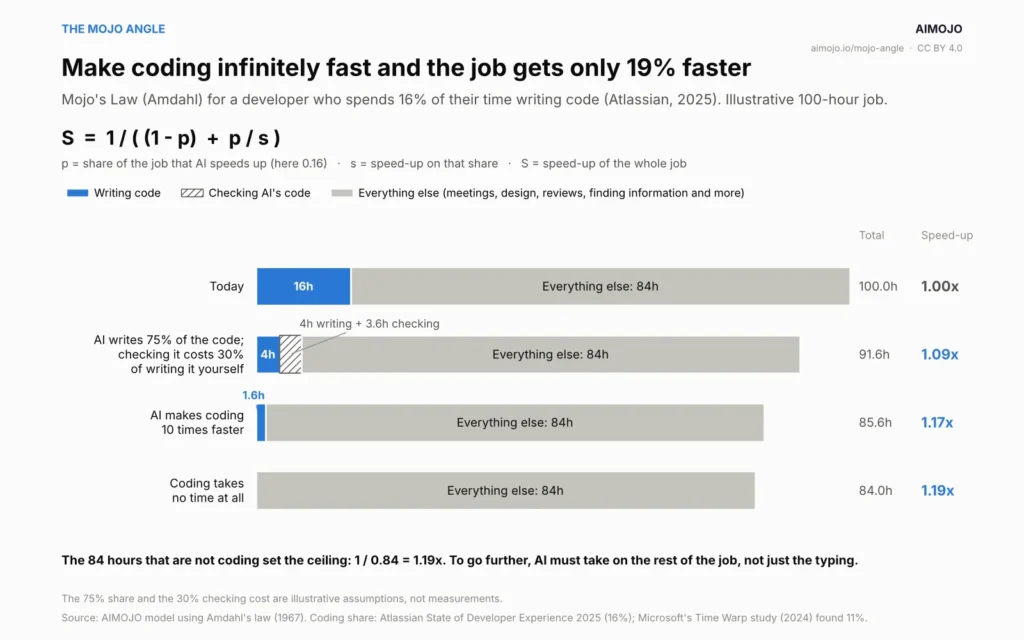
Source: AIMOJO model; Atlassian, 2025; Kumar et al., ICSE 2025.
The escape hatch: if AI also takes on debugging, reviews, design and the hunt for information, p grows and the ceiling rises. That is the real promise of coding agents.
How much of the world's kode adalah AI menulis?
Nobody knows, because every company counts something different: the claims I could verify run from 20 to more than 80%, and none is audited.
Google has the only public series. In June 2024 its research blog said AI completed 50% of code characters, counting accepted AI suggestions against hand-typed characters (Google Research, 2024). Four months later, on the October 2024 earnings call, Pichai said more than a quarter of all new code was “generated by AI, then reviewed and accepted by engineers” (Google, 2024).
Same company, same year: 50 or 25%, depending on the denominator. Google later put the new-code share at 50% by autumn 2025 and 75% by April 2026 (The Decoder, 2026).
Others use other yardsticks: 46% of code in files where Copilot was switched on (GitHub's Thomas Dohmke, Freethink, 2023); 20 to 30% of code in Microsoft's repositories (Satya Nadella, TechCrunch, 2025); about 40% of Coinbase's daily code (Brian Armstrong, The Block, 2025).
Anthropic is the most dramatic case.
- In March 2025 Dario Amodei, its chief executive, predicted AI would write 90% of code within three to six months.
- In September 2025 he said 70 to 90% of Anthropic's code was written by Claude, though not uniformly; Redwood Research's Ryan Greenblatt estimated about half of merged lines company-wide (Redwood Research, 2025).
- In June 2026 Anthropic claimed more than 80% of merged code, up from low single digits before Claude Code launched in February 2025 (Anthropic report via Decrypt, 2026).
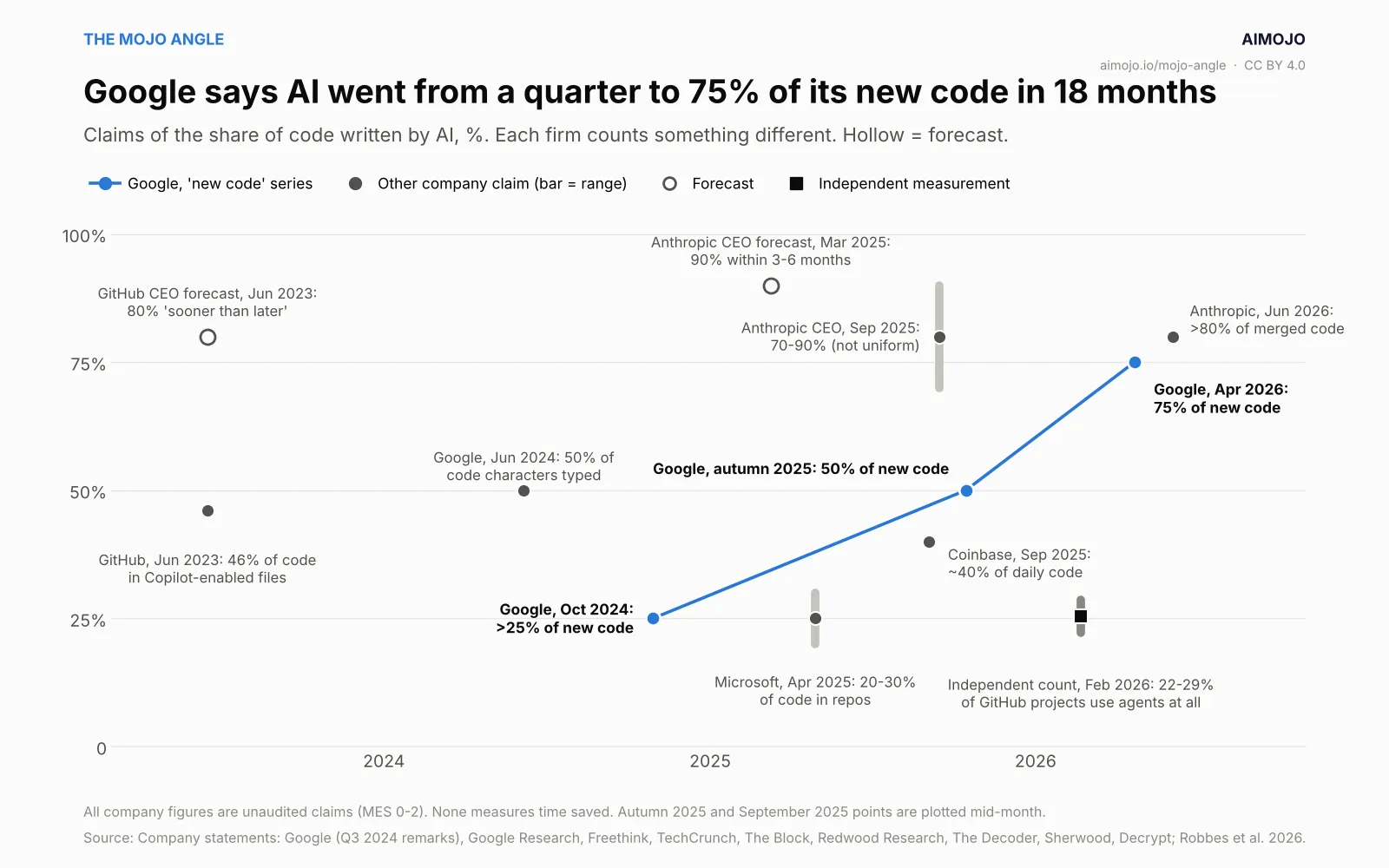
Source: company statements (Sources 1-3, 9-14); Robbes et al., 2026.
Independent counts measure something else: Romain Robbes and colleagues found signs of coding-agent use in 22 to 29% of 128,018 active GitHub projects by February 2026, a count of projects touched, not code written (Robbes et al., arXiv, 2026). And 66% of developers who use AI mengatakan Stack Overflow in 2026 that they use coding agents (Stack Overflow, 2026).
The tools have climbed fast. AI solved 4.4% of the original SWE-bench test of real GitHub issues in 2023 (Stanford AI Index, 2025). On SWE-bench Verified, a cleaner 500-problem subset released in August 2024 (OpenAI, 2024), the top provider-reported 2026 score is 96%, for Anthropic's Claude Opus 5 (BenchLM, 2026).
The tests are not like for like, and with the top three models within a point of each other, the benchmark no longer separates the best (see our Laws piece). All of this is about keystrokes, not hours.
Apakah AI make developers faster?
Yes on set tasks, by about a quarter in real companies, and unclearly for experts in code they know well.
The famous number comes from GitHub. In a 2022 lab trial, 95 freelancers were recruited to build a small JavaScript web server and 70 finished. Those with Copilot took 71 minutes on average against 161 without, 55.8% less time (95% interval 21 to 89%); three of the four authors worked for GitHub or Microsoft Research (Peng et al., arXiv, 2023).
A 2025 experiment with 151 participants, nearly all professionals, reported a 30.7% median time saving when adding a feature to a Java web app (Borg et al., arXiv, 2025). Both are well-defined tasks with no history.
Real companies are messier. Three randomised field experiments with 4,867 developers at Microsoft, Accenture and an anonymous Fortune 100 firm found 26.08% more completed tasks (standard error 10.3 points), with less experienced developers adopting more and gaining more (Cui et al., Management Science, 2025). Google's randomised trial of 96 of its engineers reported about 21% less time on a complex task, with what the authors call a large confidence interval (Paradis et al., ICSE 2025).
Then come the experts. In METR's July 2025 trial, 16 experienced open-source developers took 19% longer on 246 real issues in their own repositories with early-2025 tools, though they had expected to be 24% faster (METR, 2025).
A February 2026 follow-up with 57 developers and newer tools gave point estimates of 18% faster for returning developers and 4% for new recruits, both with intervals that include zero. METR called this “only very weak evidence” and said the true effect is probably larger (METR, 2026).
My read: outside one set lab task, nothing here shows the twofold or tenfold gains of the headlines.
Why don't faster coders make faster teams?
Because writing code is only about 11 to 16% of the week, and AI moves the queue to code review.
Microsoft's 484 engineers reported spending about 11% of the week coding, 9% debugging, 12% in communication and meetings and 5% reviewing code, and wanted about 20% for coding (Kumar et al., ICSE 2025). In Atlassian's survey, 68% said AI saved them more than 10 hours a week, but 50% lost 10 or more hours a week to organisational friction such as hunting for information (Atlassian, 2025).
Telemetry shows where the saved time goes. Faros AI, which sells engineering analytics, tracked more than 10,000 developers in 1,255 teams in 2025. High-adoption teams completed 21% more tasks and merged 98% more pull requests, but review time rose 91% and pull-request size 154%. At company level Faros reported no significant link between AI adoption and delivery (Faros AI, 2025).
Google's DORA surveys tell a mixed story. In 2024 DORA estimated that as AI adoption rose, delivery throughput fell 1.5% and stability 7.2% (Google Cloud, 2024). In 2025, with 90% of nearly 5,000 respondents using AI, the throughput link had turned positive, but AI was still linked to less stable delivery (Google Cloud, 2025).
The cleanest outside test compared 806 open-source projects that adopted the AI editor Cursor with similar projects that did not. Lines added jumped roughly three to five times in the first month and the gain was gone after about two months, while static analysis warnings rose about 30% and code complexity about 41%, and stayed up (He et al., MSR 2026). That is Amdahl in the wild: speed up the typing and the bottleneck moves to the reviewer, the tester and the meeting.
Is AI-written code safe?
Not by default: about 45% of AI-generated code samples failed Veracode's security tests in 2025, and the pass rate barely moved in 2026.
Veracode, an application security firm, tested more than 100 language models in 2025. Some 45% of samples introduced a well-known class of vulnerability; Java failed 72% of the time, and defences against cross-site scripting failed in 86% of relevant samples. Security did not improve with model size, even as code got more correct (Veracode, 2025). In 2026 Veracode reported an average pass rate of 56%, against 55% when its testing began; Java passed 30% of the time, and the best model, GPT-5.5, 68% (The Next Web, 2026).
Trust makes it worse. In a Stanford trial published in 2023, 47 participants wrote security-sensitive code; on an encryption task, about 21% of the AI kelompok's answers were secure against 43% without AI, and the AI group was more likely to think its code was safe (Perry et al., ACM CCS 2023). It used an older assistant, so treat the size of the effect with care.
New failure modes are appearing too. Across 576,000 code samples from 16 models, at least 5.2% of packages suggested by commercial models and 21.7% by open-source ones did not exist, 205,474 invented names in all (Spracklen et al., USENIX Security 2025). An attacker can publish malicious code under such a name and wait.
Maintainability is less clear. GitClear, which sells code analytics, reports refactored lines falling from 25% of changed lines in 2021 to under 10% in 2024, and copy-pasted lines rising from 8.3 to 12.3% (GitClear, 2025): a trend that coincides with AI adoption but cannot prove AI caused it. A controlled experiment suggests developers who later extended Kode yang dibantu AI were neither faster nor slower than those extending human-written code (Borg et al., arXiv, 2025).
What happens to developers, and to juniors?
Mereka menggunakan AI more and trust it less (in 2025, 84% used or planned to use it and 33% trusted its accuracy), and learning may be the hidden cost.
From 2023 to 2025, Stack Overflow's surveys show use or planned use of AI tools rising from 70 to 84%, while favourable views fell from 77 to 60% and trust in the accuracy of AI output from 42 to 33%; 46% actively distrusted it (Stack Overflow, 2023 to 2025).
The top frustration, for 66% in 2025, was answers that are “almost right, but not quite”. In 2026, favourable views ticked up to 62%, and 48% said they trust AI output when they can verify it (Stack Overflow, 2026).
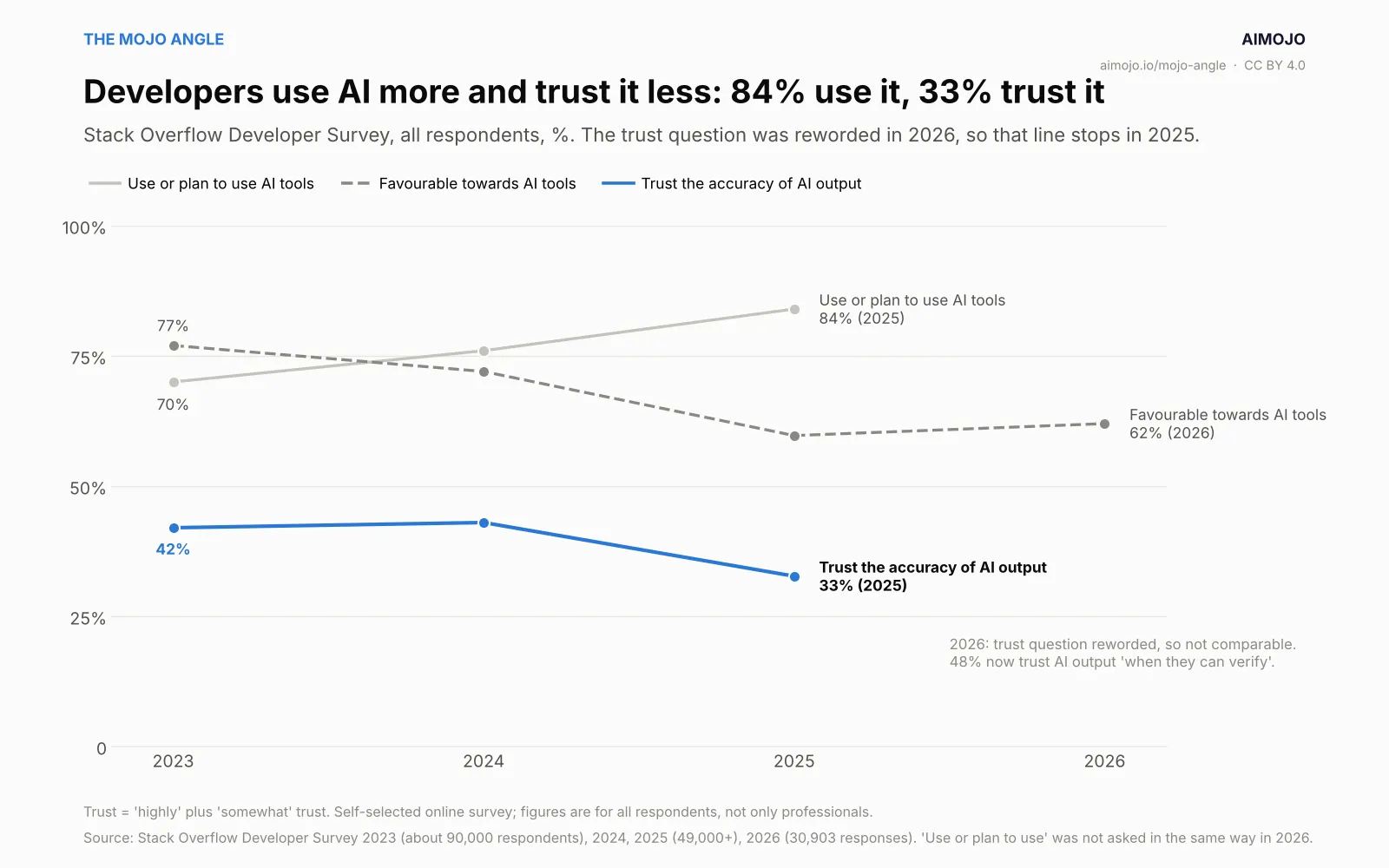
Source: Stack Overflow Developer Surveys 2023 to 2026.
Learning is the quieter risk. In a January 2026 randomised trial by Anthropic, 52 mostly junior engineers learned a new Python library with or without AI. The AI group scored 50% on a follow-up quiz against 67% for those who coded by hand, and was only about two minutes faster, which was not statistically significant. Those who asked the AI to explain, not just to write, kept more of the learning (Anthropic, 2026).
The entry-level job market is weak where AI is strong. Stanford's Digital Economy Lab reports that by June 2026, employment of 22- to 25-year-olds in the most AI-exposed occupations was about 19% below where it would be had it kept pace with less-exposed peers; the authors call this descriptive, not proof of cause (Stanford Digital Economy Lab, 2026).
At Anthropic, the company says, the junior share of technical hires fell from 27 to 9% (Anthropic, 2026). Our jobs piece memiliki lebih banyak.
Collins Dictionary made “vibe coding”, building software by describing it to an AI, its 2025 Word of the Year (The Korea Times, 2025), yet only about 15% of developers told Stack Overflow in 2025 that it is part of their professional work.
The Mojo formula: from share of code to speed
S = \frac{1}{(1 - p) + p\left[(1 - a) + a\,r\right]}My own extension of the Law turns a “share of code” claim into a speed estimate. Here a is the share of code AI writes, and r is the cost of prompting, checking and fixing an AI-written line, as a fraction of writing it yourself. The bracket is how long coding now takes: if r is below 1, AI helps; above 1, it hurts.
A worked example with illustrative numbers: Google's claimed a = 0.75, a checking cost of r = 0.3 and Atlassian's p = 0.16. Coding time falls to 0.25 + 0.225 = 0.475 of what it was, and the whole job speeds up by 1 / (0.84 + 0.076) = 1.09, or 9%; 14% if checking were free. At r = 1.3 the developer ends up 3.5% slower. That is one plausible reading of METR's 2025 result: in code they knew by heart, checking AI output cost the experts more than writing it, while juniors on unfamiliar code plausibly have a lower r.
One more illustrative check: for Amdahl alone to explain the best field result, 26% more completed tasks (read as less time per task), AI would have to remove essentially all of about a fifth of the work, since 1 – 1/1.26 is about 0.21. That is more than coding's 16% and close to coding plus debugging in Microsoft's survey, 20%, so the field gains already imply AI helps beyond the typing.
The Mojo Developer Speed Ledger
In the ledger, the median gain falls from 43% on set lab tasks to 24% in company field trials and 4% for experienced developers in their own code, and no gain has yet been measured for whole organisations.
How I built it: 18 entries (12 speed, 5 quality and security, 1 learning) cover every controlled or quasi-controlled study of AI coding productivity I could verify against a primary source, plus the main telemetry studies and surveys. Each has design, sample, measure, effect, interval, who ran it and a Mojo Evidence Scale grade. I grouped the 10 speed entries with a usable number by how close the test is to real work (positive = faster or more output) and took each group's median.
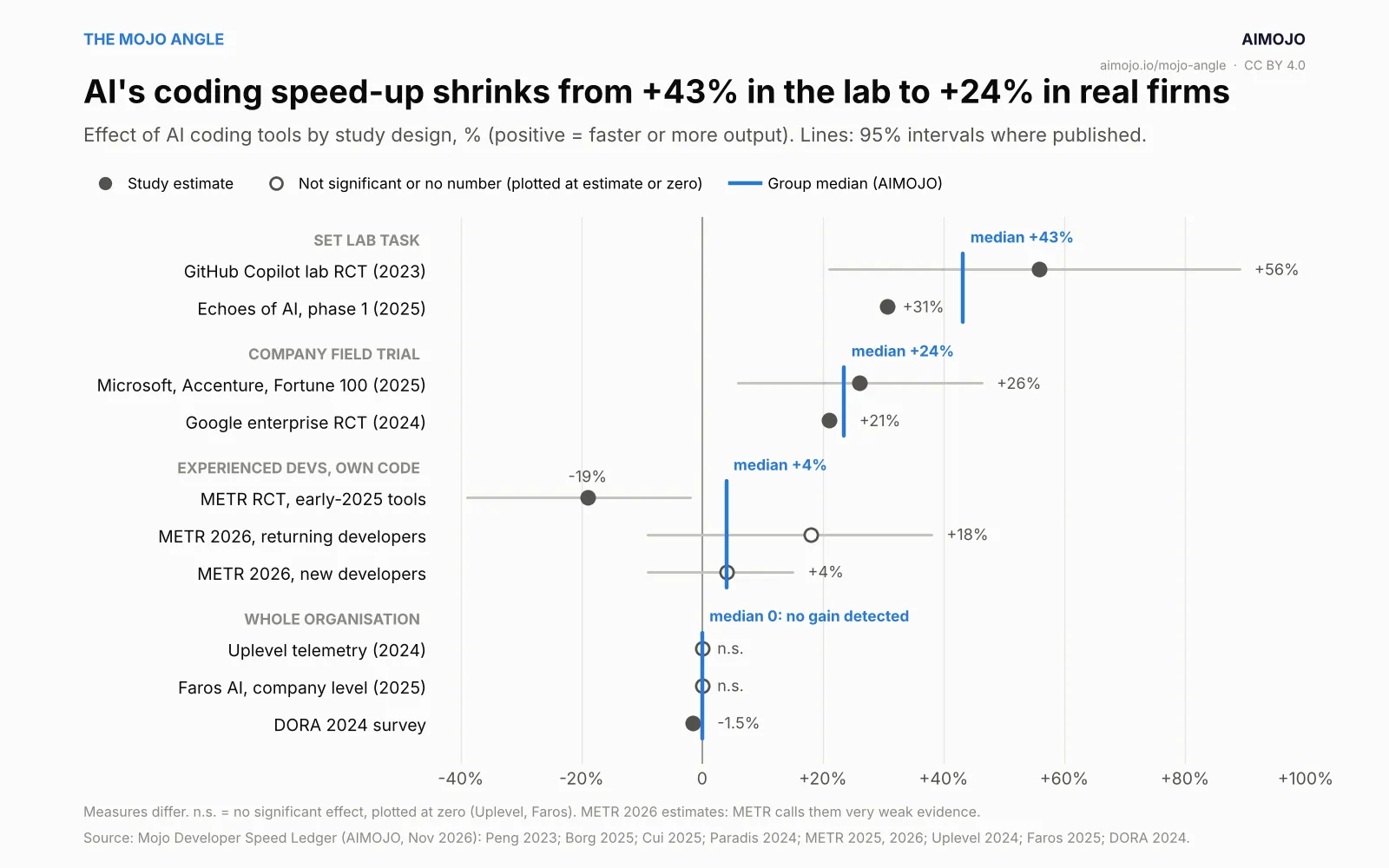
sumber: AIMOJO, from Sources 4-6, 20-24 and 32.
| Design group | Studi | Effects (%) | rata-rata | Best MES |
|---|---|---|---|---|
| Set lab task | GitHub Copilot RCT (2023); Echoes of AI (2025) | + 55.8, + 30.7 | + 43% | 3 |
| Company field trial | Microsoft, Accenture, Fortune 100 (2025); Google RCT (2024) | + 26.1, + 21 | + 24% | 4 |
| Experienced devs, own code | METR 2025; METR 2026 returning; METR 2026 new | -19, +18 (weak), +4 (weak) | + 4% | 3 |
| Whole organisation | Uplevel (2024); Faros AI company level (2025); DORA (2024) | n.s., n.s., -1.5 | 0 | 3 |
Two medians need care. The experts' +4% is the middle of three METR estimates: 19% slower in 2025, then 18 and 4% faster in 2026, figures METR calls very weak evidence and probably an underestimate. Read it as “between a slowdown and a modest gain”, not as a finding of 4%.
The organisation-level zero is an absence of evidence, not a measured zero: Uplevel and Faros, both analytics vendors, reported no significant effect and no effect size, so I plotted them at zero; DORA's 2024 estimate was -1.5%; and DORA 2025, which reported a positive link but no number, is left out.
What it shows: lab tasks are short, well specified and new, so AI shines; real organisations have history, reviews, meetings and incidents, so the gain thins out. With two or three studies per group and mixed measures, read the medians as a map, not a meta-analysis.
Cek Klaim
| Klaim | Siapa yang membuatnya? | MES | Mojo's Baca baca |
|---|---|---|---|
| Developers are 55% faster with Copilot | GitHub, citing its 2022 trial (CIO, 2024; Peng et al., 2023) | 3 | True for one set task with 70 finishers; field trials find about a quarter, not half. |
| AI tools raise completed tasks by about a quarter in real firms | Cui et al., Management Science, 2025 | 4 | The strongest evidence: 4,867 developers, three firms. Tasks are not value, and co-authors include Microsoft staff. |
| 75% dari Google's new code is AI-generated | Sundar Pichai, Apr 2026 | 1 | Unaudited and the method is unpublished; in 2024 Google's own figures were 25% or 50% depending on the denominator. |
| Claude authors more than 80% of code merged at Anthropic | Anthropic, Jun 2026 | 2 | Company-reported, with a stated denominator (merged code). Anthropic itself says lines of code are an imperfect measure. |
| AI will write 90% of code within three to six months | Dario Amodei, Mar 2025 | 0 | Missed its own deadline across the industry: by autumn 2025 Google said 50% and Coinbase about 40%. |
| AI sped me up by about 20% | Developers in METR's 2025 trial, asked afterwards (they had forecast 24%) | 0 | Measured: 19% slower. Feeling fast and being fast are different things. |
| Top models solve about 96% of real coding issues | Model providers, 2026 (SWE-bench Verified; Anthropic for Claude Opus 5) | 2 | Provider-reported on a 500-problem subset that is now saturated; not a measure of a developer's whole job. |
| AI adoption now lifts software delivery throughput | DORA (Google Cloud), Sep 2025 | 3 | A positive survey link, but AI is still linked to less stable delivery. |
| About 45% of AI-generated code fails security tests | Veracode, Jul 2025 and Jul 2026 | 3 | Repeated vendor benchmark of 100+ models; the pass rate moved from 55% to 56%. |
Sudut Balik
The strongest case against me is that my ledger is a photograph of yesterday's tools: of the 10 speed results in Figure 4, only METR's two 2026 estimates used tools released after mid-2025. Claude Code only launched in February 2025, and by June 2026 Anthropic said engineers' code output had risen about eightfold since 2024 (Anthropic report via Decrypt, 2026).
Google says a complex code migration finished six times faster than a year earlier with agents (The Decoder, 2026). METR's own result flipped from a slowdown to a weak speed-up within a year, and METR estimated in May 2026 that an early version of Claude Mythos Preview could complete, with 50% reliability, software tasks that take humans at least 16 hours (see our Laws piece).
Organisations also take years to reorganise around a new tool. Judging agents by 2024 telemetry is like judging electricity by the first factories that bolted motors onto steam-era layouts.
I accept most of that. Agents are exactly the escape hatch in Amdahl's law: they raise p by taking on debugging, testing and review, not just typing. If that happens, the ceiling lifts, and I expect it to.
But output is not outcomes. Lines merged per engineer is the measure Anthropic itself calls imperfect. The one independent quasi-experiment on an AI-first editor found a two-month burst and lasting complexity. Security pass rates have barely moved across Veracode's tests. Until someone who does not sell the tool measures hours saved on real work, I will count the claims as claims.
Sisi Manusiawi
Mojo's Ramalan
- By 31 December 2027, a randomised or quasi-experimental study of at least 100 professional developers working on their own codebases will report an average speed-up of 50% or more on whole tasks.
Kemungkinan: 25%. - Kode Vera's next annual GenAI Code Security Report, expected around mid-2027, will report an average security pass rate below 65%.
Kemungkinan: 75%. - By 31 December 2027, Google's chief executive or an official Google channel will say that at least 90% of its new code is AI-generated.
Kemungkinan: 60%.
Di mana hal ini akan diperdebatkan selanjutnya?
FAQ (Pertanyaan Umum)
How much code does AI write today?
It depends on who is counting and what they divide by. Company claims run from 20 to 30% at Microsoft (2025) to 75% of new code at Google and more than 80% of merged code at Anthropic (2026), and none is independently audited.
Apakah AI make programmers faster?
In controlled studies, yes on set tasks (about 31 to 56% less time) and by about 21 to 26% in company field trials. For experienced developers in their own code, results run from 19% slower (2025) to 4 to 18% faster (2026), which METR calls very weak evidence.
Apakah kode yang dihasilkan AI aman?
Not by default. Veracode's tests of more than 100 models found about 45% of samples failed security checks in 2025, and the pass rate was 56% in 2026, so every AI-assisted change needs review and scanning.
What is Amdahl's law, and why does it matter for AI pemrograman?
It says a job speeds up only as much as its untouched parts allow. With developers spending 11 to 16% of their time coding (Microsoft 2024, Atlassian 2025), even infinitely fast coding caps the speed-up of the whole week at 12 to 19%.
Akan AI replace software developers?
The evidence does not show that yet. Stanford's 2026 update reports employment of 22- to 25-year-olds in the most AI-exposed occupations about 19% below its kept-pace path, but does not prove AI is the cause, and the trials suggest AI changes what developers spend time on more than whether they are needed.
Apa itu vibe coding?
Building software by describing what you want to an AI and accepting what it writes, often without reading every line. Collins Dictionary named it Word of the Year for 2025, and about 15% of developers said in 2025 that it was part of their professional work.
- Google: 75% of our new code is written by AI, Sherwood News, 22 April 2026.
- Google says 75 percent of its new code is now written by AI, The Decoder, 23 April 2026.
- AI sudah berkembang AI at Anthropic, Decrypt, on Anthropic's "Kapan AI Builds Itself” report, 4 June 2026.
- The Effects of Generative AI on High-Skilled Work: Evidence from Three Field Experiments with Software Developers, Cui, Demirer, Jaffe, Musolff, Peng and Salz, Management Science, 2025 (also SSRN 4945566).
- Measuring the Impact of Early-2025 AI on Experienced Open-Source Developer Productivity, METR, 10 July 2025.
- Atlassian research: AI adoption is rising, but friction persists, Atlassian, 9 July 2025.
- Time Warp: The Gap Between Developers' Ideal vs Actual Workweeks in an AI-Driven Era, Kumar, Goel, Zimmermann, Houck, Ashok and Bansal, ICSE 2025 SEIP (arXiv, February 2025).
- Microsoft CEO says up to 30% of the company's code was written by AI, TechCrunch, 29 April 2025.
- Brian Armstrong says about 40% of Coinbase's daily code is AI-generated, The Block, 4 September 2025.
- Is 90% of code at Anthropic being written by AIs?, Ryan Greenblatt, Redwood Research, 22 October 2025.
- Agentic Much? Adoption of Coding Agents on GitHub, Robbes, Matricon, Degueule, Hora and Zacchiroli, arXiv, v2 8 April 2026.
- Dampak dari AI on Developer Productivity: Evidence from GitHub Copilot, Peng, Kalliamvakou, Cihon and Demirer, arXiv, 13 February 2023.
- Berapa harganya AI impact development speed? An enterprise-based randomized controlled trial, Paradis et al., arXiv, October 2024; ICSE 2025 SEIP.
- Speed at the Cost of Quality: How Cursor AI Increases Short-Term Velocity and Long-Term Complexity, He, Miller, Agarwal, Kästner and Vasilescu, MSR 2026 (arXiv, November 2025).
- GenAI Code Security Report, Veracode, 30 July 2025.
- Do Users Write More Insecure Code with AI Assistants?, Perry, Srivastava, Kumar and Boneh, ACM CCS 2023.
- Seterpercayaapakah Olymp Trade? Kesimpulan AI assistance impacts the formation of coding skills, Shen and Tamkin, Anthropic, 29 January 2026.
- ‘Vibe coding' named word of the year by Collins Dictionary, The Korea Times, 6 November 2025.
- AI Index Report 2025, Stanford HAI, April 2025; Introducing SWE-bench Verified, OpenAI, 13 August 2024; SWE-bench Verified leaderboard (provider self-reports), BenchLM, data verified 29 October 2026.
- Validity of the single processor approach to achieving large scale computing capabilities, Gene Amdahl, AFIPS Spring Joint Computer Conference, 1967.


 BONUS: Dapatkan $200 kami “AI “Mastery Toolkit” GRATIS jika Anda mendaftar!