

Open WebUI Key Insights
What is Open WebUI?
Ouvrir l'interface utilisateur Web is a self-hosted, open source AI platform that gives organisations a single web interface to manage conversations across multiple large language models. It connects to Ollama for local model inference, plus any OpenAI compatible API such as Anthropic, Mistral, or GroqCloud. Built to run entirely offline, it keeps all data on your own infrastructure, making it ideal for teams with strict privacy or compliance requirements.
The platform includes built-in RAG for document search, Python based plugin extensibility, voice and video calling, image generation, and enterprise grade authentication. With over 290 million Docker pulls and 140,000 GitHub stars, Open WebUI has become the go-to open source LLM frontend for businesses that want full ownership of their AI stack without vendor lock-in.

Open WebUI lets you run two or more models in parallel within a single conversation. You can compare outputs from GPT-4o, Claude, Llama, or any connected model without switching tabs. This saves significant time during model evaluation and helps teams pick the right model for each use case.
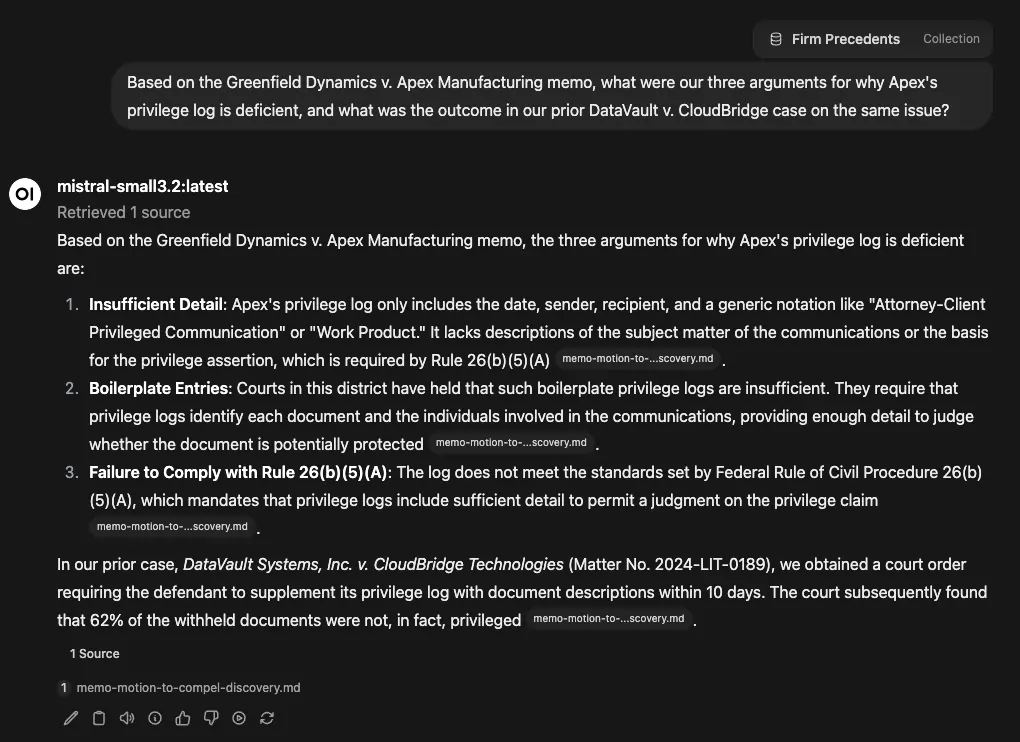
The platform supports nine vector database backends including ChromaDB, PGVector, Qdrant, and Milvus. Paired with hybrid search (BM25 plus vector) and cross-encoder reranking, your AI can pull accurate answers from uploaded documents. This makes Open WebUI a strong fit for internal knowledge bases and compliance-heavy document workflows.
You can extend Open WebUI with custom Python tools directly from its built-in code editor. It also supports Protocole de contexte modèle (MCP) servers and OpenAPI endpoints, allowing you to plug in external services without modifying the core platform. This turns the interface into a true automation hub.
Open WebUI supports SSO via OIDC, LDAP, Active Directory, and SCIM 2.0 automated provisioning. Administrators can assign granular permissions per user, group, or model. This is critical for organisations that need to comply with SOC 2, HIPAA, or GDPR requirements.
La plateforme intègre parole-texte (Whisper, Deepgram, Azure), text-to-speech (OnzeLabs, OpenAI), hands-free voice and video calling, and image generation through DALL-E, Gemini, and ComfyUI. Everything runs from the same chat window, eliminating the need for separate tools.
Open Terminal connects a real computing environment to your chat. The AI writes code, executes it, reads the output, and iterates on errors. It handles file management, package installation, and even web server previews. This feature alone sets Open WebUI apart for developer-focused teams.
Open WebUI Pricing Plans
| Nom du régime | Prix | Principales limites et fonctionnalités |
|---|---|---|
| Communauté (auto-hébergée) | $0 | All features, unlimited users, must retain Open WebUI branding |
| Entreprise | environ 5 000 $ par an | White-labelling, SLA support, dedicated onboarding, LTS versions |
| Sponsored Hosting (Third Party) | Encadrement Sur Mesure | Managed hosting via Elestio, AWS Marketplace, or similar platforms |
Open WebUI for Team Collaboration
Open WebUI includes a Channels feature that creates persistent, shared spaces where team members and AI models interact in real time. You can tag any connected model using @mentions, allowing one team member to ask GPT-4o for a draft while another tags Claude for a critique.
All responses appear in a single timeline visible to everyone. Threads, emoji reactions, and direct message channels are also available. Access control lets admins set channels to public, private, or group-based. For organisations looking to replace Slack-plus-ChatGPT workflows with something self-hosted, this feature fills a genuine gap in the market.
Avantages et inconvénients
- Connects to any LLM provider.
- Nine vector database options for RAG.
- Full offline and air-gapped capability.
- Enterprise grade authentication built in.
- Extensible with Python plugins.
- No official cloud-hosted option.
- Setup requires Docker or Kubernetes knowledge.
- Pas d'application mobile native pour le moment.
Open WebUI Community and Ecosystem
The Open WebUI community marketplace at openwebui.com hosts user-created prompts, tools, model configurations, and functions that anyone can browse and install with one click. With 418,000+ members contributing, you get access to ready-made agents for code review, meeting summaries, data analysis, and much more.
The Pipelines plugin system lets you build modular workflows for rate limiting, usage monitoring with Langfuse, traduction en direct with LibreTranslate, and toxic message filtering. If your use case is niche, chances are someone in the community has already built a tool for it. This ecosystem is what keeps Open WebUI ahead of smaller self-hosted alternatives that lack a contributor base.
Best Open WebUI Alternatives
| Self-Hosted AI Plateforme complète | Flexibilité de l'auto-hébergement | Écosystème de plugins |
|---|---|---|
| LibreChat | Strong, Docker based, good RBAC | Moderate, fewer community plugins |
| N'importe quoiLLM | Good, supports local and cloud models | Growing, built-in agent tools |
| Studio LM | Desktop only, no server deployment | Minimal, focused on model management |
| Janvier | Lightweight, local-first approach | Limited, early-stage community |