

Local Deep Research Key Insights
What is Local Deep Research?

Investigación local profunda (LDR) is a free, MIT-licensed, self-hosted AI asistente de investigación built by LearningCircuit that performs multi-source, agentic research entirely on your own machine. It decomposes complex queries into focused sub-queries, searches across 10-plus sources including arXiv, PubMed, SearXNG, Wikipedia, and your own private documents, then synthesises findings into structured, citation-backed reports.
All data is stored in per-user AES-256 encrypted SQLite databases with zero telemetry. Achieving roughly 95% accuracy on OpenAI's SimpleQA benchmark when paired with GPT-4.1-mini and SearXNG, LDR gives enterprises, researchers, and privacy-conscious professionals a direct open-source alternative to Perplexity Pro and OpenAI Deep Research, without sending a single query to a third party.
Every user gets an isolated SQLCipher database secured with AES-256, the same encryption standard used by Signal Messenger. PBKDF2-SHA512 with 256,000 iterations blocks brute-force attacks, and HMAC-SHA512 ensures data integrity. More importantly, research sessions compound into a growing local library, meaning today's PubMed pull on GLP-1 pharmacology becomes a searchable asset in tomorrow's query on GLP-1 cardiovascular outcomes.
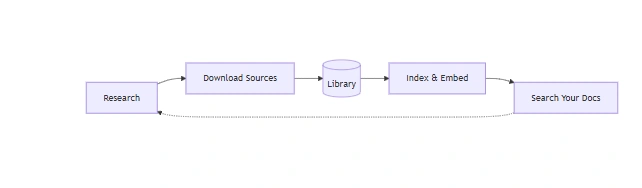
LDR ships with over 20 configurable research strategies, from Quick Summary at 30 seconds to Focused Iteration, which is the configuration responsible for the ~95% SimpleQA result. The newer LangGraph Agent mode allows the LLM itself to decide which search engines to query and when to synthesise, producing adaptive, exploratory research loops.
Out of the box, LDR searches arXiv, PubMed, Semantic Scholar, Wikipedia, SearXNG, GitHub, The Guardian, and the Wayback Machine for free. Paid add-ons include Tavily, Google via SerpAPI, and Brave Search. Private document search uses vector embedding and a local vector store, so a folder of PDFs becomes a first-class search engine alongside the open web.
LDR ships a Model Context Protocol server that registers it as a delegatable research tool inside Claude Desktop and Claude Code. Instead of stuffing raw web pages into the context window, Claude can offload deep research tasks to LDR, which handles parallel search, scraping, and synthesis. This makes LDR a native research backend for any MCP-aware agentic stack without rewriting the orchestration layer.
A fully authenticated Python client and HTTP REST API allow programmatic research at scale. Any existing LangChain-compatible retriever, including FAISS, Chroma, Pinecone, Weaviate, and Elasticsearch, can be passed directly to LDR as a named search engine.
This means teams can bolt LDR's deep-research orchestration onto an existing RAG stack without migrating the indexing pipeline, making it a realistic fit for enterprise knowledge management and compliance-driven research environments.
Local Deep Research Pricing Plans
| Nombre del Plan | Costo | Características principales |
|---|---|---|
| Código abierto (autoalojado) | $0 | Full feature access, MIT licensed, unlimited queries |
| With Local LLM (Ollama) | $0 | No API fees, fully offline LLM, privacy-first |
| With Cloud LLM | Pay-per-token to LLM provider | GPT-4.1-mini gives ~95% SimpleQA, no LDR fee |
| With Premium Search | Personalizado | Higher source quality, paid search engines |
Who Should Use Local Deep Research?
LDR is built for professionals whose queries contain information that cannot leave the organisation. Investigadores sanitarios, investigative journalists, security analysts, and legal teams all operate under compliance or confidentiality mandates that make cloud-based research tools a non-starter.
With zero telemetry, signed Docker images with Cosign and SLSA provenance attestations, and no password recovery by design, LDR is positioned as an infrastructure-grade research tool rather than a consumer app. Developers already running Ollama or llama.cpp will find LDR a natural layer on top of an existing local AI asociación.
LDR vs Cloud Research Tools
The core differentiator is data sovereignty. OpenAI Investigación profunda, Perplejidad profesional, and Google Deep Research all route your queries through proprietary infrastructure, which is acceptable for general use but disqualifying for regulated industries.
LDR matches their benchmark performance at roughly 95% on SimpleQA when configured with cloud models, and it lands in the 70 to 85 percent range with local 20B-class models, which is still production-useful for most research tasks. The persistent encrypted knowledge library that compounds across sessions is a capability none of the hosted products currently offer.
Pros y contras
- Fully free and open source.
- 10-plus search engines built in.
- 20-plus research strategies.
- Knowledge library compounds over time.
- LangChain RAG integration.
- No telemetry or analytics.
- Requires Docker or Python setup.
- GPU needed for best local models.
- No password recovery mechanism.
- PDF export on Windows needs extra steps.
Best Local Deep Research Alternatives
| Autoalojado AI Asistente de investigación | Privacidad de datos | Flexibilidad del LLM |
|---|---|---|
| Perplejidad profesional | Queries processed on Perplexity servers | No local model support |
| AbiertoAI Investigación profunda | Queries processed by OpenAI | GPT-family only |
| Investigación profunda de Google | Queries processed by Google | Gemini only |
| Tavily Research Agent | API-based, cloud-dependent | Integrates via API only |